

Key Takeaways
- Consistent sleep, movement, and social connection support mental wellness at every age.
- Simple daily routines reduce stress for children, adults, and older adults alike.
- Mental wellness practices don't require special equipment or significant time investment.
- Shared family habits reinforce individual wellbeing more effectively than solo efforts.
- Professional support remains important - these practices complement, not replace, clinical care.
Why simple habits matter more than elaborate interventions
Mental wellness doesn't require a therapist's office, a meditation retreat, or an expensive app subscription. For most American families, the most meaningful improvements to emotional health come from consistently applying a small number of evidence-supported everyday habits - the kind that can fit into a normal Wednesday morning or a hectic Sunday evening.
What makes this especially practical is that many core wellness habits benefit every member of the household, regardless of age. The meaning of mental wellness shifts across the lifespan, but the foundational inputs - sleep, movement, connection, routine, and emotional expression - remain remarkably consistent from early childhood through late adulthood.
The six practices below are drawn from behavioral health research and are designed to be realistic for busy households. They are not prescriptions, and they do not replace professional care when that's needed. They are a starting point - one that any family can adapt to their own circumstances.
These practices support wellness, not treatment
The habits described in this article are general wellness practices supported by behavioral and psychological research. They are not a substitute for professional mental health evaluation or treatment. If you or a family member are experiencing persistent symptoms of anxiety, depression, or other mental health concerns, please consult a qualified healthcare provider. Early professional support is often the most effective path forward.
Six practices that work across generations
Protect sleep as a non-negotiable foundation
Sleep is where much of the brain's emotional processing and memory consolidation happens. Research consistently links poor or insufficient sleep to heightened anxiety, mood dysregulation, and reduced ability to cope with daily stress - across all age groups, from school-age children to older adults.
Age-appropriate sleep targets differ: younger children generally need more hours than teenagers, who in turn need more than most adults. Regardless of age, consistent sleep and wake times - even on weekends - help regulate the body's internal clock and support emotional stability. Reducing bright screen exposure in the hour before bed is one of the most practically accessible changes a family can make.
Consistent sleep timing supports emotional stability more reliably than sleep duration alone.
Build movement into daily life, not just exercise sessions
Physical movement has well-documented effects on mood, anxiety, and stress regulation. The mechanism involves multiple pathways - including endorphin release, reduced cortisol levels, and improved sleep quality. Critically, these effects do not require structured gym workouts. Research suggests that even moderate-intensity movement, such as brisk walking, gardening, or active play, produces measurable mental wellness benefits.
For families, the practical approach is embedding movement into existing routines: walking to school when possible, taking stairs, doing light stretching together after dinner. For older adults especially, gentle movement supports both physical function and mood - reducing the isolation that can accompany reduced mobility.
Everyday movement - not just formal exercise - delivers meaningful mental wellness benefits for all ages.
Prioritize face-to-face connection over digital interaction
Human beings are social by nature, and meaningful interpersonal connection is one of the strongest known protective factors for mental health. This holds true whether the person is a five-year-old navigating friendships, a working parent managing stress, or a grandparent living alone. Shared meals, regular check-ins, and unhurried conversation all build the relational security that buffers against anxiety and depression.
For families with older adults at home or nearby, intentional connection matters even more. Loneliness in seniors can progress silently, making proactive family engagement an important safeguard. Quality of contact typically matters more than quantity.
Meaningful in-person connection remains one of the most powerful mental wellness tools available.
Use predictable routines to create emotional safety
Routine provides structure that the brain interprets as safety - particularly for children, whose developing nervous systems rely heavily on predictability to regulate emotion. But the stabilizing effect of routine extends well beyond childhood. Adults dealing with chronic stress and older adults facing cognitive changes both benefit from reliable daily patterns that reduce decision fatigue and uncertainty.
A family routine doesn't need to be rigid or elaborate. Regular mealtimes, consistent morning and evening sequences, and predictable transition rituals (like a short wind-down before bed) create the scaffolding that makes emotional regulation easier for everyone. See our guide to building a mental health routine at home for practical starting points.
Predictable daily routines reduce emotional dysregulation across every age group in the household.
Practice present-moment awareness in ordinary moments
Mindfulness - paying deliberate, non-judgmental attention to the present moment - has a substantial evidence base supporting its role in reducing anxiety and improving emotional regulation. The good news for busy households is that formal meditation is not required. Mindful breathing during a commute, attentive eating at dinner, or simply pausing to notice sensory details during a walk are all valid entry points.
Children can engage with age-appropriate versions: noticing five things they can see, describing how food tastes, or taking three slow breaths before reacting to frustration. For older adults, reflective practices like journaling or contemplative walks serve similar functions. Mindfulness without the jargon offers a family-friendly way to explore these techniques without overwhelm.
Mindfulness practices do not require apps or training - brief everyday moments of attention are enough to start.
Normalize talking about emotions without problem-solving pressure
One of the most durable mental wellness habits a family can build is creating space where emotional expression is welcomed rather than immediately redirected. When children hear adults name and discuss their own feelings - including frustration, sadness, or worry - they learn that emotions are manageable and not shameful. This emotional literacy supports resilience across the lifespan.
The key distinction is between listening and fixing. Being present, asking open-ended questions, and validating what someone shares is often more supportive than offering solutions. This applies equally to conversations between parents and children, between adult partners, and between family members and aging relatives. Familiarity with when professional support may help ensures the family knows when to move beyond peer support.
Families that normalize emotional expression build lasting resilience without specialized training.
Start with one habit, not six
Research on behavior change consistently shows that trying to adopt multiple new habits simultaneously reduces the likelihood that any will stick. Pick one practice from this list that seems most accessible for your household right now. Once it feels routine - typically after several weeks - consider layering in a second. Our guide to building habits that actually stick explores this approach in more depth.
Making it work as a household, not just as individuals
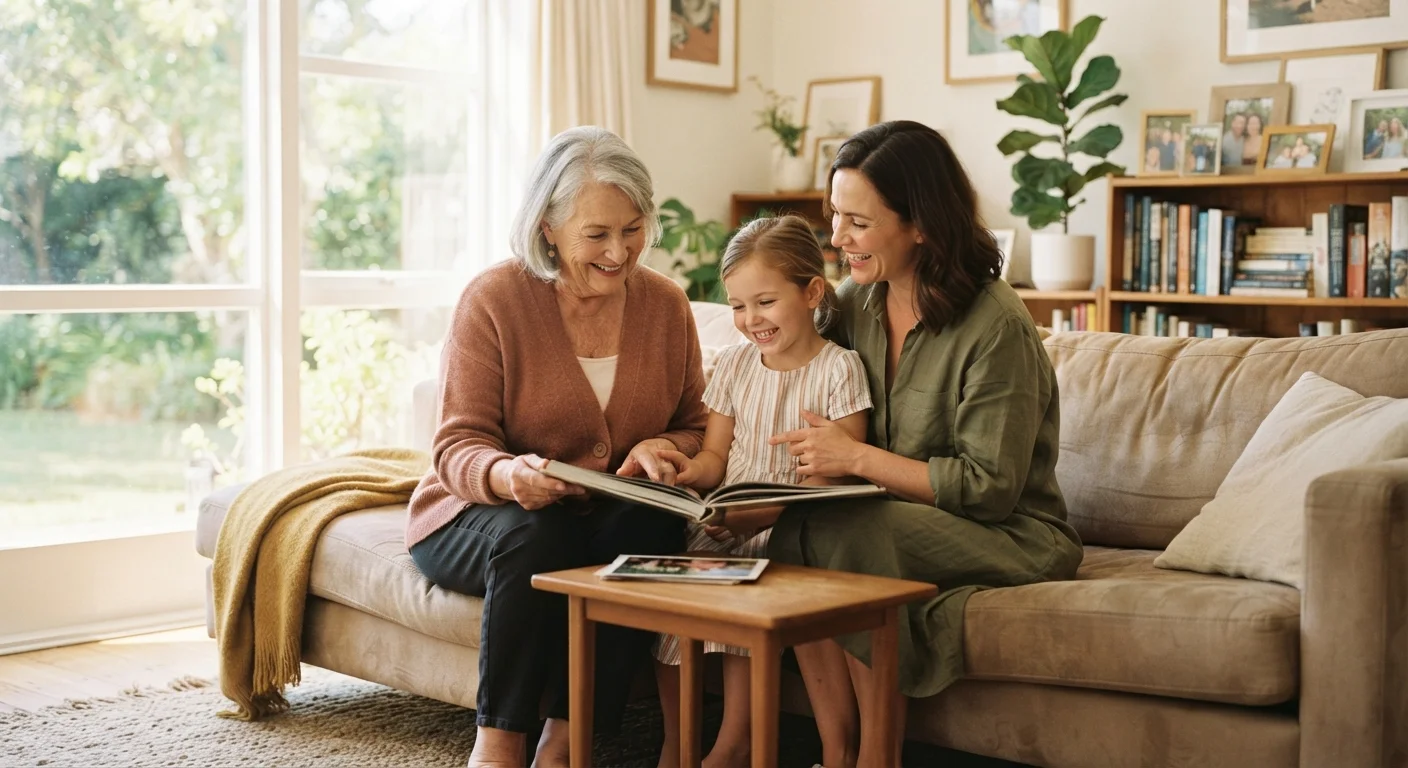
The most powerful aspect of family-based mental wellness is the reinforcing loop it creates. When a parent prioritizes sleep, it models the behavior for children. When a teenager opens up about stress at dinner, it signals safety to younger siblings. When a grandparent joins a short daily walk, it benefits everyone present.
Shared habits tend to be more durable than solitary ones because social accountability is built in. The goal isn't to optimize every family member individually - it's to build a household environment where emotional wellbeing is quietly, consistently supported. For age-specific approaches, the differences between supporting kids versus teens are worth understanding. And for a broader framework, our comprehensive family mental wellness resource covers warning signs, support options, and more detailed strategies across every life stage.
This article is for general informational and educational purposes only and does not constitute medical or mental health advice. Always consult a qualified healthcare professional for concerns about your own or a family member's mental health.