

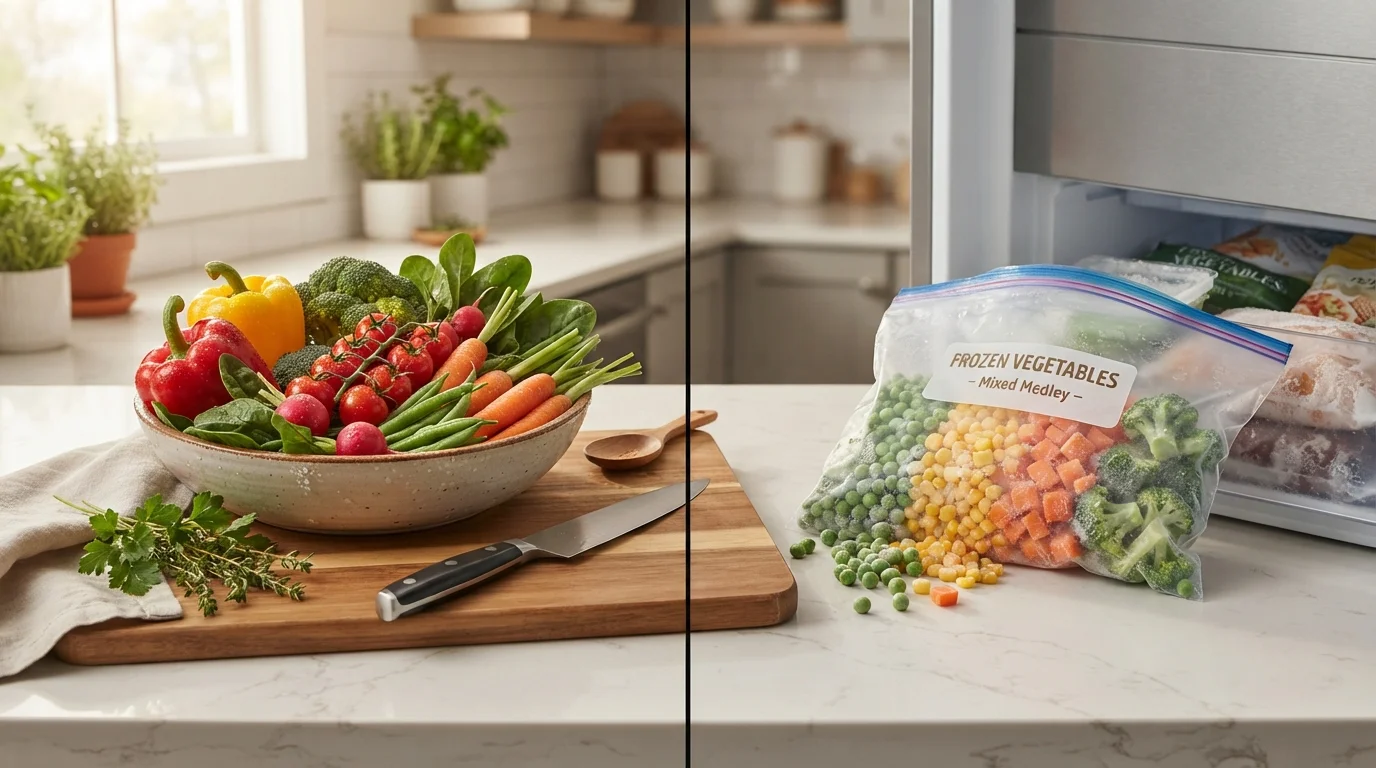
Key Takeaways
- Frozen vegetables are typically flash-frozen at peak ripeness, preserving most key nutrients.
- Fresh produce can lose significant nutrients during transport and storage before it reaches your plate.
- Frozen options are generally less expensive per serving and produce far less household food waste.
- Both forms can contribute equally to a healthy, balanced family diet when used appropriately.
- Season and geography affect fresh produce quality more than they affect frozen quality.
- A practical family strategy often combines both forms depending on the dish and the week's schedule.
Option A
Fresh Produce
The sensory-first, peak-season choice.
Best for: Families who shop frequently, cook immediately, and want maximum texture and flavor variety.
Option B
Frozen Produce
The convenient, nutrient-locked alternative.
Best for: Busy households seeking consistent nutrition and less food waste at a lower average cost.
If you prioritize consistent nutrition year-round
Frozen Produce
Flash-freezing locks in vitamins and minerals at peak ripeness, delivering reliable nutrition regardless of season or supply chain length.
If texture and flavor variety matter most for your family meals
Fresh Produce
Fresh produce offers superior texture for raw preparations like salads or crudités, and peak seasonal flavor that frozen can rarely replicate.
If reducing grocery spending and food waste is a priority
Frozen Produce
Frozen vegetables and fruit typically cost less per serving and last months in the freezer, significantly reducing the likelihood of spoilage.
If you shop at local farmers markets or have garden access
Fresh Produce
Locally grown, recently harvested fresh produce reaches you with minimal nutrient loss and often at competitive seasonal pricing.
If your household has unpredictable schedules and limited cooking time
Frozen Produce
Frozen vegetables require no washing, peeling, or chopping, making them a practical go-to for fast, nutritious weeknight meals.
The Nutrition Reality: What Science Actually Shows
Many families assume the produce aisle always outperforms the freezer section nutritionally. Research suggests the picture is more nuanced. Fresh vegetables begin losing water-soluble vitamins - particularly vitamin C and B vitamins - from the moment they are harvested. By the time fresh spinach, broccoli, or green beans travel from farm to distribution center to store shelf to your refrigerator, days or even weeks may have passed.
Frozen produce, by contrast, is typically harvested at peak ripeness and flash-frozen within hours. Studies, including research published in nutritional science journals, have found that frozen vegetables sometimes contain comparable or even higher levels of certain vitamins than their refrigerated fresh counterparts that have been stored for several days. The difference is not always dramatic, but it is consistent enough to challenge the assumption that fresh is categorically superior.
Cooking method matters at least as much as fresh versus frozen status. Boiling either form in large volumes of water can leach nutrients significantly. Steaming, roasting, or stir-frying - whether you start with fresh or frozen - better preserves nutritional value. For families exploring broader nutrition decisions, the comprehensive family nutrition guide provides context on how produce fits into the full dietary picture.
| Criterion | Fresh Produce | Frozen Produce |
|---|---|---|
| Nutrient retention | Declines with time and storage | Locked in at harvest via flash-freezing |
| Average cost per serving | Higher, especially out of season | Generally lower year-round |
| Shelf life | Days to one week refrigerated | 8-12 months in the freezer |
| Food waste risk | Higher - spoilage if unused | Lower - use only what you need |
| Preparation time | Requires washing, cutting, peeling | Minimal - often ready to cook |
| Texture for raw use | Excellent for salads and snacking | Not suitable for most raw applications |
| Seasonal availability | Varies; quality dips off-season | Consistent quality year-round |
| Variety available | Wide, including specialty items | Broad but focused on staple items |
Cost, Waste, and Practical Family Value
For value-conscious households, the economic case for frozen produce is strong. Frozen vegetables and fruit generally cost less per serving than fresh equivalents, particularly for items like berries, peas, edamame, and spinach. They also last months rather than days, which directly reduces the food waste that quietly inflates many families' grocery budgets.
The USDA estimates that American households waste a significant portion of the fresh produce they purchase - often because busy schedules interrupt meal plans. A bag of frozen broccoli sits patiently in the freezer until it is needed; a fresh head purchased Monday may be soft and yellowing by Thursday.
30-40%
Fresh produce wasted by US households
USDA research consistently estimates that American families discard a significant share of purchased fresh produce due to spoilage before consumption.
~$1.50 less
Average per-serving savings with frozen vegetables
Nutritional cost-comparison analyses frequently find frozen vegetables deliver more servings per dollar than fresh counterparts, particularly for out-of-season items.
Within hours
Time from harvest to freezing for most frozen vegetables
Commercial flash-freezing typically occurs within hours of harvest, which is why frozen produce can rival or exceed the nutrient profile of fresh produce stored for several days.
Fresh produce does have economic advantages in specific circumstances. Buying seasonal, locally grown produce - especially at farmers markets or through community-supported agriculture (CSA) programs - can be cost-competitive and delivers the freshness advantage. The guide to nourishing your family on a budget explores how to build a strategy around both categories without compromising nutrition.
Families looking to refine their overall grocery approach may also benefit from understanding foundational smart shopping habits, including reading unit prices to accurately compare fresh and frozen costs per serving.
When to Choose Each - and How to Combine Both
There is no single correct answer for every family or every meal. A practical approach draws on the strengths of each form depending on the cooking context and the time available.
Reach for fresh when:
- You are making raw preparations - salads, slaws, crudité platters - where texture and visual appeal matter.
- Produce is in local peak season and can be purchased and used within one to two days.
- Specific culinary applications, such as roasting whole asparagus or grilling corn on the cob, depend on fresh structure.
Reach for frozen when:
- You need a quick, reliable weeknight vegetable with minimal preparation time.
- Out-of-season fresh equivalents look pale, feel limp, or carry premium pricing.
- You want to keep nutritious ingredients on hand without worrying about spoilage.
- You are cooking soups, stews, casseroles, smoothies, or sauces where texture differences become negligible.
A mixed-pantry strategy - keeping a rotation of seasonal fresh produce alongside a well-stocked freezer - aligns with how nutrition experts generally describe flexible, sustainable healthy eating. Families curious about other practical nutrition trade-offs, such as grain choices, will find similar evidence-based nuance applies across many food decisions.
This article is for general informational purposes only and does not constitute medical or dietary advice. Consult a registered dietitian or qualified healthcare professional for guidance tailored to your family's specific nutritional needs.