

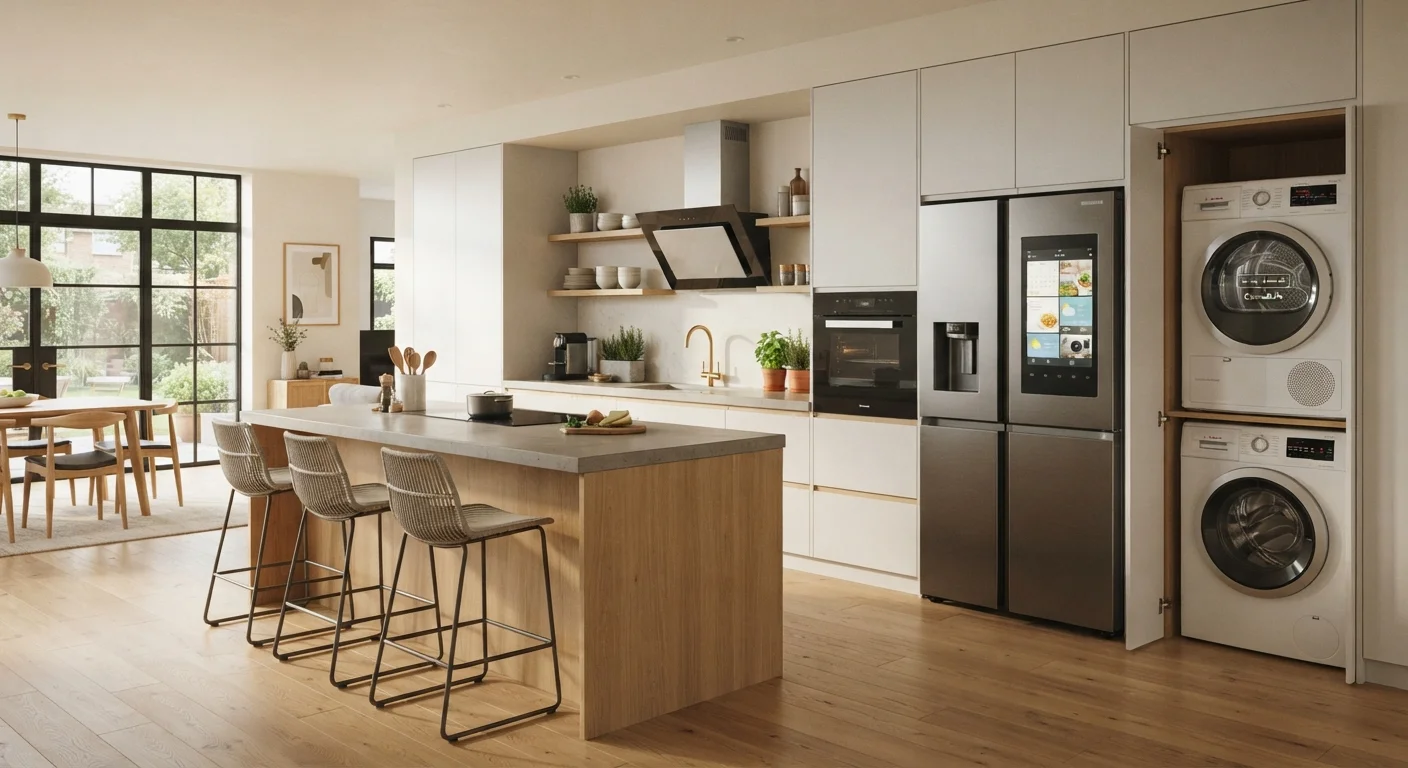
Key Takeaways
- Smart appliances offer genuine convenience features like remote control and usage monitoring, but these benefits vary widely by household.
- Higher upfront costs, Wi-Fi dependency, and shorter software support windows are real trade-offs to weigh before buying.
- Privacy concerns are legitimate - most smart appliances collect usage data that is shared with manufacturers.
- Reliability gaps tend to surface over time, especially when a manufacturer stops supporting older app versions.
- Families with simple, consistent routines often extract less value from smart features than the marketing suggests.
Remote monitoring and control from anywhere
Starting a wash cycle, preheating an oven, or checking whether the refrigerator door is closed can all be done from a smartphone. This is particularly useful for families with varied schedules.
End-of-cycle and fault notifications
Push alerts when a cycle completes or an error occurs reduce the chance of laundry sitting wet for hours or a fault going unnoticed - a practical benefit for busy households.
Energy usage visibility and scheduling
Many smart appliances display real-time or cumulative energy consumption, and some allow scheduling to run during lower-cost off-peak electricity periods where time-of-use rates apply.
Over-the-air software updates can add features
Unlike conventional appliances that are fixed at the point of manufacture, some smart models receive updates that improve performance or add new functionality after purchase.
Integration with voice assistants and routines
Compatible appliances can be included in smart home routines - for example, automatically starting the dishwasher at a set time each evening through a voice assistant or automation platform.
Higher purchase price over conventional models
Smart appliances typically cost more than functionally equivalent conventional models. In some categories, the premium can be substantial relative to the added utility.
Dependent on Wi-Fi and manufacturer cloud services
If your internet goes down, or the manufacturer discontinues its app or server infrastructure, smart features become inaccessible - even though the appliance may still work mechanically.
Software support windows are often shorter than appliance lifespan
Manufacturers typically support apps and connected features for fewer years than the expected mechanical lifespan of the appliance, leaving buyers with orphaned smart features on otherwise functional units.
Data privacy trade-offs are real
Smart appliances collect and transmit usage data to manufacturer servers. Families should review privacy policies carefully, as data-sharing practices vary significantly between manufacturers.
More complex to repair and diagnose
The addition of circuit boards, sensors, and connectivity hardware introduces more potential failure points and can make repairs more expensive or less accessible to independent technicians.
Many features go unused after initial setup
User behaviour research consistently shows that engagement with smart appliance apps drops off significantly after the first few months of ownership for a large portion of buyers.
Our Verdict
Smart appliances deliver meaningful convenience for households that can absorb their higher cost and are comfortable managing connected technology. However, the benefits are often incremental rather than transformative, and the long-term risks around software support, privacy, and repairability are worth taking seriously before committing. A conventional appliance that does its job reliably for 15 years may serve many families better than a connected counterpart with a shorter supported lifespan.
Best for tech-comfortable households with reliable home Wi-Fi, an interest in energy monitoring, and a budget that accommodates the smart-feature premium without stretching.
What 'Smart' Actually Means in an Appliance
The term smart appliance refers to any household appliance - refrigerator, washer, oven, dishwasher - that connects to your home's Wi-Fi network and can be monitored or controlled through a smartphone app, voice assistant, or automation routine. The connection enables features that go beyond what a conventional appliance's physical controls allow.
In practice, smart capabilities generally fall into three categories: remote control (start your dryer from the grocery store), status notifications (an alert when a wash cycle ends or a door is left open), and usage data (energy consumption reports or cycle logs). Some appliances also receive over-the-air software updates that add features or improve performance after purchase.
Understanding which of those three categories actually matters to your household is the first and most important question to answer - before price, brand, or any specific feature list. For more on how connected devices work together in a home environment, see how home devices and services connect.
Smart Thermostats Are a Different Case
Smart thermostats are often grouped with smart appliances but have a distinct value proposition - specifically around automated energy savings based on occupancy and learning behaviour. If you're weighing a smart thermostat separately from other appliances, see smart thermostats: energy savings, learning behaviour, and real-world limits for a dedicated breakdown. The considerations around software support and connectivity apply equally, but the energy-saving argument is generally stronger and more quantifiable for thermostats than for most other smart appliance categories.
The Genuine Benefits for Family Households
Smart appliances can deliver real, practical value in specific situations. The advantages listed below represent where connected features have a demonstrable impact - not what every household will automatically experience.
Remote monitoring and control from anywhere
Starting a wash cycle, preheating an oven, or checking whether the refrigerator door is closed can all be done from a smartphone. This is particularly useful for families with varied schedules.
End-of-cycle and fault notifications
Push alerts when a cycle completes or an error occurs reduce the chance of laundry sitting wet for hours or a fault going unnoticed - a practical benefit for busy households.
Energy usage visibility and scheduling
Many smart appliances display real-time or cumulative energy consumption, and some allow scheduling to run during lower-cost off-peak electricity periods where time-of-use rates apply.
Over-the-air software updates can add features
Unlike conventional appliances that are fixed at the point of manufacture, some smart models receive updates that improve performance or add new functionality after purchase.
Integration with voice assistants and routines
Compatible appliances can be included in smart home routines - for example, automatically starting the dishwasher at a set time each evening through a voice assistant or automation platform.
~$100-300
Typical smart-feature price premium per appliance
Industry estimates suggest smart versions of major appliances commonly carry a price premium of this range over comparable conventional models, varying by category and specification.
2-4 years
Typical smart feature software support window
Consumer electronics analysts note that many appliance manufacturers provide active app and firmware support for roughly two to four years - considerably shorter than the 10-15-year mechanical lifespan of most major appliances.
Energy monitoring is one of the more consistently useful features. A smart washer or dishwasher that can be scheduled to run during off-peak electricity hours - automatically, without manual intervention - can contribute to lower utility bills in areas with time-of-use tariffs. Similarly, a refrigerator that alerts you to a door left ajar can prevent food spoilage that would otherwise go unnoticed overnight.
For families juggling work and childcare, remote-start and end-of-cycle notifications reduce the mental overhead of managing household tasks. You don't need to hover near the laundry room; the app tells you when to move the load.
The Real Limitations to Consider
The drawbacks of smart appliances are neither trivial nor hypothetical. They tend to compound over time, often surfacing two to four years after purchase when the novelty has faded but the trade-offs remain.
Higher purchase price over conventional models
Smart appliances typically cost more than functionally equivalent conventional models. In some categories, the premium can be substantial relative to the added utility.
Dependent on Wi-Fi and manufacturer cloud services
If your internet goes down, or the manufacturer discontinues its app or server infrastructure, smart features become inaccessible - even though the appliance may still work mechanically.
Software support windows are often shorter than appliance lifespan
Manufacturers typically support apps and connected features for fewer years than the expected mechanical lifespan of the appliance, leaving buyers with orphaned smart features on otherwise functional units.
Data privacy trade-offs are real
Smart appliances collect and transmit usage data to manufacturer servers. Families should review privacy policies carefully, as data-sharing practices vary significantly between manufacturers.
More complex to repair and diagnose
The addition of circuit boards, sensors, and connectivity hardware introduces more potential failure points and can make repairs more expensive or less accessible to independent technicians.
Many features go unused after initial setup
User behaviour research consistently shows that engagement with smart appliance apps drops off significantly after the first few months of ownership for a large portion of buyers.
Perhaps the most underappreciated limitation is software longevity. Unlike a conventional appliance that functions the same on day one as it does on year twelve, a smart appliance depends on a manufacturer's app and cloud infrastructure. When a company discontinues support for older app versions - or exits the smart home market entirely - the connected features can become inaccessible, even if the appliance itself still works mechanically. This isn't a hypothetical scenario; it has happened with several product lines.
Connectivity issues are another persistent pain point. Smart appliances generally require a stable 2.4 GHz or 5 GHz Wi-Fi signal, and placement in laundry rooms, garages, or basements can mean unreliable connections. For a detailed look at why smart devices drop offline and what causes it, see why smart devices keep going offline.
Privacy and Data: What Families Should Know
Most smart appliances collect operational data - cycle frequency, temperature preferences, usage times, and in some cases audio or video if the appliance includes a camera or microphone. This data is typically transmitted to the manufacturer's servers and governed by a privacy policy that most buyers never read.
This doesn't mean smart appliances are inherently dangerous, but it does mean families should make an informed choice. Before purchasing, it is worth reviewing what data a specific appliance collects, whether it can be limited through settings, and whether the manufacturer has a history of sharing data with third parties. Common smart home myths include the assumption that appliance data stays within your home network - in most cases, it does not.
How to Decide Whether Smart Features Are Worth It for Your Home
The decision comes down to a realistic assessment of how your household operates, not how you imagine it might operate with new technology. A few grounding questions help clarify the case:
- Will you actually use the app? Many smart appliance owners stop using the companion app within a few months of setup. If your household is not in the habit of managing devices through a phone, the connected features add cost without adding value.
- Is your Wi-Fi reliable throughout your home? Appliances in distant rooms or below-grade spaces are prone to connectivity problems. See hub-based vs hub-free smart home trade-offs for context on network architecture choices.
- Does the price premium fit your budget? Smart versions of the same appliance category typically carry a meaningful cost increase. Consider whether those dollars might deliver more value elsewhere - budget-smart buying strategies can help frame that comparison.
- How long do you plan to keep the appliance? If you're buying for the long term, the software support question matters more. For guidance on extending appliance lifespan generally, see maintenance habits that extend appliance life.
Smart appliances occupy a middle ground: more capable than their conventional counterparts in specific, defined ways, but not universally superior. Matching the technology to genuine household needs - rather than buying on the assumption that more features means more value - is the approach most likely to result in a purchase you won't regret. You may also find it useful to revisit common appliance myths before finalising any decision.