

Key Takeaways
- Wet dishes after a cycle are usually caused by rinse aid, loading habits, or heat-dry settings - not a broken machine.
- Hard water minerals are the primary culprit behind white spots and cloudy film on glassware.
- Small adjustments to detergent type, water temperature, and loading technique resolve most drying and spotting issues.
- Plastic items dry poorly by design due to their low heat retention - this is normal dishwasher behavior.
- Regular filter cleaning and correct rinse aid levels prevent the majority of recurring performance problems.
Why This Problem Is Worth Solving Properly
Pulling dishes from a completed cycle only to find them dripping wet or covered in chalky spots is genuinely frustrating - especially when it happens consistently. The instinct is often to assume the appliance is failing. In most cases, however, the causes are rooted in settings, habits, or water chemistry rather than a mechanical fault.
Understanding what is actually happening inside the machine during the drying phase helps you fix the right thing. Dishwashers dry dishes through a combination of heat, water sheeting (aided by rinse aid), and residual thermal energy - not a blower or towel. When any part of that process is disrupted, dishes come out wet or marked. The sections below walk through the most common errors families make and how to address each one.
For a broader look at habits that quietly cost money over time, see our breakdown of common appliance myths worth reconsidering.
The Most Common Mistakes - and How to Fix Them
The issues below account for the overwhelming majority of wet and spotted dish complaints. Work through them systematically before assuming a service call is needed.
Running the dishwasher with an empty or depleted rinse aid dispenser.
Why it happens: Rinse aid is easy to overlook because it has no visible effect on cleaning - families often skip it or forget to refill it after assuming detergent alone is sufficient.
Selecting energy-saving or eco cycles and expecting fully dry results.
Why it happens: Eco and quick cycles use lower water temperatures and shorter drying phases to reduce energy consumption - a trade-off that isn't always made clear in the settings menu.
Loading dishes so they nest together or face upward, trapping water in concave surfaces.
Why it happens: Fitting as many items as possible per load is understandable, but bowls and cups stacked or angled incorrectly pool water that cannot drain or evaporate.
Using too little detergent, the wrong detergent format, or old detergent that has clumped or absorbed moisture.
Why it happens: Detergent pods, gels, and powders behave differently at different water temperatures, and households sometimes reduce dosage to stretch a box - unaware that under-dosing affects both cleaning and spotting.
Never cleaning the dishwasher's filter, leading to recirculated debris and greasy film on dishes.
Why it happens: Many families don't realize modern dishwashers have a manual-clean filter (rather than a self-cleaning grinder), so it is never removed or rinsed.
Running the dishwasher when household hot water has been depleted, so the first fill is lukewarm.
Why it happens: Dishwashers draw from the home's hot water line. If someone has just showered or run the washing machine, the incoming water may be significantly cooler than the cycle needs to work properly.
Don't Increase Detergent to Fix Spotting
Adding extra detergent in response to spots or poor cleaning is a common reflex - but it typically makes the problem worse. Excess detergent leaves its own residue on dishes and glassware, creating a filmy buildup that is easily mistaken for hard water deposits. If performance is poor, check rinse aid levels and water temperature before adjusting detergent quantity.
Hard Water and Mineral Deposits: The Spotting Culprit
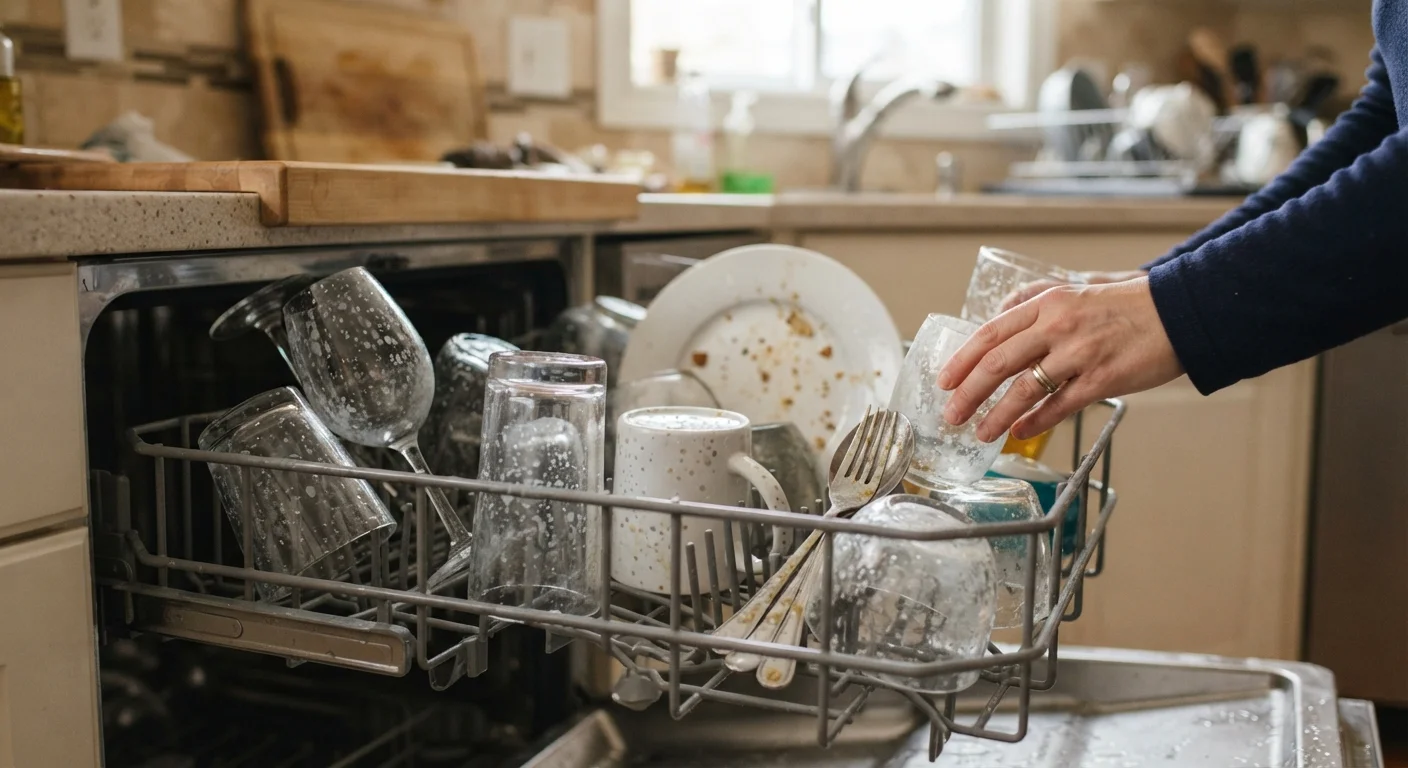
If your dishes come out clean but develop a white haze or cloudy film - particularly on glassware - hard water minerals are almost certainly involved. Hard water contains dissolved calcium and magnesium. When water evaporates during the drying phase, those minerals are left behind as visible deposits.
85%
US homes affected by hard water
According to the U.S. Geological Survey, approximately 85% of American homes receive water classified as moderately to very hard, making mineral spotting a near-universal dishwasher concern.
120°F
Minimum inlet water temperature for effective drying
Most dishwasher manufacturers specify a minimum hot-water inlet temperature of 120°F (49°C) for proper detergent activation and drying performance.
The practical fix has two components: using the correct rinse aid level (which causes water to sheet off surfaces rather than bead and evaporate in place) and, in areas with very hard water, using a detergent that includes a built-in water softener or adding dishwasher salt if your machine has a dedicated softener compartment. Check your appliance manual to confirm whether your model has that feature. Routine filter maintenance also reduces mineral buildup over time - our guide to appliance maintenance habits covers this in practical detail.
A Note on Plastic Items and Realistic Expectations
One complaint that does not indicate a problem: plastic containers, lids, and utensils almost always come out wetter than ceramic or glassware. This is not a malfunction. Plastic has low thermal mass, meaning it does not retain the heat needed to evaporate remaining water droplets the way glass or ceramic does. Condensation-dry systems - which many modern dishwashers use - rely on hot dishes attracting moisture away from cooler surfaces. Plastic undermines this process.
Placing plastic items on the top rack (where heat is lower and they are less likely to warp) and expecting to hand-dry them is the realistic approach. If bone-dry plastics are important to you, look for models with a dedicated fan-assisted drying system when you next replace the appliance - though this is a feature consideration, not a fix for an existing machine.
Staying informed about how your home tech actually works can prevent a lot of unnecessary troubleshooting. The same principle applies across connected devices - see why smart devices keep going offline for a similar plain-language breakdown of persistent connectivity issues.