
High-Deductible vs. Low-Deductible Plans: Which Structure Suits Different Households

Key Takeaways
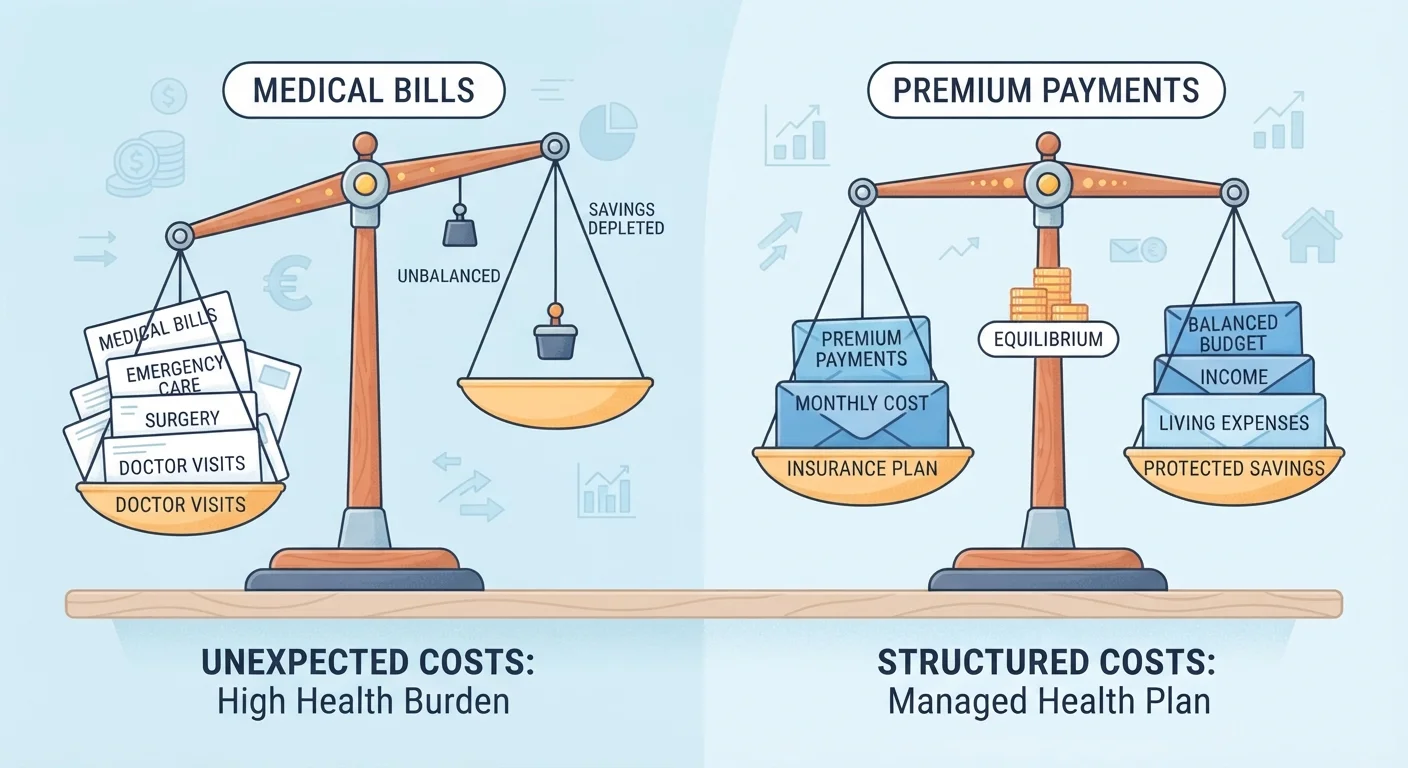
- A higher deductible means lower monthly premiums but more out-of-pocket costs before insurance pays.
- A lower deductible means higher monthly premiums but earlier coverage activation during a claim.
- Your household's savings cushion, health usage patterns, and income stability all influence which structure fits better.
- High-deductible health plans (HDHPs) may qualify you for a Health Savings Account (HSA), adding a tax advantage.
- Neither structure is universally superior - the right choice depends on your household's specific risk profile.
Option A
High-Deductible Plan
Lower monthly premiums, higher out-of-pocket exposure when you need care.
Best for: Households with strong savings, low expected healthcare use, and the ability to absorb a large unexpected expense.
Option B
Low-Deductible Plan
Higher monthly premiums, but coverage kicks in sooner when costs arise.
Best for: Families with predictable, recurring medical needs or limited cash reserves to cover sudden large expenses.
If your household rarely uses healthcare and has solid emergency savings
High-Deductible Plan
You're unlikely to hit a high deductible in most years, so lower premiums translate into real savings over time.
If you have young children, manage a chronic condition, or anticipate frequent medical visits
Low-Deductible Plan
Coverage activates sooner, protecting you from repeatedly absorbing high out-of-pocket costs across multiple claims.
If you want to build tax-advantaged savings alongside your health coverage
High-Deductible Plan
Qualifying HDHPs unlock access to Health Savings Accounts, letting you set aside pre-tax dollars for medical expenses.
If your household budget is tight and an unexpected $3,000-$6,000 expense would be destabilising
Low-Deductible Plan
Paying a higher premium each month is more manageable than facing a large lump-sum deductible during a crisis.
If you are evaluating coverage across multiple policy types for the whole household
Low-Deductible Plan
Predictable cost structures make it easier to coordinate budgets when managing health, auto, and home coverage simultaneously.
What the Deductible Level Actually Controls
A deductible is the dollar amount you pay toward covered services before your insurer begins sharing costs. Understanding exactly how deductibles work is the foundation for making this comparison meaningfully - not just knowing the definition, but seeing how the deductible interacts with your real-world usage.
In a high-deductible plan, that threshold is significantly elevated - for health insurance, the IRS sets minimum thresholds each year that a plan must meet to qualify as an HDHP. In a low-deductible plan, you reach that threshold sooner, which means your insurer's cost-sharing kicks in earlier during a covered event.
The key relationship to hold in mind: as deductibles go up, premiums tend to go down, and vice versa. Insurers price this trade-off deliberately - they're shifting more initial risk to you in exchange for lower monthly costs. Premiums, deductibles, and co-pays all interact within a single policy structure, so adjusting one lever affects the others.
| Criterion | High-Deductible Plan | Low-Deductible Plan |
|---|---|---|
| Monthly Premium | Lower | Higher |
| Deductible Amount | Higher (e.g. $3,000-$7,000+) | Lower (e.g. $250-$1,500) |
| Coverage Activation | Later - after higher threshold | Earlier - lower threshold met sooner |
| HSA Eligibility | Yes (if IRS-qualifying HDHP) | Generally no |
| Best for Cash Flow | Strong reserves, infrequent claims | Tight budget, predictable needs |
| Risk Exposure per Claim | Higher initial out-of-pocket | Lower initial out-of-pocket |
| Total Cost if Low Usage | Often lower overall | Often higher overall |
| Total Cost if High Usage | Often higher overall | Often lower overall |
The Real Cost Comparison: Total Outlay, Not Just Premiums
Many households focus on the monthly premium when choosing a plan, but total annual cost is the more accurate lens. Consider a simplified scenario: a high-deductible plan costs $150 less per month than a low-deductible alternative. That's $1,800 in annual premium savings - but if you use the plan heavily and hit a deductible that's $2,500 higher, you've spent more overall.
The break-even calculation matters: divide the premium difference by the deductible difference to understand how much healthcare use tips the math in either direction. If you rarely make claims, the high-deductible plan often wins. If you regularly reach or exceed your deductible, the low-deductible plan frequently costs less in total.
~57%
Workers enrolled in HDHPs as of recent years
According to KFF (formerly the Kaiser Family Foundation) employer health benefits surveys, more than half of covered workers are now enrolled in plans with deductible structures consistent with HDHPs.
$1,763
Average individual deductible for single coverage
KFF employer health benefits data indicates average single-coverage deductibles have risen steadily over the past decade, increasing the financial stakes of the deductible choice.
~30%
Adults who report difficulty affording a surprise medical bill
Federal surveys consistently show a significant share of U.S. adults would struggle to cover an unexpected medical expense, underscoring the importance of matching deductible levels to actual household reserves.
This is why your household's historical healthcare use is one of the most useful inputs. Families managing chronic conditions, ongoing prescriptions, or regular specialist visits tend to find low-deductible plans reduce total exposure - while generally healthy households with robust savings often come out ahead with a high-deductible structure.
Household Risk Profile: What Changes the Equation
Beyond math, the right deductible structure depends on factors that are unique to your household. Three questions are especially clarifying:
- What is your cash reserve? A high deductible only works as a strategy if you can actually absorb it. If a $4,000 deductible would require borrowing, the premium savings may not compensate for the financial stress of a claim.
- How predictable is your healthcare use? Predictable, recurring costs - regular therapy, maintenance medications, planned procedures - favor lower deductibles. Unpredictable, sporadic use favors higher ones.
- What is your income stability? Households with variable income may prefer the certainty of lower out-of-pocket maximums, even at a higher premium cost, to avoid large bills during low-income months.
Calibrating coverage accurately means resisting the pull toward extremes in either direction. A plan that's technically affordable on paper may still leave your household financially exposed if the deductible structure doesn't match your actual risk tolerance and cash flow.
For a broader household-wide perspective, reviewing all your policies together can reveal whether your deductible choices across health, auto, and home insurance create compounding risk in the same months.
Deductibles Work Differently Across Insurance Types
While this article focuses primarily on health insurance, deductible structures appear across auto, home, and other policy types as well. In home and auto insurance, deductibles typically apply per claim rather than accumulating annually. This distinction matters when evaluating your overall household risk - a high deductible on a home policy, for example, behaves differently from a high deductible on a health plan. Always confirm how each deductible functions within its specific policy type.
The HSA Advantage - and Its Limits
One structural benefit exclusive to qualifying high-deductible health plans is access to a Health Savings Account (HSA). An HSA allows you to contribute pre-tax dollars that can be used for qualified medical expenses, and unlike Flexible Spending Accounts, unused funds roll over year to year.
For households that can afford to contribute to an HSA consistently, this tax advantage can partially offset the higher deductible exposure - effectively lowering the true cost of a high-deductible plan over time. Some employers also contribute to employee HSAs, adding further value.
However, the HSA benefit only helps if you can actually fund the account. For households living close to their monthly budget ceiling, the theoretical tax advantage may not translate into a practical cushion. If an HSA sits at a low balance when a large claim arrives, the high deductible still lands as a significant out-of-pocket burden.
For more context on how high-deductible health plans work across different household situations, a closer look at HDHP trade-offs can help you assess both the upside and the limitations with more specificity.
This article provides general information about insurance structures and is not personalised insurance, financial, or tax advice. Coverage terms, deductible thresholds, and HSA contribution limits vary by plan and may change annually. Always review actual policy documents and consult a licensed insurance agent or qualified financial adviser before making coverage decisions for your household.