

Key Takeaways
- Coverage amount reflects the value of what you want to protect; policy limit is the maximum your insurer will pay.
- When your actual loss exceeds your policy limit, you pay the difference out of pocket.
- Policy limits can be per-occurrence, per-person, aggregate, or sub-limit - each caps payouts differently.
- Reviewing limits annually helps ensure your coverage keeps pace with rising costs and changing assets.
- Gaps between coverage amount and policy limit are one of the most common causes of post-claim financial hardship.
Option A
Coverage Amount
The value you're trying to protect or replace.
Best for: Estimating how much protection you need based on what you own, owe, or could lose.
Option B
Policy Limit
The maximum your insurer will pay under your policy.
Best for: Defining the ceiling on any claim payout, regardless of the actual loss you experience.
If you want to know how much protection to buy
Coverage Amount
Start by calculating the full value of what you need to protect - your home, income, vehicles, or liability exposure - then use that figure to set your coverage amount goal.
If you're reviewing an existing policy before a claim
Policy Limit
Check every limit listed in your policy declarations page to confirm that no single cap falls below the realistic cost of a loss you could face.
If you experienced a loss and the payout seems low
Policy Limit
Your insurer's payout is constrained by your policy limit, not solely by the cost of your loss. Understanding sub-limits and per-occurrence caps can explain shortfalls.
Two Terms, Two Very Different Jobs
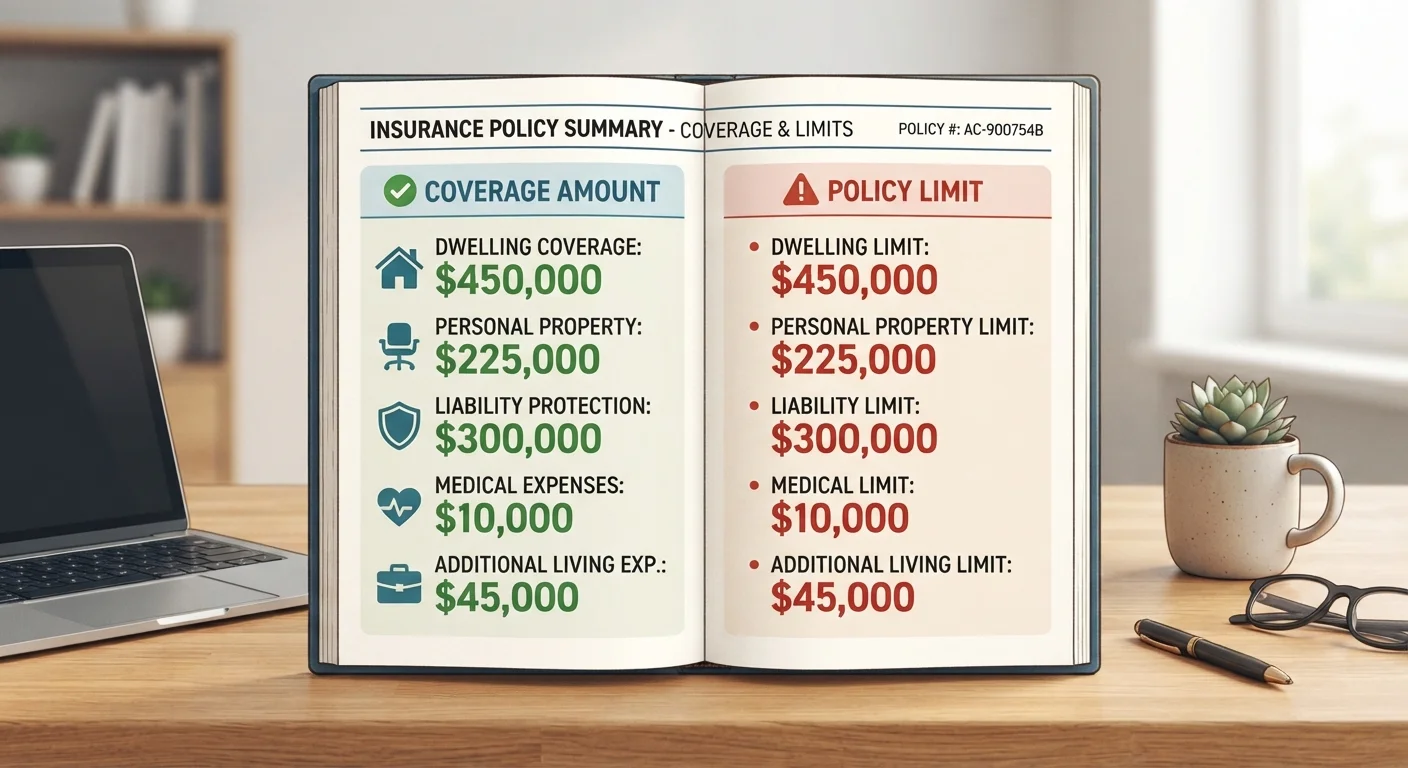
Most policyholders use coverage amount and policy limit interchangeably. They sound like they mean the same thing - how much your insurance will pay - but they serve fundamentally different functions, and confusing them can be expensive.
Coverage amount refers to the dollar value of what you're trying to protect. If you insure your home for $350,000, that figure represents the estimated cost to rebuild the structure after a total loss. If you carry $100,000 in bodily injury liability on your auto policy, that reflects the level of financial exposure you've decided to cover. Coverage amounts are chosen by you, ideally based on a realistic assessment of your assets and risk.
Policy limits, on the other hand, are the contractual ceilings your insurer will honor - the maximum they'll pay under specific conditions. Your policy might carry a $300,000 dwelling limit, but include a $10,000 sub-limit for jewelry. Both are limits, but they operate independently. Exceeding either cap means you absorb whatever remains.
Think of coverage amount as your goal and policy limit as the guardrail your insurer sets. When those two numbers don't align, you have a gap - and gaps show up at the worst possible moment. See our guide to decoding policy numbers for help interpreting the figures on your declarations page.
How Policy Limits Work in Practice
Policy limits come in several forms, and understanding each type prevents misreading what your policy promises.
| Criterion | Coverage Amount | Policy Limit |
|---|---|---|
| What it represents | Value of what you want to protect | Maximum your insurer will pay |
| Set by | Policyholder (with agent guidance) | Policy contract terms |
| Can it vary mid-policy? | Yes, by requesting an endorsement | Only by changing or endorsing the policy |
| What happens when exceeded? | You may be underinsured | Insurer stops paying; you cover the rest |
| Common sub-types | Dwelling, personal property, liability | Per-occurrence, per-person, aggregate, sub-limit |
- Per-occurrence limits cap what the insurer pays per individual incident, regardless of total costs involved.
- Per-person limits appear most often in auto liability policies - for example, a policy written as 50/100 means $50,000 per injured person and $100,000 per accident.
- Aggregate limits set a maximum across all claims within a policy period, common in commercial and umbrella policies.
- Sub-limits are internal caps on specific categories within a broader policy, such as a $5,000 limit on electronics within a renters policy with $30,000 in total personal property coverage.
Sub-limits are where families most often encounter surprises. A homeowner might carry what appears to be robust coverage only to discover that a specific category of loss - water backup, fine art, home office equipment - falls under a far smaller internal cap. Understanding where your coverage ends is just as important as knowing what it includes.
When the Gap Between the Two Creates Real Financial Risk
The practical problem emerges when the cost of your actual loss exceeds your policy limit. Suppose a fire causes $280,000 in structural damage to your home, but your dwelling limit is $240,000. Your insurer pays $240,000. The remaining $40,000 is yours to cover - regardless of whether your original coverage amount was intended to reflect the full rebuild cost.
~60%
U.S. homes estimated to be underinsured
Industry analyses have consistently estimated that a majority of American homes are insured for less than their current full rebuild cost, leaving policyholders exposed to out-of-pocket shortfalls after major losses.
25-30%
Typical underinsurance gap on affected homes
Research by insurance industry groups suggests that underinsured homeowners often carry coverage that falls 25 to 30 percent below actual replacement costs, a gap that has widened with rising materials and labor prices.
This gap can happen for several reasons:
- Underinsurance at purchase: The coverage amount set when you bought the policy no longer reflects current replacement costs, particularly in periods of rising construction or labor expenses.
- Unreviewed limits after renovations: Home improvements that increase rebuild value may not be reflected in your existing dwelling limit.
- Assumed coverage that isn't there: Some families believe their policy covers a risk - flooding, earthquake, identity theft - without confirming it explicitly. Those coverage assumptions can be costly.
The solution isn't simply buying more coverage - it's making sure your chosen coverage amounts are matched by policy limits that can actually pay them out. Reviewing your declarations page annually, and after any significant life or property change, is the most reliable way to close that gap.
This article is for general informational and educational purposes only and does not constitute personalized insurance, financial, or legal advice. Coverage terms, limits, and exclusions vary by provider and state. Read your actual policy documents carefully and consult a licensed insurance agent or adviser for guidance specific to your situation.