

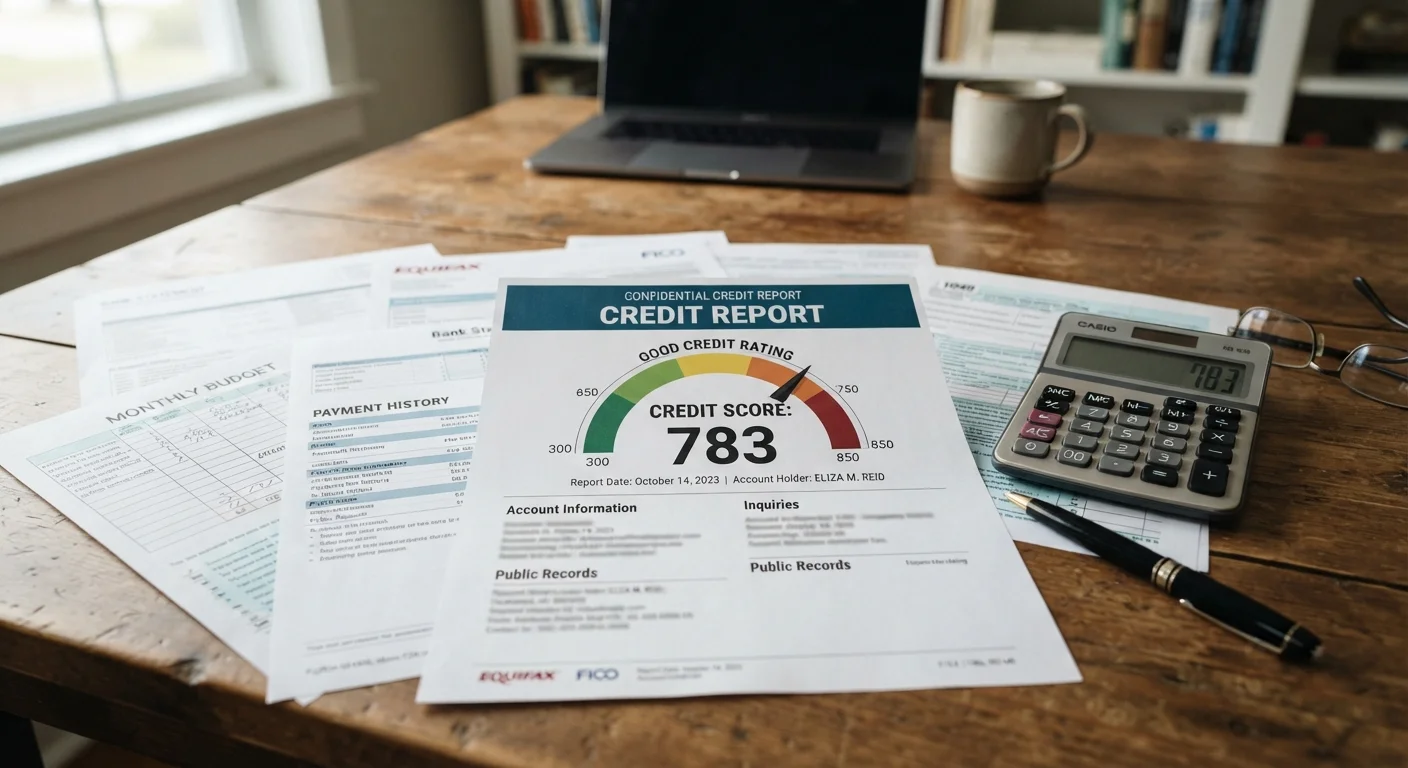
Key Takeaways
- Credit scores measure borrowing behavior, not financial health, wealth, or income.
- Payment history and credit utilization together account for roughly two-thirds of most scores.
- Checking your own credit score does not lower it - only hard inquiries from lenders do.
- Carrying a balance month to month does not improve your score and costs you interest.
- A high credit score doesn't mean you're debt-free or financially secure.
How Credit Scores Are Actually Calculated
A credit score is a three-digit number - typically ranging from 300 to 850 under the most widely used models - that summarizes the information in your credit file into a single risk indicator for lenders. It does not reflect your character, your financial goals, or your overall money management skills. It reflects one thing: how predictably you have managed borrowed money in the past.
The five core factors in most widely used scoring models, in approximate order of weight, are:
- Payment history (~35%): Whether you pay on time, and how severely or recently you've missed payments.
- Credit utilization (~30%): The proportion of your available revolving credit that you're currently using.
- Length of credit history (~15%): How long your accounts have been open, on average.
- Credit mix (~10%): Whether you have experience with different types of credit (revolving accounts, installment loans, etc.).
- New credit (~10%): Recent applications for credit, reflected as hard inquiries.
Multiple scoring models exist - FICO and VantageScore being the most prevalent - and lenders may use different versions for different products. This means you don't have a single fixed score; you have a range of scores that shift based on which model and which credit bureau's data is used.
~35%
Weight of payment history in FICO scores
Payment history is the single largest factor in the FICO scoring model, underscoring why on-time payments matter more than any other behavior.
30%
Credit utilization's share of FICO score
Keeping utilization below 30% of available credit is a widely cited general guideline; lower utilization typically correlates with higher scores.
3
Major U.S. credit bureaus reporting scores
Equifax, Experian, and TransUnion each maintain separate credit files, meaning your score may differ across bureaus depending on what each has on record.
Common Myths, Corrected
Misconceptions about credit scores are widespread enough that they influence real financial decisions - sometimes at significant cost. The pairs below address the most consequential ones.
Myth
Checking your own credit score will hurt it.
Fact
Viewing your own credit report or score is a 'soft inquiry' and has no effect on your score whatsoever.
Credit inquiries fall into two categories: soft inquiries and hard inquiries. When you check your own score - through a bank portal, a credit monitoring service, or AnnualCreditReport.com - it registers as a soft inquiry and is invisible to lenders. Only hard inquiries, triggered when a lender reviews your credit as part of an application decision, can temporarily lower your score by a small number of points. Avoiding self-checks out of fear means missing errors on your report that could be dragging your score down without your knowledge.
Myth
You need to carry a balance to build your credit score.
Fact
Paying your balance in full each month is better for your score - and costs you nothing in interest.
This is one of the most persistently harmful myths in personal finance. Credit scores do not reward you for paying interest. What the scoring model measures is whether you use credit and pay on time - not whether you maintain a revolving balance. Carrying a balance increases your credit utilization ratio (the share of available credit you're using), which can actually reduce your score if it climbs too high. Paying in full each statement cycle demonstrates responsible use without costing you finance charges. See also: how minimum payments accumulate interest over time.
Myth
Income and net worth are factored into your credit score.
Fact
Credit scores are based entirely on your borrowing and repayment history - not how much you earn or own.
Your salary, savings account balance, investment portfolio, and home equity are invisible to credit scoring models. The score is calculated exclusively from data in your credit file: whether you pay on time, how much of your available credit you use, how long you've had accounts, what types of credit you hold, and how recently you've applied for new credit. A high earner who misses payments will score lower than a moderate earner who consistently pays on time. Income is often collected separately during loan applications, but it plays no role in the score calculation itself.
Myth
Closing old credit card accounts improves your score.
Fact
Closing old accounts typically lowers your score by reducing your available credit and shortening your credit history.
Two scoring factors work against account closure. First, it reduces your total available credit limit, which - if you carry any balances elsewhere - raises your utilization ratio. Second, closed accounts eventually drop off your credit file, which can shorten your average age of accounts, another factor scoring models consider. Unless an account carries fees that outweigh its benefits, keeping older accounts open and occasionally active is generally preferable. For a broader look at how different card types function, see how credit, debit, and charge cards differ structurally.
Myth
A high credit score means the person is in excellent financial health.
Fact
A high score reflects disciplined use of credit products - it says nothing about debt load, savings, or overall financial stability.
Someone can carry significant debt, have minimal savings, and still maintain a high credit score - provided they make on-time payments and manage their utilization ratio. The score is a narrow, specific metric designed to predict the likelihood of repaying a new debt as agreed. It is not a measure of financial well-being. Conversely, a person with a modest score may have strong savings and low obligations but limited credit history. Understanding this distinction matters when interpreting your own financial picture or comparing metrics like debt-to-income ratio, which lenders also consider. The broader context of household debt metrics can help complete the picture.
This article is for general informational and educational purposes only and does not constitute personalized financial or legal advice. Consult a licensed financial professional for guidance specific to your situation.