

Key Takeaways
- The true cost of a purchase includes replacement frequency, maintenance, and performance over its entire lifespan.
- Cost per use is a more reliable measure of value than the initial price tag.
- Some categories reward quality investment; others offer little benefit from spending more.
- Repeated replacement of cheap items often exceeds the one-time cost of a durable alternative.
- Understanding where to spend more - and where not to - is the foundation of smart family budgeting.
The Hidden Maths of Cheap Purchases
When a family is watching its budget, reaching for the lowest-priced option feels responsible. But purchase price and total cost are two different numbers - and confusing them is one of the most common and costly shopping mistakes households make.
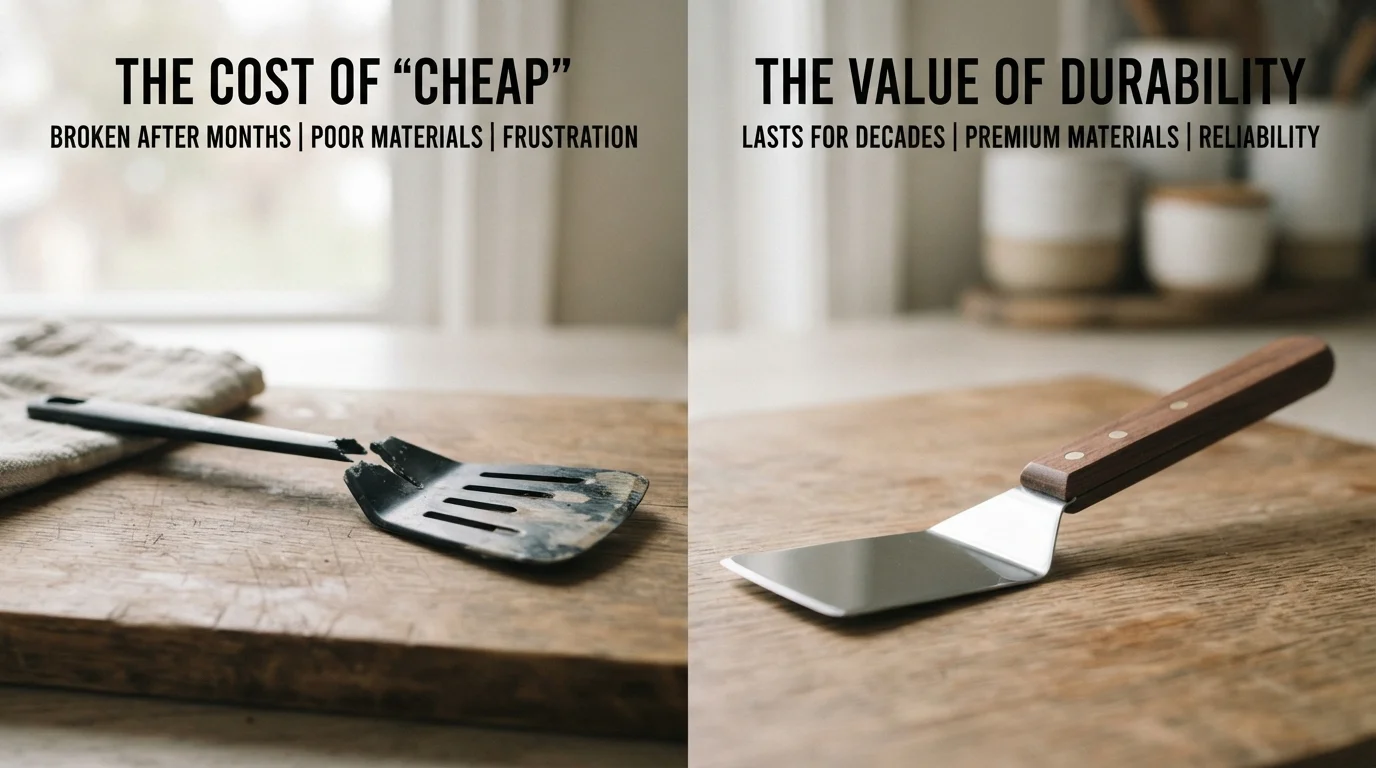
The concept at the heart of this is cost per use: the price of an item divided by how many times you actually use it before it needs replacing. A $15 non-stick pan that warps after three months and gets replaced twice a year costs $45 annually. A $60 pan that lasts four years costs $15 per year. The math isn't complicated, but it's easy to ignore at the point of purchase. See our guide to cost per use for a deeper breakdown of this metric across everyday categories.
This pattern repeats across product categories - footwear, appliances, tools, bedding - wherever durability determines lifespan. The key is learning which purchases reward a higher upfront spend and which don't.
Myth
Buying the cheapest option always saves money.
Fact
When replacement frequency is factored in, cheap items frequently cost more over a 12-to-24-month horizon than moderately priced alternatives.
This is the core false economy trap. A low sticker price creates the impression of savings, but savings only materialise if the item performs adequately across its expected lifespan. When it doesn't - and cheaper construction often means it won't - the household pays the purchase price again, sometimes multiple times. Tracking what you actually spend on a category over a year, rather than per transaction, reveals patterns that single-purchase thinking conceals. The lowest price isn't always the best value - a principle worth applying before every significant household purchase.
Myth
Spending more guarantees better quality.
Fact
Price and quality correlate inconsistently depending on the product category; premium pricing often reflects brand positioning, not superior materials or performance.
Markup structures vary enormously across retail. Fashion, cosmetics, and branded electronics carry significant margin for marketing, packaging, and perceived prestige - not necessarily for better components or longer life. Consumer testing organizations routinely find mid-range products outperforming expensive counterparts in durability and function. The relevant question isn't "is this expensive?" but "does the construction, materials, or warranty justify this price for how I'll use it?"
Myth
If something breaks, replacing it cheaply is the economical move.
Fact
Repeatedly replacing a failed cheap item is one of the clearest and most measurable forms of overspending - and a pattern that common overspending habits research consistently identifies.
Every replacement purchase resets the clock on your spend without resetting the underlying problem: an item that isn't suited to the job it's being asked to do. Before replacing like-for-like, it's worth calculating how much has already been spent in that category over the past year. In many cases, a single higher-quality purchase - even at two or three times the per-unit cost - would have come out ahead. This is especially true for items used daily or under physical stress.
Myth
Bulk buying and multi-packs are always the more economical choice.
Fact
Bulk purchases only deliver savings when the full quantity is used before expiry or obsolescence; unused product is money spent, not saved.
The unit price on a bulk pack is often lower - but unit price and actual savings are not the same thing. Perishables that spoil, cleaning products that sit unused, or clothing multipacks where most items go unworn all represent negative returns. As our article on buying in bulk explains, the critical variable is your household's realistic consumption rate, not the shelf price.
Myth
Online prices are reliably lower than in-store prices.
Fact
Platform fees, dynamic pricing, and upsells mean online retail is not systematically cheaper; the channel advantage depends heavily on the specific product and timing.
Online shopping introduces costs that are easy to overlook: shipping fees, return postage, subscription requirements to unlock certain prices, and dynamic pricing that can shift within hours. In-store retailers, by contrast, sometimes offer price-match guarantees, immediate availability, and no return friction. Our piece on why assuming online is cheaper is a mistake goes into detail on where this assumption breaks down most reliably.
Where This Thinking Actually Applies
Not every product category follows the same logic. The durability-versus-price relationship is strong in items that absorb physical stress: work boots, cookware, mattresses, power tools, and outerwear. It's much weaker in categories where product generations turn over quickly - consumer electronics, for instance - or where ingredients and formulas are standardized across price points, such as many generic medications and pantry staples.
3×
Typical replacement rate for low-durability goods
Consumer durability research suggests budget-tier items in high-stress categories (footwear, cookware, tools) are replaced roughly three times as often as mid-tier equivalents.
~40%
Bulk purchases estimated to go partially unused
Household waste studies have found a significant share of bulk-purchased perishables and consumables are discarded before full use, eroding anticipated savings.
Children's clothing is a useful case study in the opposite direction. Because kids grow quickly, expensive garments may be outgrown before they show wear. As we explore in our article on why spending more on children's clothes doesn't always mean better quality, price and quality correlate poorly in this category. Similarly, generic versus name-brand comparisons show that store brands frequently match premium products where formulations are regulated or standardized.
The practical takeaway: apply cost-per-use thinking selectively. Focus your quality investment on items with long intended lifespans and high replacement costs. For fast-turnover or standardized categories, the cheaper option may genuinely be the smarter one.
Don't Let Sunk Cost Drive Replacements
A common trap is continuing to buy cheap replacements simply because "that's what we always spend on this." If an item has failed twice or more in under two years, treat it as a signal to reassess the category - not an excuse to repeat the same purchase. Calculating your total spend in that category over 24 months often makes the case for a different approach more clearly than any single price comparison.
After-sales factors also shift the equation. Warranties, return policies, and repair availability can meaningfully reduce the real cost of ownership on durable goods. Our article on warranty and after-sales support costs walks through what to check before committing to any major purchase.
For a broader framework on evaluating any purchase, see the real difference between price and value - and for ongoing budget discipline, the Budgeting Basics hub offers practical strategies families can start using immediately.