

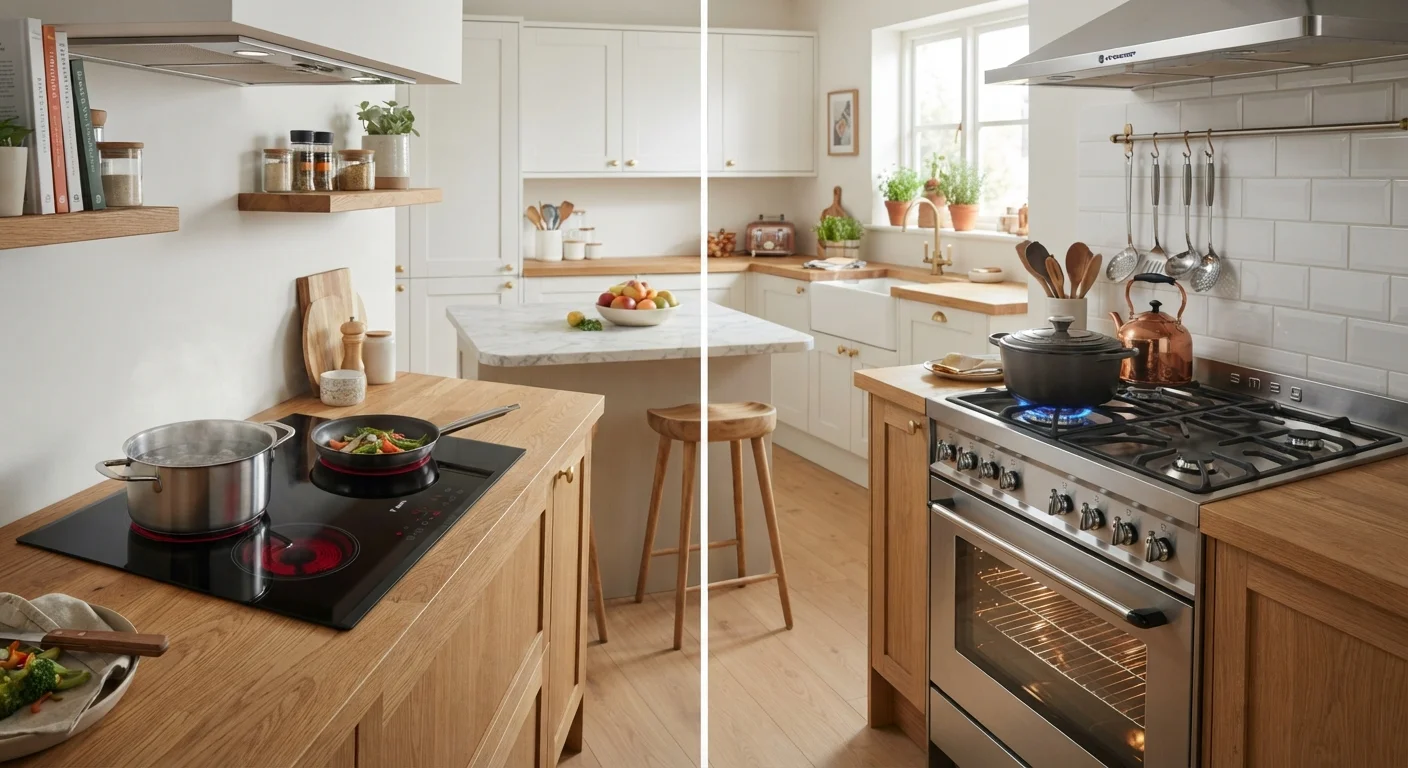
Key Takeaways
- Induction hobs heat cookware directly using electromagnetism; only magnetic pots and pans will work on them.
- Gas cookers use an open flame, making them compatible with virtually any cookware but requiring proper ventilation.
- Induction tends to be more energy-efficient, converting more electricity to usable heat than gas burns to usable heat.
- Gas cookers carry open-flame and carbon monoxide risks; induction surfaces stay cooler, reducing burn hazards.
- Switching from gas to induction typically requires an electrical upgrade and may require new cookware.
- Running costs depend on your local gas and electricity tariffs - neither fuel type is universally cheaper.
Option A
Induction Hob
The precise, energy-efficient electric alternative.
Best for: Families who want fast, controllable heat, easy cleaning, and a safer cooking surface - especially in households with young children.
Option B
Gas Cooker
The familiar, flame-based kitchen workhorse.
Best for: Households already connected to a gas supply who prefer immediate visual heat feedback and compatibility with all cookware types.
If you have young children and prioritize kitchen safety
Induction Hob
The cooking surface itself does not get dangerously hot, and there is no open flame - significantly reducing burn and fire risks in busy family kitchens.
If you own a wide variety of cookware including non-magnetic pans
Gas Cooker
Gas works with cast iron, aluminum, copper, and ceramic without any compatibility concerns, so your existing cookware collection stays fully usable.
If precise, consistent temperature control matters to your cooking style
Induction Hob
Induction responds almost instantly to temperature adjustments and holds heat levels steadily, making it easier to simmer sauces or melt chocolate without scorching.
If your home already has a gas connection and you want to avoid rewiring costs
Gas Cooker
Switching to induction may require upgrading your home's electrical circuit - a cost that can make gas the more practical choice if infrastructure is already in place.
If quick, easy daily cleaning is a priority
Induction Hob
The flat, smooth glass-ceramic surface has no grates or burner caps to scrub, and spills rarely burn on because the surface stays relatively cool.
How Each Technology Actually Works
Understanding the core difference between induction and gas makes every other comparison easier to follow.
A gas cooker burns natural gas or propane to produce an open flame directly beneath your pot or pan. Heat transfers from flame to cookware to food - a process that has remained essentially unchanged for generations. The flame's intensity is controlled by adjusting the gas flow, and you can see it working in real time.
An induction hob works on an entirely different principle. Beneath the smooth glass-ceramic surface sit copper coils. When you place a pan on the hob and switch it on, an alternating electric current passes through those coils and creates a magnetic field. That field induces an electric current directly inside the base of the pan, which generates heat within the metal itself. The hob surface only warms up from contact with the hot pan - not from the hob generating heat independently.
The practical consequence: induction only works with cookware that contains ferrous (iron-based) metal. Stainless steel and cast iron work. Pure aluminum, copper, and most ceramic pans do not, unless they have a magnetic base layer added by the manufacturer. Before switching, check your pans with a fridge magnet - if it sticks firmly to the base, the pan will work on induction.
| Criterion | Induction Hob | Gas Cooker |
|---|---|---|
| Heat source | Electromagnetic field in pan base | Open gas flame beneath cookware |
| Cookware compatibility | Magnetic bases only (iron/steel) | Works with virtually all cookware |
| Heat-up speed | Very fast | Moderate to fast |
| Temperature precision | Very high - near-instant response | Good - visual flame helps judgment |
| Surface burn risk | Low - surface stays relatively cool | High - open flame present |
| Energy efficiency | ~85-90% of energy used | ~40-55% of energy used |
| Cleaning ease | Easy - flat glass surface | Moderate - grates and burner caps |
| Works in power outage | No | Yes (with manual ignition) |
| Installation requirement | High-amperage electrical circuit | Gas supply line |
Heat Control, Speed, and Everyday Cooking
Both technologies can boil water and sear a steak, but they feel noticeably different to cook on.
Induction heats up faster - water comes to a boil more quickly than on most gas burners - and responds to temperature changes almost instantly. Turn the power down and the pan cools within seconds. This precision is particularly useful for delicate tasks: keeping a béchamel sauce at a gentle simmer, melting chocolate without a double boiler, or holding a jam at exactly the right temperature.
Gas offers its own form of intuitive control through the visible flame. Many experienced cooks find it easier to judge heat visually and to use techniques like charring vegetables or tilting a pan over the flame. Gas also works in a power outage (provided your ignition has a manual override), which induction does not.
For families cooking everyday meals - pastas, stir-fries, soups - both perform reliably. The learning curve of switching is real but manageable within a few weeks of regular use. You can also explore which oven features genuinely help in daily family cooking to round out your kitchen setup decisions.
~85-90%
Induction hob energy efficiency
Industry engineering data consistently places induction hob thermal efficiency between 85 and 90 percent, compared to roughly 40-55 percent for open gas burners.
32A+
Typical electrical supply needed for induction
Most standalone induction hobs require a dedicated 32-amp or higher circuit, which older homes may not already have wired to the kitchen.
Safety, Running Costs, and Kitchen Compatibility
Safety considerations differ meaningfully. Gas carries the risks associated with open flames - ignition of nearby items, gas leaks, and the production of combustion byproducts including carbon monoxide. Good kitchen ventilation and working carbon monoxide detectors are important in any gas kitchen. Induction carries no combustion risk, and its surface temperature stays low enough that accidental contact is far less likely to cause a serious burn - though the pan itself remains very hot.
Running costs are harder to generalize. Induction is more energy-efficient in converting its energy source to usable heat (typically around 85-90% efficiency versus roughly 40-55% for gas burners). Whether that translates to a lower bill depends entirely on the relative cost of electricity versus gas in your area and your utility tariffs. In regions where electricity is significantly more expensive per unit of energy than gas, the efficiency advantage of induction may not fully offset the higher energy price.
Installation and compatibility are practical switching barriers. Most induction hobs require a dedicated high-amperage electrical circuit - often a 32-amp or higher supply - that many older kitchens do not have. If your kitchen wiring is not already set up for this, an electrician's visit adds to the upfront cost. Gas cookers require a gas supply line and should be professionally connected. Neither installation is a DIY job.
Checking Your Cookware Before You Switch
Before committing to an induction hob, place a standard fridge magnet against the base of each pan you own. If the magnet holds firmly, the pan is induction-compatible. A weak hold or no hold means that pan will not work on induction. Many households find they can keep some existing pans and replace only a few, but it is worth auditing your collection before making a final decision.
For families, the cookware question often surprises people most. Replacing a full set of pans adds a meaningful cost to any induction switch that should be factored in from the start.