
Features on Modern Ovens That Families Actually Use (Versus Ones That Sound Impressive)

Key Takeaways
- Fan-assisted (convection) cooking is the single most useful feature for everyday family meals.
- Pyrolytic self-cleaning saves real effort but requires planning around high heat and fumes.
- Steam injection benefits specific tasks like bread baking - it's genuinely useful but not essential for all households.
- Wi-Fi connectivity and voice control rarely change how families actually cook day-to-day.
- Understanding oven capacity in usable terms matters more than the headline liter figure.
Why Oven Feature Lists Can Mislead Shoppers
Walk through any appliance showroom - or scroll any retailer's website - and modern ovens come loaded with features that sound transformative: steam injection, pyrolytic cleaning, sabbath mode, pizza settings, dual-zone cooking. Some of these genuinely change how a family uses their kitchen. Others are engineering curiosities that rarely get touched after the first month.
This guide cuts through the spec-sheet language to look honestly at which oven features pull their weight over years of family cooking, and which ones you're largely paying for without using. For quick definitions of any appliance term that comes up here, the Family Household Appliance Glossary is a useful companion. And if you're also comparing your oven choice alongside a new cooktop, our look at induction hobs versus gas cookers covers the broader kitchen picture.
Fan-Assisted (Convection) Cooking - Worth Every Penny
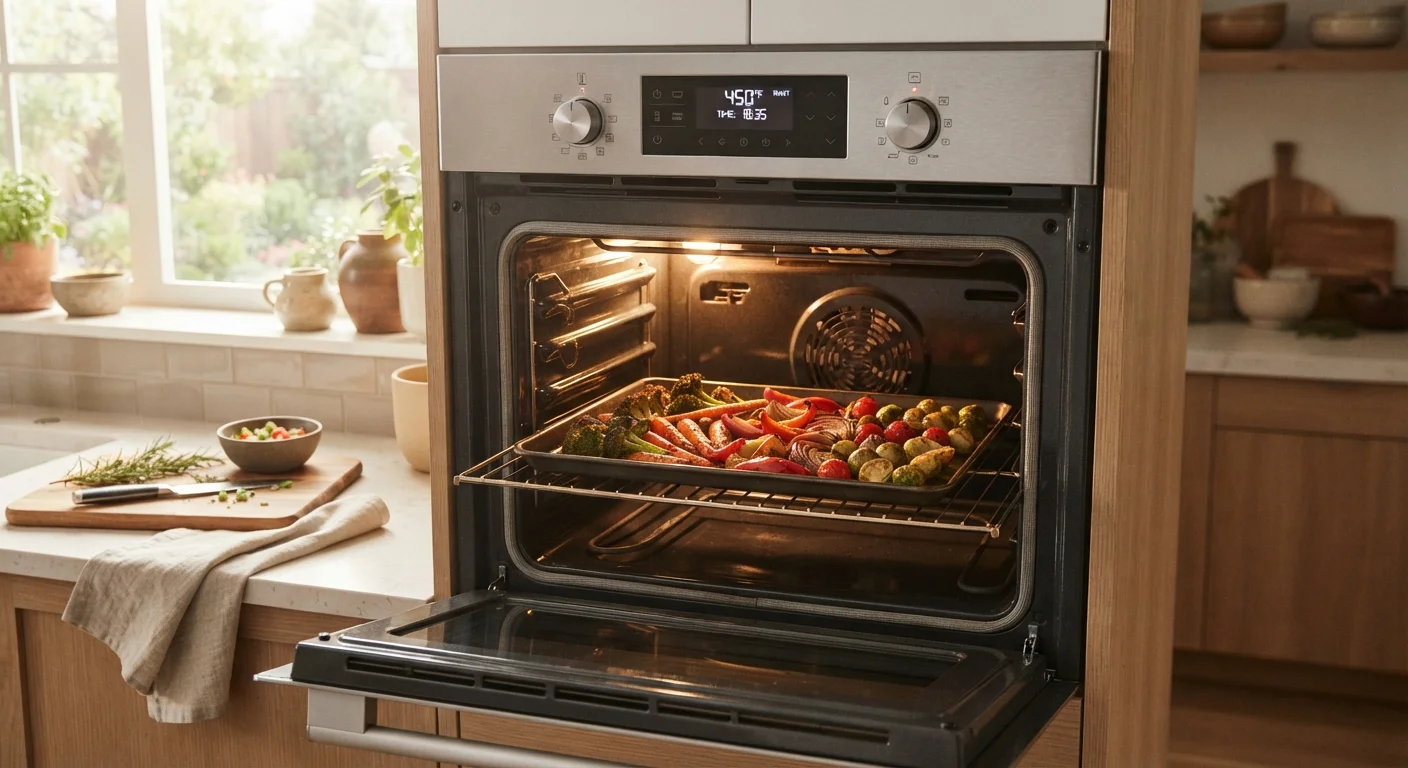
A fan-assisted oven - often labeled convection in the US - circulates hot air continuously around the food. The practical result: more even cooking, faster heat-up times, and the ability to run multiple racks without the top tray burning while the bottom one lags behind. For families cooking sheet-pan dinners, roasting vegetables, or baking cookies in batches, this is the feature that makes a daily difference. Most modern ovens include it; the question is whether the fan speed and placement are well-designed, not simply whether the label is there.
Fan-assisted cooking is the one feature that genuinely changes daily outcomes for family meals.
Pyrolytic Self-Cleaning - Genuinely Useful, With Caveats
Pyrolytic cleaning locks the oven door, raises the interior temperature to around 900°F (480°C), and incinerates grease and food residue to ash you simply wipe away. It works, and it works well - particularly for families dealing with roasting spills and baked-on cheese. The caveats are real, though: a full cycle takes two to three hours, draws significant electricity, and produces heat and some odor. You need good ventilation and should plan the cycle for a time when the kitchen won't be in use. Still, for households who find oven scrubbing genuinely burdensome, this feature pays back its cost over time.
Pyrolytic cleaning works - but plan for the heat, time, and ventilation it requires.
Multiple Heating Modes - Useful If You Learn Three or Four
Premium ovens may offer eight to twelve distinct cooking modes: top heat only, bottom heat only, grill, fan grill, pizza mode, bread mode, and so on. Most families settle into two or three they trust and rotate between them. That's fine - knowing when to switch from fan-assisted to bottom heat for a pie crust, or to grill for a final browning, does make a practical difference. The risk is paying extra for an oven with ten modes when an oven with five well-executed modes would serve the household just as effectively. Focus on the quality and consistency of the modes you'll actually use.
Most families reliably use three or four heating modes - prioritize quality over quantity.
Steam Injection - Niche but Genuinely Effective
Steam-injection ovens introduce moisture into the cavity during cooking. For bread baking, this is meaningful: it keeps the outer crust from setting too quickly, allowing better oven spring and a crispier final crust. For reheating leftovers, a brief steam cycle prevents food from drying out. However, if your household doesn't bake bread regularly and reheats primarily in a microwave, the steam function may see very limited use. It's a feature worth having if it aligns with how you cook - not a reason on its own to choose a more expensive model.
Steam injection excels at bread baking and reheating - less relevant if you rarely do either.
Wi-Fi Connectivity and App Control - Rarely a Cooking Game-Changer
The ability to preheat your oven remotely via a phone app sounds convenient, and occasionally it is - arriving home to a pre-heated oven shaves a few minutes off dinner. In practice, most families find they're simply not structured around remote oven use in the way that, say, remote thermostat control genuinely changes behavior. Safety concerns (an oven left on in an empty house) also give many households pause. If smart home integration is already central to how your family operates, this feature fits naturally. For most households, it's a novelty that fades quickly. For more on this pattern, see our full look at smart appliance trade-offs.
Remote oven control is convenient in theory - most families use it infrequently in practice.
Built-In Meat Probes - Underrated and Genuinely Helpful
Some mid-range and higher ovens include a wired temperature probe that connects inside the cavity. You set a target internal temperature for whatever you're roasting, and the oven alerts you - or automatically switches off - when the food reaches it. For families who regularly roast whole chickens, pork shoulders, or large cuts of beef, this removes the guesswork that leads to either overcooked or undercooked results. It's not a flashy feature, but it's one of the most practically effective additions on a family cooking list, especially for cooks who are still building confidence with larger roasts.
A built-in meat probe quietly solves one of the most common family cooking headaches.
Making a Smarter Decision When You Buy
The pattern across these features is consistent: the ones that reward families are the ones that solve a repeating problem - uneven cooking, messy cleanup, time pressure. The ones that underdeliver tend to address occasions that rarely come up or add complexity without proportional payoff.
Test the Interface Before You Commit
If possible, interact with an oven's controls in person before purchasing. Complex touch interfaces that seem intuitive in a showroom can become frustrating under the time pressure of weeknight cooking. Dials and clearly labeled buttons tend to hold up better in busy household kitchens than multi-layer touchscreen menus.
Before finalizing any oven purchase, it's worth considering usable interior capacity alongside the headline liter figure - our article on matching appliance capacity to your household's real needs explains how manufacturers measure these numbers and what they mean in practice. For families thinking about app-connected ovens specifically, Smart Appliances in the Family Home offers an honest assessment of where connectivity genuinely helps and where it doesn't.