

Key Takeaways
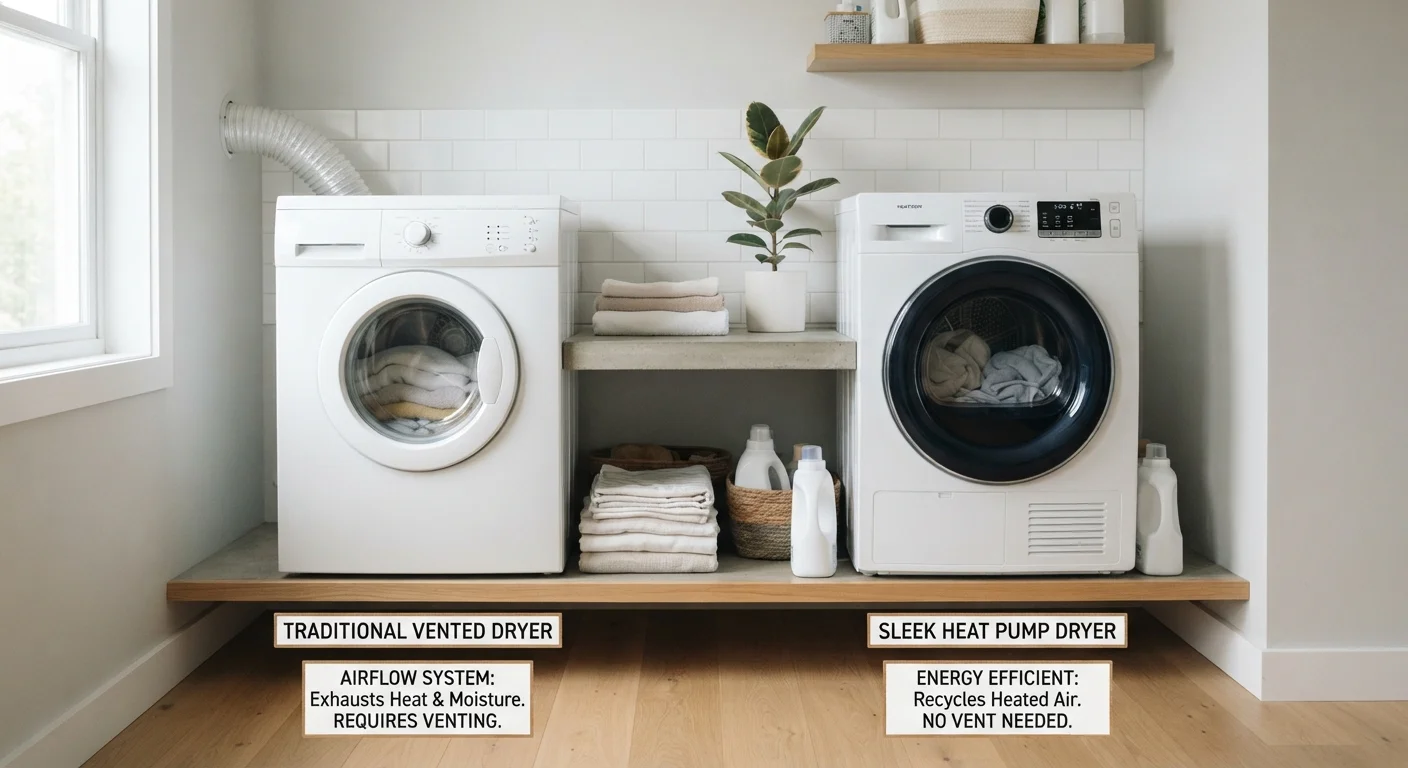
- Conventional dryers heat air and exhaust it; heat pump dryers recycle warm air in a closed loop.
- Heat pump dryers use significantly less electricity per cycle than conventional vented or condenser models.
- Conventional dryers typically run hotter and faster; heat pump cycles are longer but gentler on fabrics.
- Heat pump models cost more upfront but can offset that through lower energy bills over time.
- Neither type requires external venting - condenser and heat pump models both collect moisture internally.
- Your household's laundry volume, cycle frequency, and budget all influence which type makes more sense.
Option A
Conventional Tumble Dryer
The familiar, fast-drying workhorse.
Best for: Households that prioritize speed and lower upfront cost over energy efficiency.
Option B
Heat Pump Dryer
The energy-efficient, gentle alternative.
Best for: Families focused on lower running costs and protecting delicate fabrics over time.
If you do large loads frequently and speed is the priority
Conventional Tumble Dryer
Conventional dryers run hotter and finish cycles faster, making them practical for high-volume, time-sensitive laundry routines.
If you want to reduce electricity use and lower ongoing running costs
Heat Pump Dryer
Heat pump dryers use roughly half the energy of conventional models per cycle, which adds up meaningfully over months of regular use.
If you wash a lot of delicate or synthetic fabrics
Heat Pump Dryer
Lower drum temperatures reduce the risk of shrinkage or fabric damage, making heat pump dryers gentler across a wider range of garments.
If upfront appliance cost is your main constraint
Conventional Tumble Dryer
Conventional vented and condenser dryers generally carry a lower purchase price, making them more accessible when budget is the deciding factor.
How Each Dryer Type Actually Works
Both dryer types tumble clothes in a rotating drum, but the way they generate and manage heat is fundamentally different - and that difference drives most of the trade-offs families encounter.
Conventional tumble dryers (whether vented or condenser) work by drawing in ambient air, heating it with an electric element, passing it through the drum to absorb moisture from clothes, and then either expelling that humid air outside through a duct (vented) or cooling it to condense the moisture into a water tank (condenser). Either way, the heat is used once and discarded. The element has to reheat fresh air for every part of every cycle, which consumes a steady, relatively high amount of electricity throughout.
Heat pump dryers take a different approach. Instead of discarding the warm, moisture-laden air, they pass it through a heat exchanger - essentially a refrigerant-based system similar in principle to an air conditioner running in reverse. The moisture condenses out into a collection tank, and the now-dry, warm air is recirculated back into the drum. Because the heat is reused rather than expelled, far less energy is needed to maintain drying temperatures. The trade-off is that operating temperatures are lower - typically around 40-50°C versus 70-75°C in a conventional model.
This internal recycling loop is why heat pump dryers carry higher energy efficiency ratings. For a plain-language breakdown of what those ratings actually mean for your electricity bill, see our guide to energy labels on home appliances.
| Criterion | Conventional Tumble Dryer | Heat Pump Dryer |
|---|---|---|
| Drying mechanism | Heats & exhausts fresh air | Recirculates warm air via heat exchanger |
| Operating temperature | ~70-75°C | ~40-50°C |
| Energy use per cycle | Higher (no heat recovery) | Lower (~50% less typical) |
| Cycle duration | Faster | Slower (30-60 min longer) |
| Fabric gentleness | Moderate - higher heat risk | Gentler - lower heat |
| Upfront cost | Generally lower | Generally higher |
| Venting required | Vented models: yes; Condenser: no | No |
| Filter maintenance | Lint filter only | Lint filter + heat exchanger filter |
What the Differences Mean Day to Day
Understanding the technology helps, but what most families want to know is: how does this play out in the laundry room?
~50%
Less electricity per cycle (heat pump vs conventional)
General appliance efficiency data consistently shows heat pump dryers use roughly half the energy of conventional electric models per drying cycle.
40-50°C
Typical heat pump dryer operating temperature
Compared to 70-75°C in conventional models, this lower range reduces thermal stress on fabrics across repeated cycles.
Cycle time: Because heat pump dryers operate at lower temperatures, they generally take longer to dry a full load - often 30 to 60 minutes more than a comparable conventional cycle. For households doing one or two loads a week, that's unlikely to matter much. For families running the dryer daily, the slower throughput could become a scheduling consideration.
Fabric care: Lower heat means less stress on fibres, elastic, and synthetic materials. Garments that are prone to shrinking or pilling may fare better in a heat pump dryer over time. Conventional dryers running at higher temperatures can gradually degrade some fabrics, particularly if cycles are run at maximum heat settings.
Running costs: Heat pump models typically use around 50% less electricity per cycle than conventional dryers, according to general appliance efficiency data. Across frequent use over several years, that difference can be material - though actual savings depend on your local electricity rate and how often you run the machine.
Maintenance: Heat pump dryers have two filters that need regular cleaning - the standard lint filter and a secondary heat exchanger filter. Neglecting these reduces efficiency noticeably. Conventional dryers typically require only lint filter maintenance. For a broader look at keeping dryers and other appliances performing well, our appliance maintenance guide covers the habits that make the most difference.
Installation: Neither condenser nor heat pump dryers require external venting, giving more flexibility about where they're placed. Vented conventional dryers need a duct to an outside wall or window, which can limit placement options in some homes.
Washer-Dryer Combos Are a Separate Category
If you're also evaluating washer-dryer combination units, note that these work differently again - they wash and dry in a single drum but often have smaller effective drying capacities than standalone dryers. For a plain-language comparison of washing machine formats, our washing machine types overview covers the key differences.