

Key Takeaways
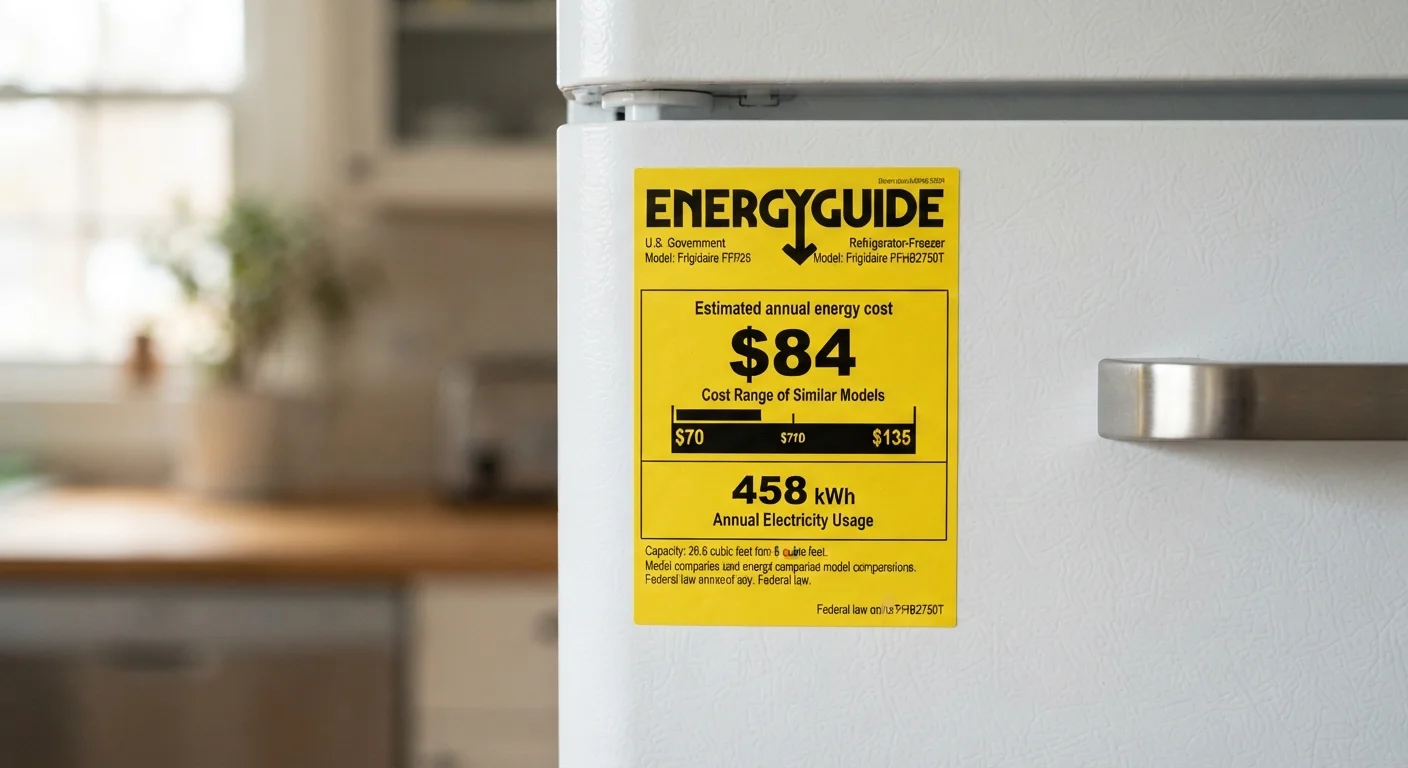
- The EnergyGuide label shows estimated annual kWh use and projected operating cost based on national average electricity rates.
- ENERGY STAR certification means an appliance meets efficiency thresholds set by the EPA - typically 10-50% more efficient than standard models.
- The label's cost estimate is a baseline, not a guarantee; your actual bill depends on local utility rates and how often you run the appliance.
- Higher upfront cost for an efficient model can be offset by lower running costs over the appliance's lifetime.
- Labels compare appliances within the same category - a washing machine label only compares it to other washing machines, not all appliances.
Appliance Energy Rating
An energy rating is a standardized label placed on household appliances - such as refrigerators, washing machines, and dishwashers - that communicates how efficiently the appliance uses electricity compared to similar models. In the United States, the primary label is the FTC-mandated EnergyGuide, a bright yellow tag showing estimated annual energy consumption in kilowatt-hours (kWh) and a projected yearly operating cost. The label also positions the appliance on a scale showing how it compares to similar models on the market.
Kilowatt-hours (kWh) is the unit electric utilities use to bill consumption; one kWh equals 1,000 watts of power used continuously for one hour. The cost estimate on EnergyGuide labels is calculated using a national average electricity rate, so your actual cost will vary based on your local utility rate and usage patterns.
What the EnergyGuide Label Is Actually Showing You
Walk into any appliance section of a store and you'll see bright yellow tags hanging from fridges, washers, and dishwashers. That's the federally required EnergyGuide label, mandated by the Federal Trade Commission (FTC) for most major household appliances. It isn't a marketing badge - it's a standardized disclosure tool, and once you know how to read it, it becomes genuinely useful.
The label has three core elements:
- Estimated annual energy use - measured in kilowatt-hours (kWh), this is how much electricity the appliance is projected to consume in a year under standardized test conditions.
- Estimated annual operating cost - a dollar figure calculated by multiplying the kWh estimate by a national average electricity rate. This number is a reference point, not a bill prediction.
- Comparison scale - a horizontal bar showing how this model's energy use stacks up against similar appliances in its category. Models toward the left use less energy; those toward the right use more.
For a plain-language breakdown of related appliance terminology, see our Family Household Appliance Glossary.
~$500
Typical lifetime savings from an ENERGY STAR refrigerator
According to the U.S. EPA's ENERGY STAR program, certified refrigerators can save households several hundred dollars in energy costs over the product's lifetime compared to non-certified models.
10-50%
Efficiency improvement over minimum federal standards
The EPA states that ENERGY STAR certified appliances generally use 10 to 50 percent less energy than required by federal minimum efficiency standards, depending on the appliance category.
~$150
Average annual energy cost of a standard refrigerator
The U.S. Department of Energy estimates that refrigerators are among the largest continuous energy consumers in most homes, with annual costs varying by size, age, and model efficiency.
ENERGY STAR: What the Blue Logo Adds
You'll often see a separate blue logo marked "ENERGY STAR" on appliances that have earned a certification from the U.S. Environmental Protection Agency (EPA). This is distinct from the EnergyGuide label. While EnergyGuide shows you the data, ENERGY STAR tells you the appliance has cleared a specific efficiency threshold set by the EPA.
Efficiency thresholds vary by appliance category. A certified clothes washer, for instance, must meet different criteria than a certified refrigerator. The program is voluntary - manufacturers choose whether to submit products for testing - but it's widely adopted across major appliance categories.
Check the kWh Number, Not Just the Logo
The ENERGY STAR logo tells you an appliance clears an efficiency threshold - but it doesn't tell you where it sits within the certified range. Two ENERGY STAR washers can have meaningfully different annual energy consumption figures. Always cross-reference the kWh number on the EnergyGuide label to make a precise comparison between models you're seriously considering.
One important nuance: ENERGY STAR certification is not a guarantee of the lowest energy use in any given category. It marks a meaningful improvement over minimum federal standards, but two ENERGY STAR appliances in the same category can still vary considerably in how much electricity they consume. Always check the kWh figure on the EnergyGuide label rather than relying on the logo alone.
How Running Costs Really Add Up for Families
The cost estimate on the EnergyGuide label is calculated using a standardized national average electricity rate, which may differ substantially from what your utility actually charges. Some households in states with high electricity rates - or those in climates where a refrigerator works harder year-round - will see noticeably higher real-world costs than the label suggests.
That said, the label is still a reliable tool for comparison. If Model A shows 400 kWh per year and Model B shows 600 kWh per year, that 200 kWh difference is meaningful regardless of your local rate. Multiply it by your actual cost per kWh (found on your electricity bill) and you get a realistic picture of annual savings. Over a 10-year appliance lifespan, even modest per-year differences can add up considerably.
This kind of long-term thinking also connects to how you size an appliance. An oversized fridge running near-empty draws more power than a right-sized one running full. See our guide to matching appliance capacity to your household's real needs for context on that decision.
For a broader look at assumptions that quietly inflate household running costs, our article on appliance myths that keep costing families money covers several that directly relate to energy use.
Applying This Knowledge When It Matters
Energy ratings shouldn't be the only factor in an appliance decision - capacity, reliability, and fit for your household's actual routines all matter. But the label gives you concrete data that's easy to overlook when you're focused on price tags and features.
A few practical habits when evaluating appliances:
- Find the kWh number on the EnergyGuide label and multiply it by your local electricity rate (in dollars per kWh) to estimate your real annual cost.
- Use the comparison scale to understand whether this model is in the efficient or inefficient end of its category.
- Check whether it carries an ENERGY STAR logo, and if so, treat that as a baseline quality signal - then go back to the kWh figure for specifics.
- For appliances with very different upfront prices, calculate how many years the energy savings would take to offset the price gap.
If you're evaluating a washing machine specifically, our guide to reading a washing machine spec sheet walks through how energy figures sit alongside other technical numbers. For dryers, the technology itself has a significant impact on efficiency - see our explainer on tumble dryers vs. heat pump dryers for how the underlying design shapes running costs.
Energy labels are a tool, not a verdict. Used alongside capacity guidance and an honest look at your household's usage patterns, they give you a clearer picture of what an appliance will actually cost to live with - not just to bring home.
This article is for general informational purposes only. Energy cost estimates and efficiency thresholds can change; always verify current figures directly with the relevant labeling authority or your utility provider.