

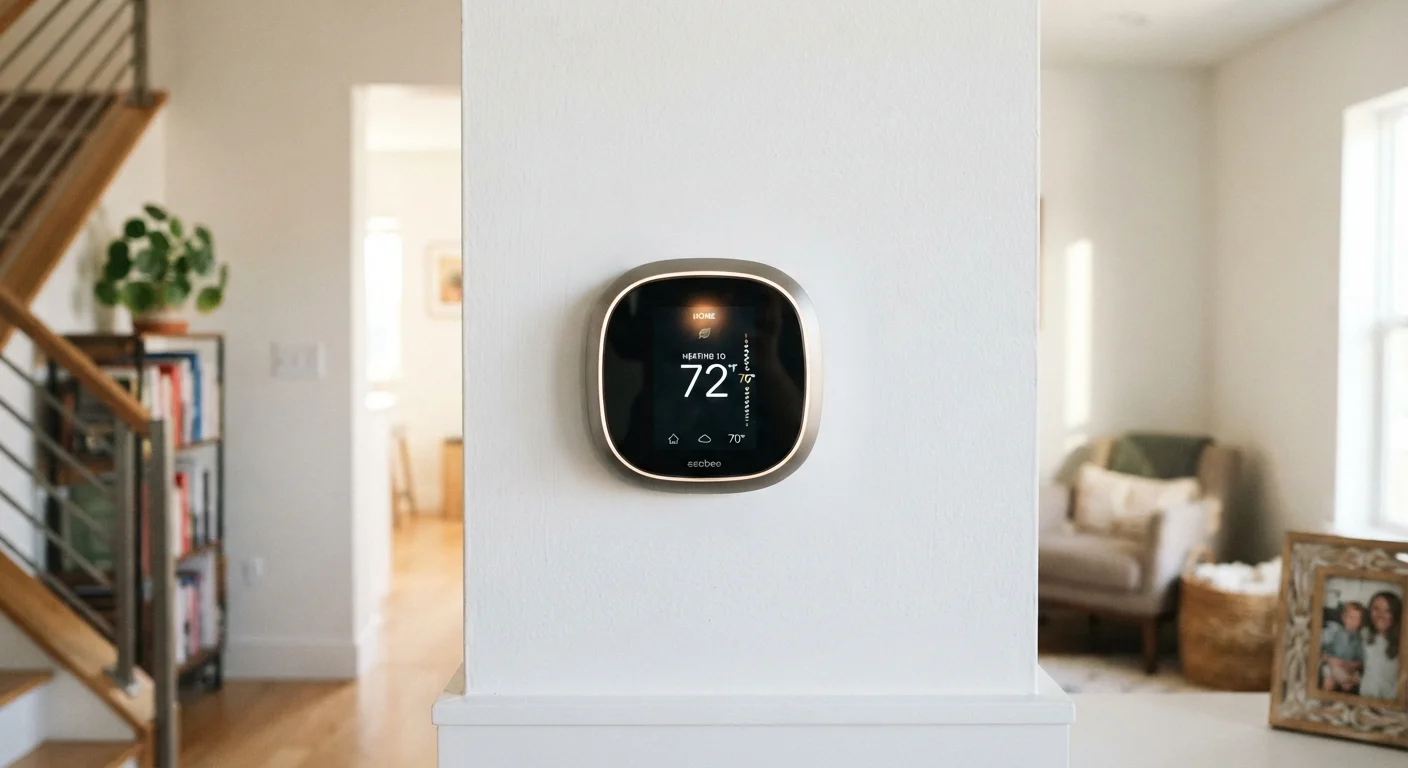
Key Takeaways
- Smart thermostats can reduce heating and cooling costs, but savings vary widely by household.
- Learning algorithms need consistent routines to work effectively - irregular schedules limit their value.
- Compatibility with your existing HVAC system is not guaranteed and must be checked before purchase.
- Remote control and scheduling features deliver convenience regardless of how much energy you save.
- Privacy considerations matter - these devices collect data about your daily patterns and home occupancy.
Automates temperature setbacks without manual effort
Once configured, the thermostat handles energy-saving adjustments around your schedule - no relying on memory to turn the heat down before bed or when leaving for work.
Remote control from anywhere with Wi-Fi
Returning home early or running late? Adjusting the temperature from your phone prevents both discomfort on arrival and wasted energy during an unexpectedly long absence.
Usage reports surface hidden inefficiencies
Most models log runtime by day, helping households identify patterns - like a system that runs excessively on mild days - that point to insulation gaps or HVAC maintenance needs.
Learning mode reduces setup friction over time
Households that find traditional programmable thermostats tedious to configure benefit from algorithms that build a schedule automatically based on observed behavior.
Potential for measurable energy cost reduction
Automated setbacks, especially during working hours and overnight, can reduce heating and cooling runtime in ways that show up in monthly utility bills over a full season.
Compatibility gaps with many HVAC systems
Homes with older wiring lacking a common (C) wire, boiler systems, or complex multi-zone setups may require additional hardware or professional installation - or may not be supported at all.
Learning mode underperforms with irregular schedules
Shift workers, freelancers, or families with unpredictable routines may find the learned schedule inaccurate, leading to the system heating or cooling an empty home.
Occupancy data is collected and stored remotely
Smart thermostats build detailed profiles of when your home is occupied. This data is held on manufacturer servers and may be shared with third parties depending on the privacy policy.
Upfront cost takes time to recover
The device and any professional installation represent an upfront investment that requires sustained energy savings over months or years to offset - savings that are not guaranteed.
Poor placement undermines accuracy and efficiency
A thermostat installed near heat sources, drafts, or direct sunlight will misread ambient temperature, causing the system to over- or under-cycle and potentially increasing energy use.
Our Verdict
Smart thermostats offer real, measurable benefits for households with predictable schedules, compatible HVAC systems, and a willingness to engage with setup and tuning. Energy savings are plausible but not guaranteed, and the convenience features alone may justify the upgrade for many families. Those with older or complex heating systems, or highly variable daily routines, may see more modest returns.
Best for families in homes with standard central HVAC systems who keep fairly regular daily schedules and want hands-free temperature management without constant manual adjustments.
What Smart Thermostats Actually Do
A smart thermostat replaces your standard programmable thermostat and connects to your home Wi-Fi, allowing you to control heating and cooling remotely via a smartphone app. Beyond that basic function, most models add scheduling tools, usage reports, and - in many cases - learning algorithms that observe your behavior and adjust temperatures automatically over time.
The core promise is straightforward: heat and cool your home only when needed, reduce wasted energy during empty hours, and do it all with less manual effort than traditional programmable thermostats require. Whether that promise holds up depends on several variables your household controls - and some it doesn't.
Before exploring the trade-offs, it's worth understanding that smart thermostats are one piece of a broader connected home picture. If you're building out a smart home setup, see our guide to common smart home misconceptions for a grounded starting point.
The Real Advantages
Automates temperature setbacks without manual effort
Once configured, the thermostat handles energy-saving adjustments around your schedule - no relying on memory to turn the heat down before bed or when leaving for work.
Remote control from anywhere with Wi-Fi
Returning home early or running late? Adjusting the temperature from your phone prevents both discomfort on arrival and wasted energy during an unexpectedly long absence.
Usage reports surface hidden inefficiencies
Most models log runtime by day, helping households identify patterns - like a system that runs excessively on mild days - that point to insulation gaps or HVAC maintenance needs.
Learning mode reduces setup friction over time
Households that find traditional programmable thermostats tedious to configure benefit from algorithms that build a schedule automatically based on observed behavior.
Potential for measurable energy cost reduction
Automated setbacks, especially during working hours and overnight, can reduce heating and cooling runtime in ways that show up in monthly utility bills over a full season.
The energy savings conversation deserves particular attention. Independent studies - including research cited by the U.S. Department of Energy - suggest that adjusting your thermostat by 7-10°F for 8 hours a day can reduce annual heating and cooling costs by around 10%. A smart thermostat automates that adjustment, removing the reliance on human memory. For households that previously left the heat running at full strength all day, the reduction can be meaningful.
The usage reports many models provide are also genuinely useful. Seeing a clear breakdown of when your system runs longest - and correlating it with weather or occupancy data - can help families identify inefficiencies beyond the thermostat itself. Understanding energy consumption is a foundational step; for broader context on efficiency labeling, our explainer on home appliance energy ratings covers related ground.
Where They Fall Short
Compatibility gaps with many HVAC systems
Homes with older wiring lacking a common (C) wire, boiler systems, or complex multi-zone setups may require additional hardware or professional installation - or may not be supported at all.
Learning mode underperforms with irregular schedules
Shift workers, freelancers, or families with unpredictable routines may find the learned schedule inaccurate, leading to the system heating or cooling an empty home.
Occupancy data is collected and stored remotely
Smart thermostats build detailed profiles of when your home is occupied. This data is held on manufacturer servers and may be shared with third parties depending on the privacy policy.
Upfront cost takes time to recover
The device and any professional installation represent an upfront investment that requires sustained energy savings over months or years to offset - savings that are not guaranteed.
Poor placement undermines accuracy and efficiency
A thermostat installed near heat sources, drafts, or direct sunlight will misread ambient temperature, causing the system to over- or under-cycle and potentially increasing energy use.
Compatibility is the friction point most buyers underestimate. Homes with older wiring, multi-stage systems, heat pumps, or boiler-based radiant heating may require a professional assessment before installation - and some systems simply aren't supported. Checking compatibility before purchasing avoids a frustrating return process.
It's also worth considering the data these devices collect. A smart thermostat tracks when you're home, when you wake up, and when the house goes quiet - detailed occupancy patterns that are transmitted to the manufacturer's servers. Families who are cautious about data privacy should review the manufacturer's data policy carefully. Our guide to smart home data privacy walks through what connected devices collect and how to limit exposure.
Smart Thermostats and Rental Homes
Renters should confirm with their landlord before replacing an existing thermostat - the HVAC system is typically the property owner's equipment. Some landlords welcome the upgrade; others require the original unit to be reinstalled on move-out. Check your lease and get written agreement before proceeding.
Getting the Most From a Smart Thermostat
The learning feature in many models requires two to four weeks of normal behavior before it produces reliable schedules. During that period, use the device as you normally would - adjusting temperatures when you're too warm or cold - so the algorithm has accurate data to work from. Families with highly irregular schedules may find manual scheduling more reliable than the learning mode.
Placement matters more than many buyers realize. A thermostat located near a drafty window, in direct sunlight, or close to a kitchen will read temperatures inaccurately and cycle your system unnecessarily. Standard guidance calls for installation on an interior wall, away from vents, windows, and heat-generating appliances.
For families focused on household budget efficiency, a smart thermostat is one tool among several. Pair it with air sealing and insulation improvements for a more complete approach. You can explore broader cost-management strategies through our budget-smart buying hub.
~10%
Potential annual heating/cooling savings
The U.S. Department of Energy estimates roughly 10% savings from adjusting the thermostat 7-10°F for 8 hours daily - the behavior smart thermostats automate.
2-4 weeks
Typical learning algorithm calibration period
Most learning thermostats require several weeks of observed household behavior before generating a reliable automatic schedule.