

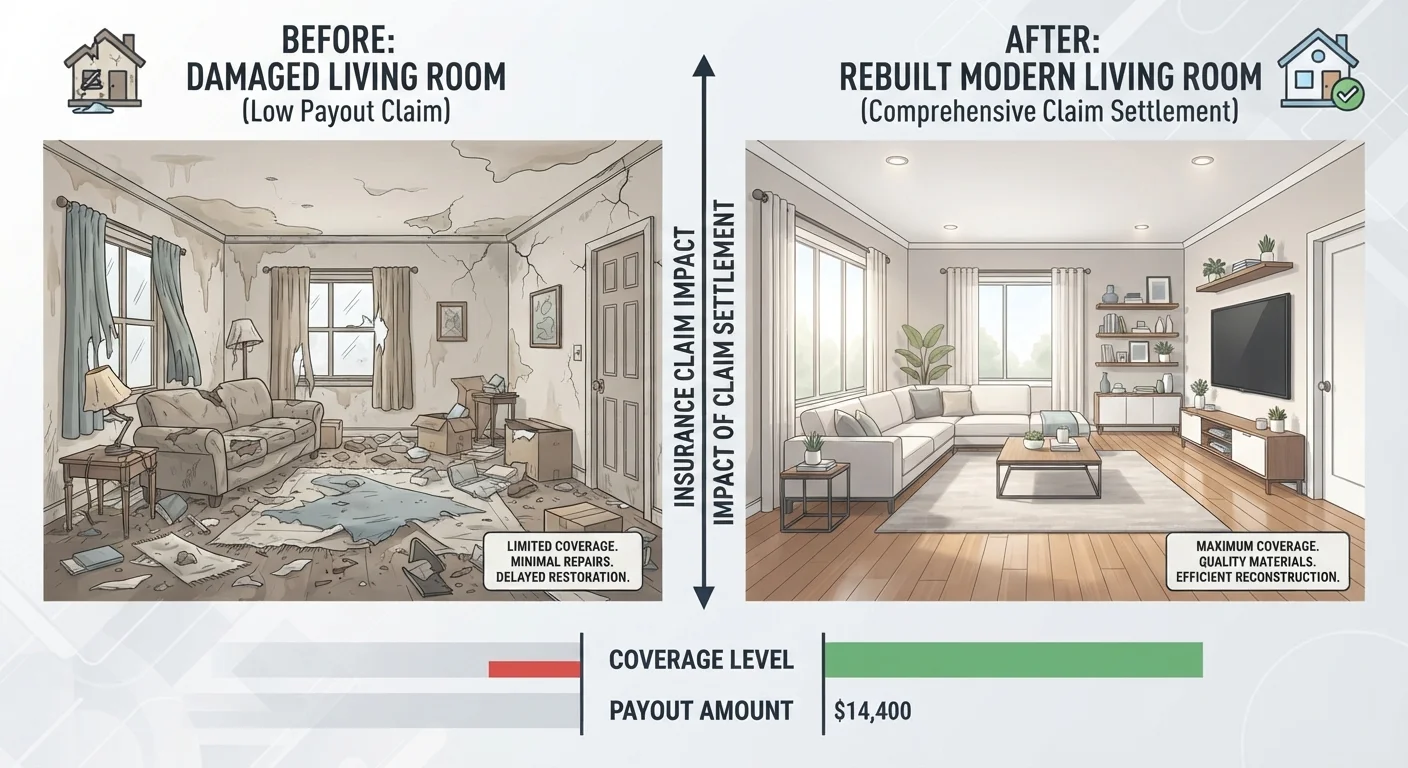
Key Takeaways
- ACV pays what your property was worth at the time of loss, after depreciation is subtracted.
- Replacement cost pays what it actually costs to replace the property with a comparable new item today.
- The gap between ACV and RCV can amount to thousands of dollars out of pocket after a claim.
- RCV policies typically carry higher premiums than ACV policies for the same coverage.
- Your policy documents state which method applies - always verify before assuming.
Option A
Actual Cash Value (ACV)
The depreciation-adjusted payout method.
Best for: Policyholders who want lower premiums and can absorb some out-of-pocket cost after a claim.
Option B
Replacement Cost Value (RCV)
The full replacement payout method.
Best for: Families who need full financial protection and want to replace lost or damaged property without a coverage gap.
If you want the lowest possible premium and own older belongings
Actual Cash Value (ACV)
ACV coverage costs less monthly and may be sufficient if you can cover the depreciation gap yourself or your property has low remaining value.
If you could not afford to replace your home contents or roof without insurance proceeds
Replacement Cost Value (RCV)
RCV eliminates the depreciation deduction, ensuring you receive enough to actually buy replacement items at today's prices.
If you own newer appliances, electronics, or recently renovated your home
Replacement Cost Value (RCV)
Newer items depreciate quickly; RCV protects against receiving only a fraction of your property's purchase price after a short ownership period.
If you are insuring a rental property or older vehicle with limited market value
Actual Cash Value (ACV)
When the market value of a property is already low, the difference in payout may not justify the higher RCV premium.
The Core Difference: Depreciation Is Everything
When you file a property insurance claim, the amount your insurer pays depends on a single, often overlooked factor: how your policy values what you lost. Two policies covering the same home and the same peril can produce dramatically different claim checks - and the reason comes down to depreciation.
Actual Cash Value (ACV) is calculated by taking the replacement cost of the item and subtracting depreciation - the wear, age, and obsolescence that reduce an item's market value over time. If your five-year-old roof costs $15,000 to replace but has depreciated by $6,000, an ACV policy pays $9,000. You cover the rest.
Replacement Cost Value (RCV) pays what it actually costs to replace the damaged or destroyed property with a comparable new item at current prices - no depreciation deducted. For that same roof, an RCV policy would pay the full $15,000 (minus your deductible).
This distinction is explored further in our guide on commonly misread insurance terms, where ACV is among the most frequently misunderstood concepts families encounter.
| Criterion | Actual Cash Value (ACV) | Replacement Cost Value (RCV) |
|---|---|---|
| Payout basis | Depreciated value at time of loss | Current cost to replace with comparable item |
| Depreciation deducted | Yes | No |
| Typical premium cost | Lower | Higher |
| Out-of-pocket risk after claim | Higher - covers only market value | Lower - covers replacement cost |
| Best suited for | Older property; tighter budgets | Newer property; full protection priority |
| Common in | Auto insurance, older home policies | Homeowners, renters contents coverage |
How Depreciation Is Calculated - and Why It Matters
Insurers determine depreciation using several factors: the item's age, expected useful lifespan, condition at the time of loss, and sometimes local market data. Depreciation is not standardized across insurers, which means two companies may value the same loss differently.
Consider a family whose basement floods and destroys a washer purchased four years ago for $900. If the appliance has a 10-year useful life, the insurer may calculate 40% depreciation - paying out $540 under an ACV policy. Replacing it today might cost $1,050. The family must cover the $510 difference themselves.
~20-30%
Typical annual depreciation rate for appliances
Insurance industry guidance commonly uses useful-life schedules that depreciate major appliances at roughly 10-15 years, resulting in significant value reductions within a few years of purchase.
Thousands
Potential out-of-pocket gap on a single roof claim
On an older roof, the difference between ACV and RCV payouts can easily reach several thousand dollars depending on age, materials, and local labor costs.
Under an RCV policy, the insurer would pay the current replacement cost of a comparable washer - closer to the full $1,050 minus the deductible. That gap matters most when multiple items are damaged simultaneously, such as after a fire or severe storm.
Understanding how payout methods interact with your overall coverage structure is equally important. See our article on policy limits vs. coverage amounts to see how these elements combine at claim time.
Premium Costs and the Trade-Off Families Face
RCV coverage generally costs more in premiums because the insurer is accepting greater financial exposure. The difference varies widely by property type, location, and insurer, but it is a real and consistent trade-off. For a tight household budget, paying less now can seem reasonable - until a major claim reveals the coverage gap.
Families evaluating this decision should think honestly about two questions: Could we absorb a significant out-of-pocket expense after a loss? And: How much would it cost to replace our most valuable belongings at today's prices? The answers often reveal that ACV coverage leaves a larger financial exposure than policyholders realized when they signed up. This connects to a broader principle about price versus value - lower premiums do not always mean better financial protection.
Some insurers offer a hybrid approach: ACV policies that allow policyholders to claim full replacement cost after repairs are completed and receipts submitted. This is sometimes called a "recoverable depreciation" provision. Read your policy declarations page carefully, and ask your licensed insurance agent to explain which method applies before you assume.
Check Your Declarations Page First
Your policy's declarations page - typically the first one or two pages of your policy document - will state whether your coverage is based on actual cash value or replacement cost. If the language is unclear, ask your insurer or agent to explain it in writing before a claim occurs. Do not assume one method applies because it is more common or because a neighbor has it.
This article provides general insurance education and is not personalized insurance, financial, or legal advice. Coverage terms, exclusions, and eligibility vary by insurer and state. Always read your actual policy documents and consult a licensed insurance agent or adviser for guidance specific to your situation.