
Budgeting Approaches Compared: Percentage Rules, Cash Envelopes, and Pay-Yourself-First

Key Takeaways
- Percentage-based rules (like 50/30/20) offer a low-effort starting point but may not fit irregular incomes.
- Cash envelopes enforce strict spending limits and work well for households prone to overspending in specific categories.
- Pay-yourself-first prioritizes savings automatically, leaving the remainder for discretionary spending.
- No single method suits every family - income stability, spending habits, and personal discipline all factor in.
- Combining elements from multiple frameworks is common and often more practical than rigid adherence to one system.
Our Verdict
Each of these three frameworks addresses a different financial challenge. Percentage rules are easiest to start with; cash envelopes provide the tightest spending control; and pay-yourself-first is strongest for building savings over time. Most families benefit from understanding all three before committing to one - or mixing approaches.
| Best for | Recommended |
|---|---|
| Families new to budgeting who want a simple starting framework | Percentage Rules (e.g., 50/30/20) |
| Households that consistently overspend in specific categories like groceries or dining | Cash Envelopes |
| Earners with stable incomes who want savings to happen automatically | Pay-Yourself-First |
| Families with variable income or complex spending patterns | Hybrid approach combining elements of all three |
Why the Budgeting Method Matters
A budget that looks good on paper but doesn't fit how a family actually earns or spends rarely holds up beyond the first month. The framework you choose shapes not just how you organize money - it shapes how much mental energy the system demands, whether it accommodates irregular income, and whether it naturally reinforces the financial behaviors you're trying to build.
This comparison focuses on three frameworks commonly recommended for households: percentage-based rules, cash envelope budgeting, and pay-yourself-first. For a broader introduction to budgeting concepts, see Family Budgeting From the Ground Up.
| Percentage Rules | Cash Envelopes | Pay-Yourself-First | |
|---|---|---|---|
| Setup effort | Low - simple math on income | High - physical or digital cash sorting | Low - one automatic transfer |
| Ongoing effort | Low - periodic check-ins | High - per-category tracking required | Low - runs largely on autopilot |
| Spending control | Broad guardrails only | Strong - hard category limits | Minimal guidance post-savings |
| Savings focus | Built into the percentages | Not a primary feature | Core purpose of the method |
| Works with variable income | Requires recalculation each cycle | Adaptable but more complex | Can be difficult to sustain |
| Best entry point | New budgeters wanting structure | Households overspending in specific areas | Those with stable income and saving gaps |
Percentage-Based Rules: Structure Without Micromanagement
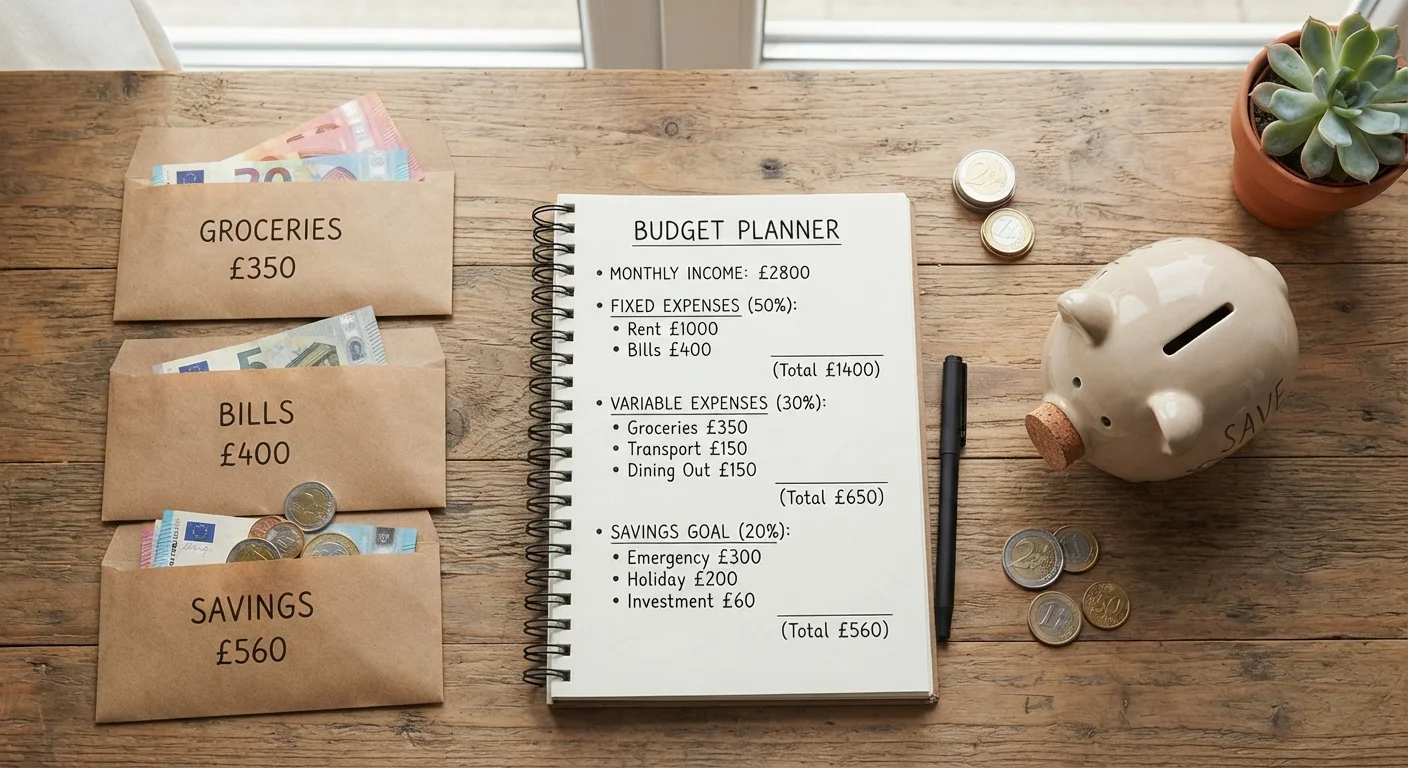
Percentage rules divide take-home income into broad spending buckets. The widely discussed 50/30/20 framework, for example, allocates roughly 50% to needs, 30% to wants, and 20% to savings and debt repayment. Other variations shift those ratios depending on income level or financial goals.
Strengths: These rules are fast to set up, easy to explain, and require no tracking of individual transactions. They work reasonably well for households with predictable monthly income.
Limitations: Fixed percentages can feel disconnected from real life. A family in a high cost-of-living area may find that housing alone pushes the "needs" category well above 50%. The framework also offers little guidance when overspending occurs - it tells you the target but not how to hit it. For a deeper comparison of percentage approaches, Zero-Based Budgeting vs. the 50/30/20 Rule covers the trade-offs in detail.
Adjust Percentages to Reflect Your Reality
Percentage rules are guidelines, not rigid formulas. If your housing costs exceed 30% of take-home pay - a common situation in high cost-of-living areas - simply redistribute the ratios to reflect your actual fixed obligations. The goal is a proportional framework that's honest about your income and expenses, not strict adherence to a textbook split.
Cash Envelopes: Tangible Limits on Spending
The envelope method assigns physical (or digital) cash to specific spending categories at the start of each pay period. Once an envelope is empty, spending in that category stops until the next cycle. The friction of handling physical cash - or monitoring a digital envelope balance - is intentional: it creates a direct, real-time connection between spending decisions and available funds.
Strengths: Research on spending psychology consistently suggests that paying with physical cash increases awareness of spending compared to card transactions. The method is particularly effective for categories where discretionary overspending tends to creep in, such as groceries, dining, or entertainment.
Limitations: Cash envelopes are labor-intensive. Withdrawing cash, sorting it, and reconciling envelopes every pay period demands consistent effort. The method also doesn't translate easily to automatic bill payments or online purchases. Zero-Based Budgeting vs. the Envelope Method explores how envelope budgeting compares to a zero-based approach for everyday families.
Pay-Yourself-First: Savings as a Non-Negotiable
Pay-yourself-first reverses the typical saving logic. Rather than spending throughout the month and saving whatever remains, this approach moves a set amount into savings or a retirement account immediately when income arrives - before any other spending occurs. What's left is available for all other expenses.
Strengths: Automating savings contributions removes the decision-making (and willpower) required to save consistently. It's particularly well-suited to households with stable incomes who struggle to save because spending expands to fill available funds.
Limitations: This framework provides no guidance on how to manage what remains after savings are set aside. Without additional structure, households can still overspend on discretionary items during the month. It's also less forgiving when income is variable - a slow month can make fixed savings transfers difficult to sustain.
For strategies on building savings alongside debt reduction, the Saving & Debt hub offers foundational guidance for households managing both priorities simultaneously.
~57%
U.S. adults living paycheck to paycheck
Survey data from LendingClub's 2023 Paycheck to Paycheck report found the majority of U.S. consumers report little to no funds remaining after monthly expenses.
Under $1,000
Emergency savings for many households
Federal Reserve surveys have repeatedly found a significant share of U.S. adults could not cover a $400 unexpected expense from savings alone, underscoring the importance of savings-first strategies.
Choosing the Right Framework for Your Household
Before committing to any single approach, it's worth mapping your household's specific stressors. Are you struggling to save at all? Pay-yourself-first addresses that directly. Do you routinely overspend in one or two categories? Envelopes can contain exactly those areas. Are you new to budgeting and overwhelmed by detail? A percentage rule gives you a benchmark without demanding granular tracking.
Many families find success using a hybrid: a percentage rule to set overall targets, envelopes to govern a few high-risk spending categories, and an automatic savings transfer to enforce the pay-yourself-first principle. For help choosing how you'll track whichever method you use, Paper Budget vs. Spreadsheet vs. App walks through the practical trade-offs. The Budget-Smart Buying hub also covers how budgeting frameworks connect to everyday purchase decisions.
This article is for general informational and educational purposes only. It does not constitute personalized financial advice. Consult a qualified financial professional regarding decisions specific to your household's circumstances.