

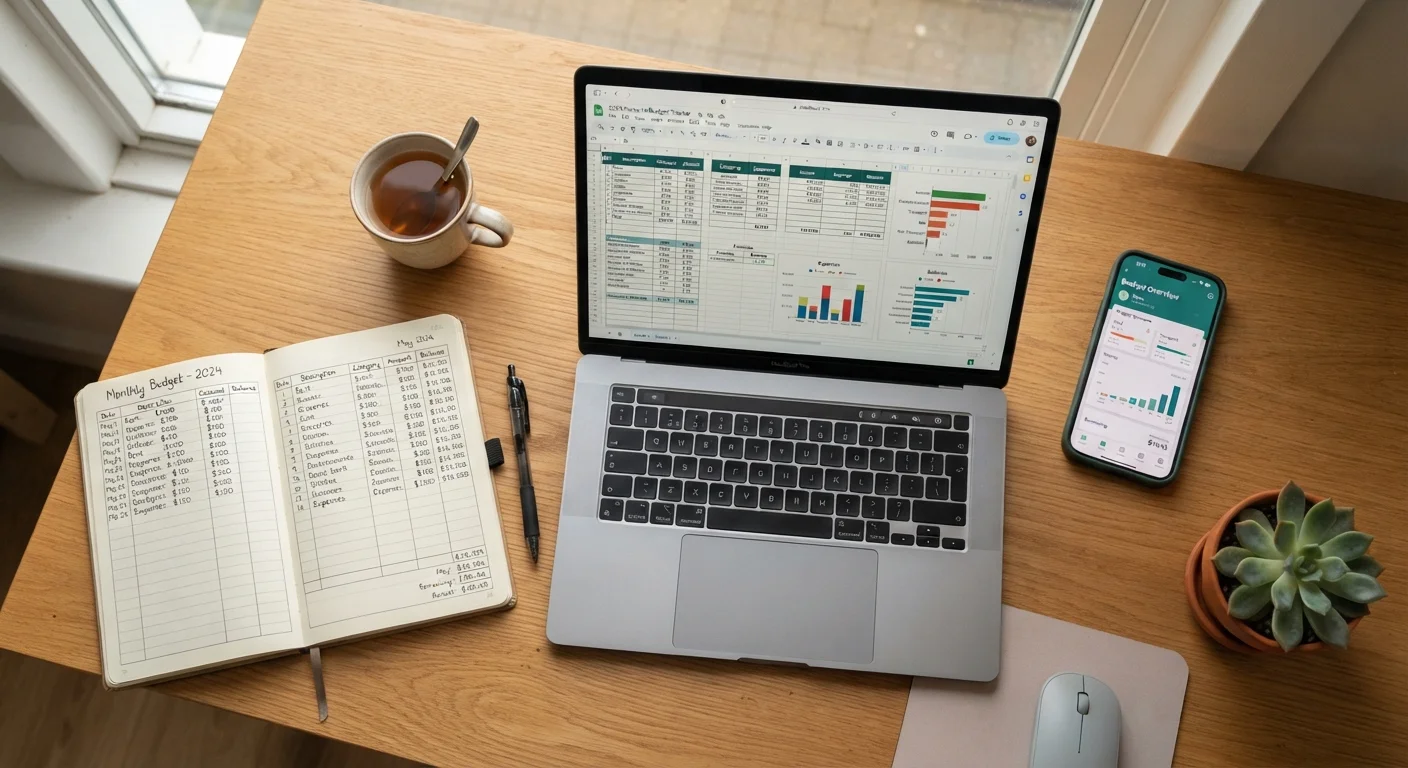
Key Takeaways
- Paper budgeting builds strong spending awareness but requires consistent manual effort.
- Spreadsheets offer flexibility and control with moderate setup time and no cost.
- Budgeting apps automate tracking but require sharing financial account access.
- The method you'll actually stick with is more valuable than the technically superior one.
- Families can combine methods - for example, an app for tracking plus paper for goal-setting.
Our Verdict
No single tracking method works for every household. Paper budgeting rewards those who learn through writing; spreadsheets suit detail-oriented planners who want full customization; apps work best for busy families who prioritize automation over manual engagement. The most effective budget is the one your household will maintain consistently over time.
| Best for | Recommended |
|---|---|
| Families new to budgeting who want to build spending awareness | Paper budgeting |
| Detail-oriented households who want customizable, cost-free tracking | Spreadsheet |
| Busy families who need low-effort, automated expense categorization | Budgeting app |
| Households that have tried single methods and struggled with consistency | Hybrid approach |
Why Your Tracking Method Matters
The mechanics of how you track spending shape whether a budget survives past the first month. A system that fits your household's habits gets used - one that doesn't, gets abandoned. Before comparing tools, it helps to understand what makes budgeting stick.
If you're starting from scratch, our introduction to family budgeting covers the foundational concepts before you commit to any particular method. Once you have a framework in mind, choosing the right tracking tool becomes much clearer.
The three primary methods - paper, spreadsheet, and app - differ not just in format, but in the level of effort they require, the data privacy trade-offs involved, and how well they adapt as your family's finances evolve.
| Paper | Spreadsheet | App | |
|---|---|---|---|
| Setup effort | Minimal - pen and paper | Moderate - template design | Low - account connection |
| Ongoing effort | High - all manual entry | Medium - periodic entry | Low - mostly automated |
| Cost | Near zero | Free tools available | Often subscription-based |
| Privacy risk | None | None | Requires account access |
| Customization | Fully flexible | Highly customizable | Limited to app categories |
| Real-time accuracy | Only if updated daily | Only if updated regularly | Near real-time |
| Best for | Beginners, cash users | Detail-oriented planners | Busy, multi-account families |
Paper Budgeting: Slow Down to Spend Smarter
Writing expenses by hand forces deliberate attention. Research in cognitive psychology consistently finds that handwriting engages memory and comprehension more actively than typing, which may help households internalize spending patterns more effectively.
Paper works particularly well for families using cash-based systems. If you're exploring that angle, zero-based budgeting versus the envelope method explains how manual tracking pairs naturally with physical cash allocation.
Where paper struggles: It doesn't scale well. Tracking dozens of transactions across multiple accounts by hand is time-consuming, and there's no automatic calculation. A missed entry can throw off an entire month's picture. Paper also offers no backup - a lost notebook means lost records.
Start With One Week of Paper Tracking
Before committing to any system, try recording every transaction by hand for seven days. This exercise builds an honest baseline picture of where money actually goes - not where you think it goes. Many households are surprised by the gap between their assumptions and their actual spending patterns. That clarity makes choosing a longer-term method much easier.
Spreadsheets: Control Without Cost
A well-built spreadsheet sits between paper and app in terms of effort. Free tools like Google Sheets or Excel allow families to design exactly the categories, formulas, and visual summaries they need - with no subscription required and no third-party access to financial account data.
Spreadsheets reward households willing to invest initial setup time. A template built around your actual spending categories - groceries, utilities, childcare, insurance - is far more useful than a generic one. Many families find that the act of building the spreadsheet itself clarifies their financial priorities.
The case for keeping your budget simple is worth reading before over-engineering a spreadsheet. A 10-tab model with complex conditional formatting often collapses faster than a single straightforward sheet.
Key limitation: Spreadsheets still require manual data entry unless you export bank transaction files and paste them in. They're only as current as the last time someone updated them.
~40%
US adults without a monthly budget
According to a National Foundation for Credit Counseling survey, a substantial share of American adults do not track monthly household spending in any format.
1 in 3
Budgeters who quit within 3 months
Financial habit research consistently finds that tool complexity is one of the most cited reasons households abandon budgeting systems early.
Budgeting Apps: Automation With Trade-Offs
App-based budgeting tools connect directly to bank accounts and credit cards to automatically categorize transactions in near real-time. For households juggling multiple accounts and income streams, this automation removes a significant barrier to staying current.
The privacy trade-off is real and worth acknowledging. Connecting financial accounts to a third-party app means sharing read access to transaction data with a commercial service. Families should review an app's data security practices and privacy policy before connecting accounts - not after.
Apps also introduce subscription costs, which vary by provider. Over several years, these fees add up. If cost is a concern, budget-smart buying strategies can help offset recurring software expenses elsewhere in the household budget.
Another consideration: app categorization isn't always accurate. Automatic labels often require manual corrections, and if nobody reviews the dashboard regularly, errors compound quietly.
Mixing Methods: A Practical Hybrid
Many households find that a hybrid approach resolves the individual weaknesses of each method. A common pattern: use an app or spreadsheet for transaction-level tracking, and a paper notebook for monthly goal-setting and reflection.
This mirrors advice in our comparison of percentage rules, cash envelopes, and pay-yourself-first - the framework and the tracking tool are separate decisions. You can use a 50/30/20 percentage rule as your framework while tracking it in a spreadsheet, or apply zero-based budgeting logic inside an app.
Once your tracking system is established, the natural next step is directing the savings you uncover. Our saving and debt guidance provides practical frameworks for putting those findings to work.
The most important criterion for choosing a method isn't features - it's whether your household will open it every week. Consistency over six months will always outperform the most sophisticated system used sporadically.
This article is for general informational purposes only and does not constitute personalized financial advice. Consult a qualified financial professional for guidance specific to your circumstances.