

Key Takeaways
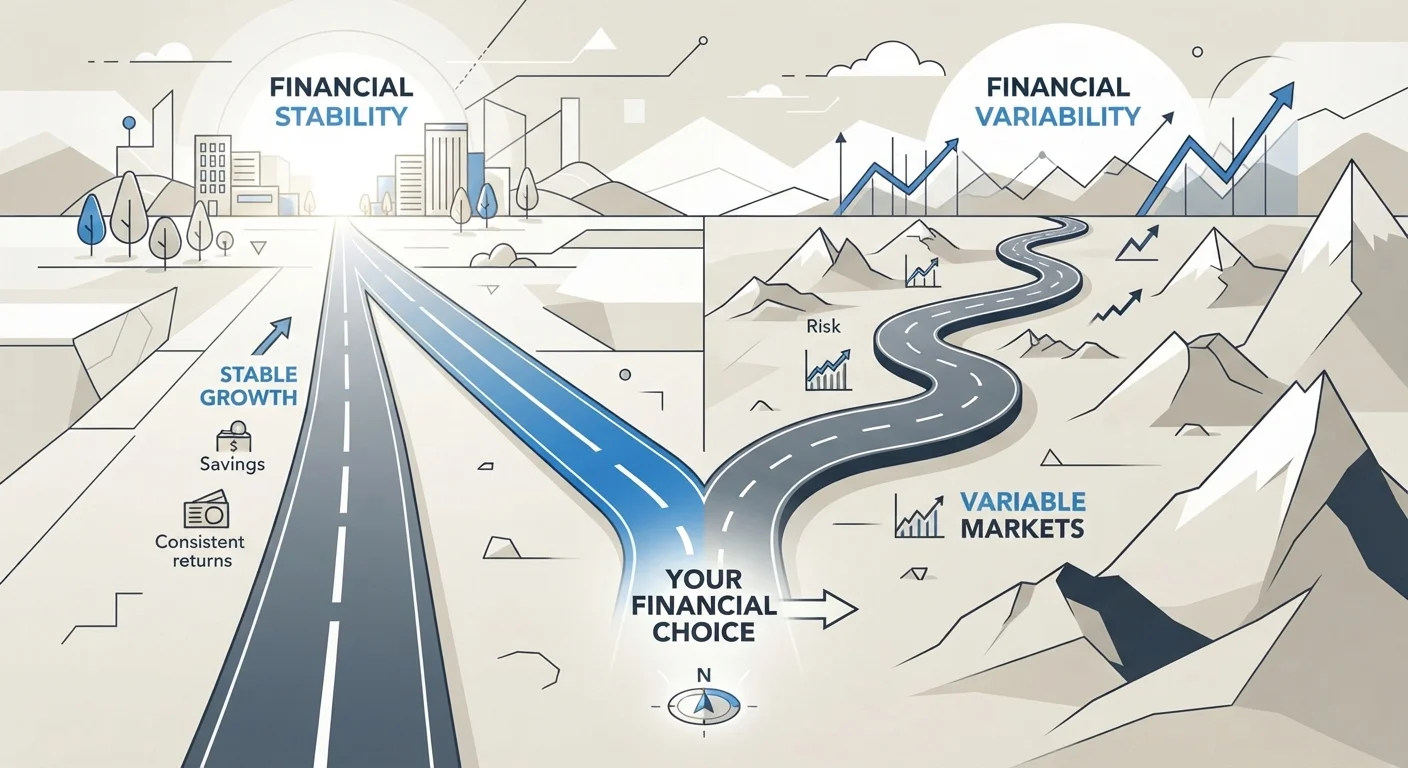
- Fixed-rate loans lock in your interest rate for the life of the loan, making monthly payments predictable.
- Variable-rate loans are tied to a benchmark rate index and can rise or fall over time, changing what you owe.
- Fixed rates typically start higher than variable rates, but eliminate the risk of payment increases.
- Variable rates carry payment uncertainty - a risk that grows with longer loan terms and larger balances.
- Neither structure is universally safer; the right choice depends on your loan term, balance, and financial stability.
- Always consult a licensed financial professional before committing to a loan structure for your specific situation.
Option A
Fixed-Rate Loans
The predictable, payment-stable borrowing structure.
Best for: Borrowers who prioritize budget certainty and want protection from rising interest rate environments.
Option B
Variable-Rate Loans
The flexible structure that moves with market conditions.
Best for: Borrowers comfortable with payment fluctuation who may benefit if market rates decline or who plan to repay quickly.
If you need consistent monthly payments for long-term budgeting
Fixed-Rate Loans
A locked rate means your payment never changes, making it easier to plan household expenses for the duration of the loan.
If you plan to repay the loan quickly or in a falling-rate environment
Variable-Rate Loans
Short repayment timelines reduce your exposure to rate increases, and you may pay less overall if the benchmark rate stays low or decreases.
If your household income is fixed or highly predictable
Fixed-Rate Loans
Payment stability protects households on tight or inflexible income from the financial shock of a sudden rate adjustment.
If you're borrowing a smaller amount with a short term
Variable-Rate Loans
Lower initial rates can reduce total interest paid when the window for rate increases is narrow due to a short loan duration.
How Each Rate Structure Works
When you take out a loan, the interest rate structure determines how much you pay over time - and how predictably. Understanding the mechanics of each type is foundational to evaluating which carries more risk for your situation.
Fixed-rate loans set your interest rate at the time of origination and hold it constant for the entire repayment term. Your monthly principal-and-interest payment stays the same whether rates in the broader economy rise or fall. This structure is common in mortgages, auto loans, and many personal loans.
Variable-rate loans - sometimes called adjustable-rate loans - tie your interest rate to a benchmark index, such as the SOFR or the prime rate. Lenders add a margin on top of that index to arrive at your actual rate. As the index moves, your rate adjusts at predetermined intervals (monthly, quarterly, or annually, depending on your loan terms). Variable rates appear frequently in student loans, home equity lines of credit (HELOCs), and some personal loans.
For a deeper look at how home equity products use variable structures specifically, see our article on how borrowing against your property works.
| Criterion | Fixed-Rate Loans | Variable-Rate Loans |
|---|---|---|
| Rate stability | Constant for loan life | Fluctuates with index |
| Starting rate | Typically higher | Typically lower |
| Payment predictability | High - payment never changes | Low - payment can rise or fall |
| Risk of payment shock | None | Present, especially long-term |
| Benefit if rates fall | None (without refinancing) | Yes - rate and payment decrease |
| Best loan term fit | Long-term loans | Short-term loans |
| Budgeting ease | Simple - fixed obligation | Complex - requires planning for changes |
Where the Risk Actually Lives
Risk in a loan structure is not one-dimensional. Both fixed and variable rates carry trade-offs that shift depending on market conditions and your personal financial position.
The risk in fixed-rate loans
Fixed rates typically start higher than variable rates because lenders price in the cost of absorbing future rate volatility. If market rates fall significantly after you lock in, you may end up paying more in interest than a variable-rate borrower would - unless you refinance, which carries its own costs. Fixed rates also offer no upside if economic conditions improve.
The risk in variable-rate loans
The primary risk is payment shock - a sudden or sustained rise in benchmark rates can meaningfully increase your monthly payment. On a large balance or long loan term, even a modest rate increase compounds into substantially higher total interest costs. This unpredictability makes budgeting harder and can strain households with little financial flexibility.
Just as fixed and variable costs behave differently in a household budget - a concept explored in our guide on fixed costs vs. variable expenses - fixed and variable loan rates shape your financial obligations in fundamentally different ways.
~2%
Typical initial rate gap between fixed and variable
Variable rates often start roughly 1-2 percentage points below fixed rates, though the spread varies with market conditions and lender policies.
30 years
Maximum window for variable-rate exposure on a mortgage
A 30-year adjustable-rate mortgage exposes a borrower to decades of potential rate movement, compared to a few years on a short-term personal loan.
5/1 ARM
Common hybrid structure: fixed 5 years, then annual adjustments
Many adjustable-rate mortgages in the US use a hybrid structure where the rate is fixed for an initial period before periodic adjustments begin.
Key Factors to Weigh Before Choosing
No rate structure is categorically safer. The more relevant question is: which structure is less risky for you, given your circumstances?
- Loan term: The longer your repayment period, the more time a variable rate has to move against you. On a 30-year mortgage, variable-rate exposure is far greater than on a 3-year personal loan.
- Balance size: A one-percentage-point rate increase on a $200,000 balance adds roughly $2,000 annually in interest. On a $10,000 balance, the same increase adds about $100. Scale amplifies variable-rate risk.
- Rate caps: Many variable-rate loans include lifetime and periodic caps - limits on how much the rate can increase per adjustment period and overall. These caps meaningfully reduce worst-case outcomes and should be reviewed carefully before signing.
- Current rate environment: Borrowing when rates are historically low reduces the upside advantage of a variable rate starting point, since there is more room for rates to rise than to fall further.
- Income stability: Households with variable or unpredictable income are generally more exposed to payment shock from rising variable rates.
Before signing any loan document, understanding which clauses govern your rate adjustments and caps is essential. Our guide on reading a loan agreement walks through the sections that carry the most financial weight.
For a broader foundation on how loan components interact, see our anatomy of a personal loan, which covers APR, amortization, and repayment in plain language.
This article is for general informational and educational purposes only and does not constitute personalized financial or legal advice. Consult a licensed financial professional before making borrowing decisions specific to your situation.