
Fixed Costs vs. Variable Expenses: Understanding the Difference in Your Household Budget

Key Takeaways
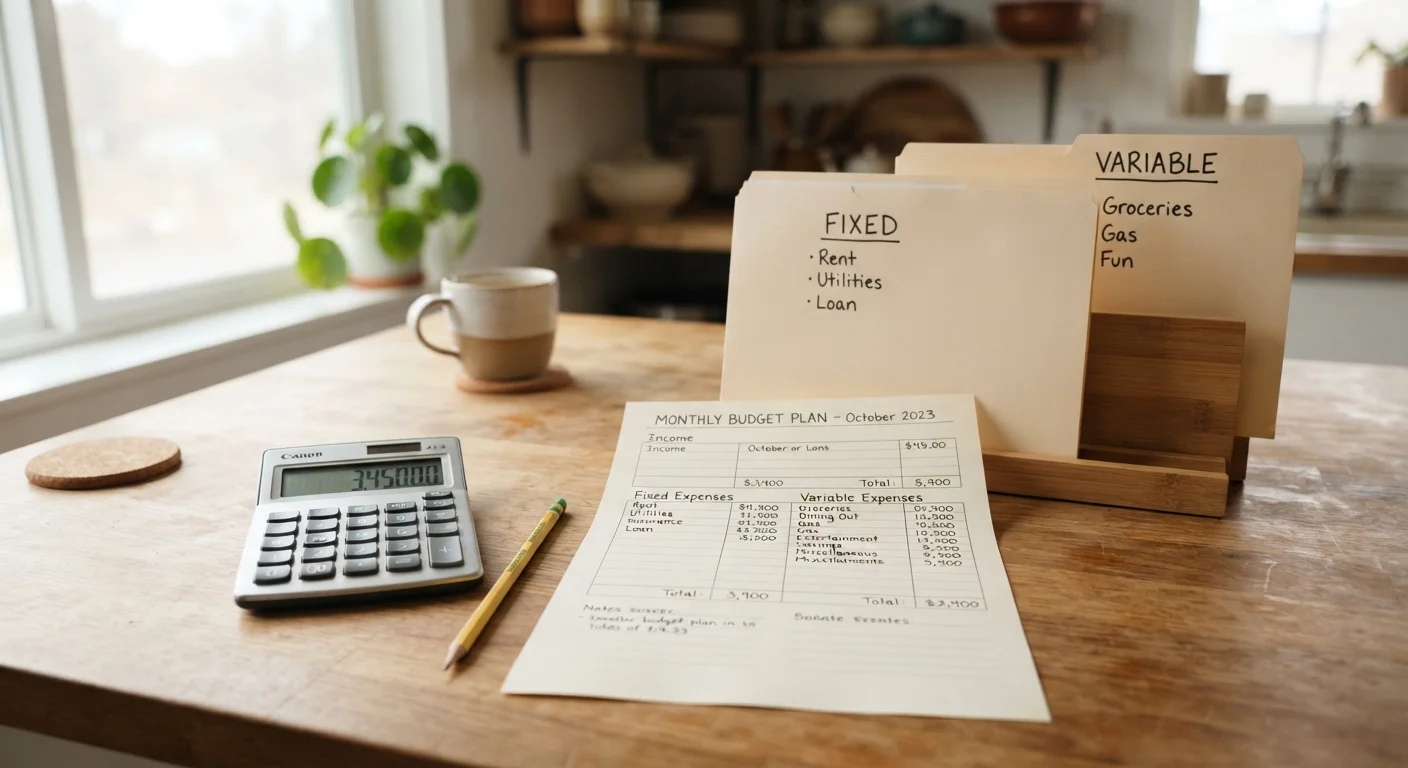
- Fixed costs stay the same each month and are generally harder to reduce quickly.
- Variable expenses fluctuate and offer the most immediate opportunity to cut spending.
- Knowing which category each expense falls into helps families respond to income changes.
- Some costs - like utilities - are semi-variable and require separate planning strategies.
- Reducing fixed costs permanently has a larger long-term impact than trimming variable spending.
- Building a budget that maps both categories clearly reduces financial stress and surprises.
Option A
Fixed Costs
The predictable, non-negotiable foundation of your budget.
Best for: Households that need a stable baseline to plan around each month.
Option B
Variable Expenses
The flexible, adjustable layer where spending control lives.
Best for: Families looking for levers to pull when cash flow gets tight.
If you want to lower your monthly baseline spending
Fixed Costs
Targeting fixed costs - such as refinancing a loan or downsizing a plan - produces lasting monthly savings that compound over time without requiring repeated decisions.
If you need to free up cash quickly this month
Variable Expenses
Variable expenses like dining out, entertainment, and discretionary shopping can be reduced immediately without breaking contracts or long-term commitments.
If you are building your first household budget
Fixed Costs
Start by listing all fixed costs to establish your non-negotiable floor - this gives you a clear picture of the minimum income your household requires each month.
If your income varies month to month
Variable Expenses
Households with irregular income benefit most from keeping variable expenses flexible so spending can scale up or down in proportion to what actually comes in.
What Makes a Cost 'Fixed'?
A fixed cost is any expense that stays the same regardless of how your household behaves in a given month. Your mortgage or rent payment is the clearest example: whether you spend the month at home or traveling, that bill doesn't change. Other common fixed costs include auto loan payments, insurance premiums, subscription services billed at a flat rate, and minimum debt repayments.
The defining characteristic is predictability. Fixed costs can be scheduled in advance because the amount is known. That reliability makes budgeting simpler in one respect - you don't have to estimate - but it also means these expenses are harder to reduce on short notice. Cutting a fixed cost usually involves renegotiating a contract, refinancing a loan, or eliminating a recurring commitment entirely, none of which happen overnight.
Understanding which of your costs are truly fixed helps you identify the minimum monthly income your household needs to stay solvent. This floor figure is a critical number that every family budget should calculate. For more on how budgeting structures use this baseline, see our comparison of common budgeting frameworks.
| Criterion | Fixed Costs | Variable Expenses |
|---|---|---|
| Monthly amount | Stays the same | Changes each month |
| Examples | Rent, loan payments, insurance | Groceries, fuel, dining out |
| Ease of reducing quickly | Difficult - requires contract changes | Easy - reduce spending immediately |
| Long-term savings impact | High - permanent monthly reduction | Moderate - requires ongoing discipline |
| Predictability for planning | Very high | Low to moderate |
| Tracking effort | Low - amounts are known in advance | High - requires regular monitoring |
| Flexibility during hardship | Limited without major lifestyle change | High - first line of defense |
What Makes an Expense 'Variable'?
A variable expense changes from month to month based on choices, consumption, or circumstances. Groceries, gasoline, clothing, dining out, and entertainment all fall into this category. The amount you spend on these items is not predetermined - it reflects decisions made throughout the month.
Variable expenses are where most families have the most direct control over their budget. When income drops or an unexpected bill arrives, it is variable spending that can be reduced immediately, without breaking a contract or incurring a penalty. That flexibility is valuable, but it also means variable expenses are the easiest category to underestimate. Without tracking, discretionary spending tends to creep upward in ways that only become visible in hindsight.
It is worth noting that some expenses sit in a middle ground - often called semi-variable or mixed costs. Utility bills are a common example: there is a fixed base charge, but the variable portion reflects actual usage. Tracking these separately, or averaging them across 12 months, helps avoid budget shocks. The spending categories families most often overlook include several semi-variable items worth flagging in your own plan.
~33%
Average share of income spent on housing
The U.S. Bureau of Labor Statistics Consumer Expenditure Survey consistently finds housing to be the largest single fixed cost for American households.
~15%
Average share of income on food
Food - a largely variable expense - represents roughly 12-15% of household budgets according to USDA Economic Research Service data, with significant variation by income level.
~60%
Household budget that is often fixed or semi-fixed
Personal finance researchers estimate that housing, transportation, insurance, and debt payments together commonly account for more than half of a household's monthly outflows.
How to Use This Distinction Practically
Once you separate your expenses into fixed and variable columns, two things become immediately clearer: how much financial flexibility you actually have, and where to focus when you need to make changes.
When money is tight, most families instinctively try to cut everywhere at once, which can feel overwhelming and often fails. A more structured approach is to work in layers. First, confirm your fixed costs are optimized - are you paying for subscriptions you no longer use? Could you refinance at a lower rate? These changes take effort upfront but reduce your baseline permanently. The distinction between fixed household costs and fixed loan structures has parallels in how lenders design products; fixed-rate vs. variable-rate loans follow a similar logic worth understanding separately.
Second, set monthly targets for your major variable categories - groceries, fuel, dining, entertainment - based on realistic averages from past spending, not aspirational guesses. Review these weekly so adjustments happen early rather than at month's end. Families who engage with both layers of their budget, rather than focusing only on variable spending, tend to make more durable financial progress. For a side-by-side look at budgeting methods that structure this process, zero-based budgeting vs. the envelope method is a useful next read.
This article is for general informational and educational purposes only and does not constitute personalized financial advice. Consult a qualified financial professional for guidance specific to your household's situation.