

Key Takeaways
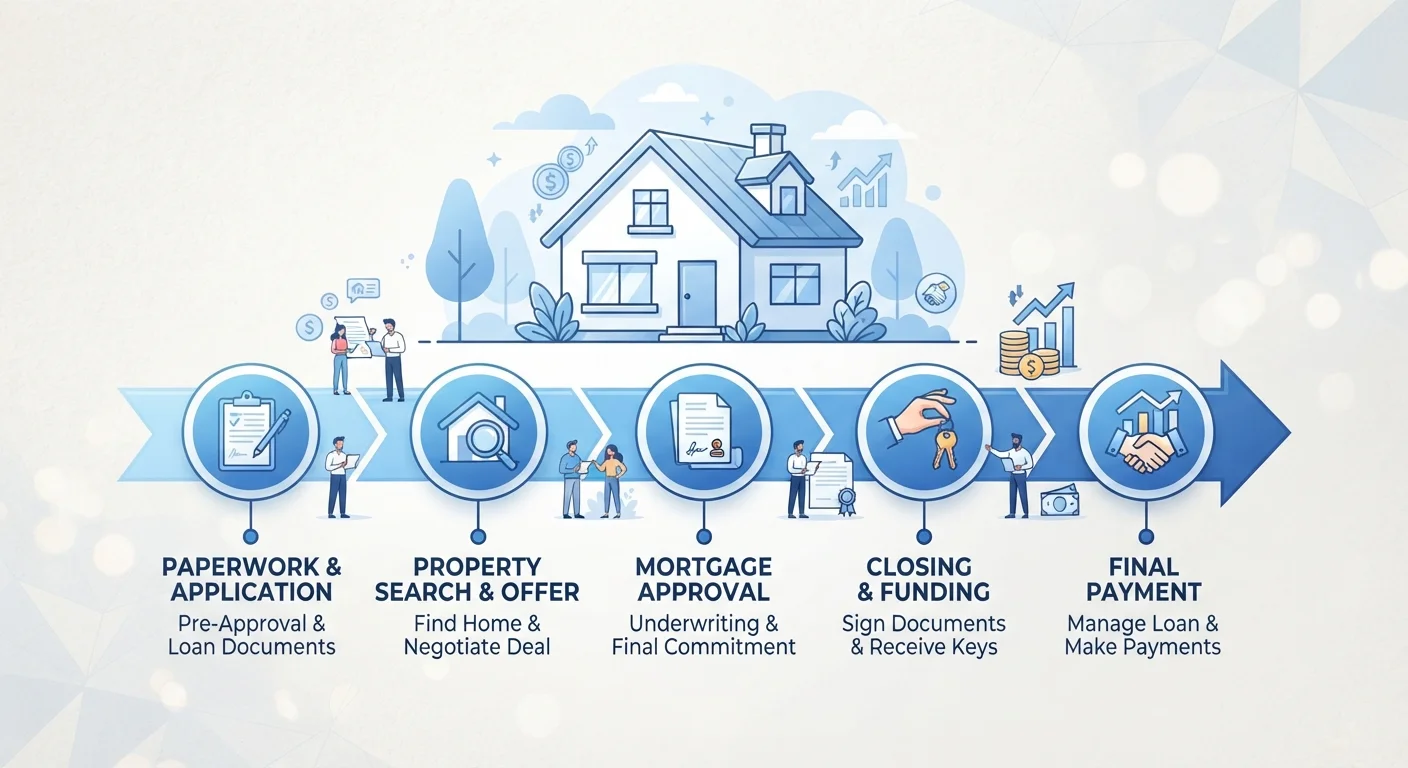
- A mortgage moves through six distinct stages, each with its own requirements and decisions.
- Underwriting scrutinizes your credit, income, and property before any loan is approved.
- Early mortgage payments go mostly toward interest; equity builds more slowly at first.
- Refinancing can alter your rate or term but restarts certain costs - weigh this carefully.
- At payoff, you must formally request and record the lien release from your lender.
- Understanding each stage reduces surprises and helps families plan more effectively.
What a Mortgage Actually Is
A mortgage is a secured loan used to finance real property. The lender provides funds to purchase a home; the borrower repays that principal plus interest over an agreed term - typically 15 or 30 years. Critically, the property itself serves as collateral, meaning the lender holds a legal claim (called a lien) on the home until the loan is fully repaid.
Mortgages differ from other borrowing in important ways. Unlike a personal loan, which is unsecured, a mortgage's collateral arrangement generally allows lenders to offer lower interest rates - but it also means the home can be subject to foreclosure if payments are not made. For a plain-language comparison, see how personal loans are structured.
This article provides general financial education only and is not personalized financial or legal advice. Consult a licensed mortgage professional for guidance specific to your situation.
Stage 1: Pre-Application and Preparation
Before submitting a formal application, preparation can significantly affect both the likelihood of approval and the terms offered. Lenders evaluate three core dimensions: creditworthiness, income stability, and debt-to-income ratio (DTI) - the share of your gross monthly income that goes toward debt payments.
- Credit reports and scores: Review all three major credit bureau reports for errors and dispute any inaccuracies before applying.
- Down payment: The amount you contribute upfront affects your loan-to-value ratio (LTV). Lower LTV generally means less risk for lenders.
- Pre-qualification vs. pre-approval: Pre-qualification is an informal estimate; pre-approval involves verified documentation and carries more weight with sellers.
Request your credit reports from all three major bureaus at least three to six months before applying - not the day before. Dispute cycles can take 30 to 45 days, and you want time to see the corrected results reflected.
Credit report errors affect a significant share of consumers, and lenders use all three reports in their evaluation. Starting early leaves room to address discrepancies without delaying your application timeline.
When comparing loan offers, look at the Annual Percentage Rate (APR) alongside the interest rate. APR folds in lender fees and gives a more complete picture of total borrowing cost.
A low headline rate can be offset by high origination fees. APR standardizes the comparison and is required to be disclosed by lenders under the Truth in Lending Act (TILA).
Families managing multiple financial obligations can benefit from the guidance in key questions to ask before applying for any financial product.
Stage 2: The Application and Underwriting Process
A formal mortgage application collects detailed personal, employment, and financial data. After submission, the file moves to underwriting - the lender's risk-assessment process. An underwriter reviews:
- Verification of income (pay stubs, tax returns, employer confirmation)
- Asset documentation (bank statements, retirement accounts)
- A property appraisal to confirm the home's market value supports the loan amount
- Title search to ensure no existing liens or ownership disputes
Don't Change Your Financial Profile During Underwriting
Opening new credit lines, making large purchases, or changing jobs during the underwriting period can materially change your debt-to-income ratio or credit score. Even seemingly minor changes have caused loan approvals to be withdrawn. Keep your financial activity stable until after closing.
Underwriting may take two to six weeks. During this period, avoid opening new credit accounts, making large purchases on credit, or changing employment - each can alter your risk profile and delay or derail approval.
Stage 3: Closing and Loan Origination
Once underwriting is complete and the loan is approved, the file moves to closing. At closing, the borrower signs a package of legal documents including the promissory note (the repayment promise) and the deed of trust or mortgage instrument (the lien agreement). The lender disburses funds to the seller; the borrower pays closing costs, which typically range from 2% to 5% of the loan amount and include origination fees, title insurance, and prepaid interest.
Before signing, carefully review every document. Understanding the clauses that matter most can help you identify provisions - such as prepayment penalties or escrow requirements - that affect long-term costs.
Your Loan May Be Sold After Closing
It is common for lenders to sell mortgages to other financial institutions on the secondary market after origination. If this happens, you will receive written notice and new payment instructions. Your loan terms - rate, balance, and payment schedule - remain unchanged. Continue making payments to the new servicer as directed.
Stage 4: Repayment and How Amortization Works
Amortization is the scheduled process of paying down a loan through fixed periodic payments. Each payment covers both interest and principal, but the split changes over time. In the early years of a 30-year mortgage, a larger share of each payment goes toward interest; as the balance decreases, progressively more goes toward reducing principal.
~80%
Interest share of early mortgage payments
On a standard 30-year fixed mortgage, roughly 80% of the initial monthly payment goes toward interest rather than principal in the first years of repayment.
2%-5%
Typical closing cost range
The Consumer Financial Protection Bureau notes that closing costs generally fall between 2% and 5% of the loan amount, varying by lender, location, and loan type.
30 years
Most common US mortgage term
The 30-year fixed-rate mortgage remains the predominant loan structure for US homebuyers, according to data from Freddie Mac's Primary Mortgage Market Survey.
This front-loaded interest structure means equity - your ownership stake in the home - accumulates slowly at first. Borrowers who understand this are better positioned to make informed decisions about extra payments or refinancing later in the loan.
Most lenders also collect funds for property taxes and homeowners insurance through an escrow account, paying those bills on your behalf from the pooled balance. Managing a mortgage alongside other financial products requires organization; practical approaches for managing multiple financial products can help keep everything on track.
Stage 5: Mid-Loan Decisions - Refinancing and Extra Payments
Homeowners are not locked into their original terms indefinitely. Two common mid-loan strategies are worth understanding:
- Refinancing
- Replacing your existing mortgage with a new one, potentially at a different rate, term, or loan type. Refinancing restarts amortization and incurs new closing costs, so the decision requires careful break-even analysis - how long must you stay to recoup those costs through lower payments?
- Extra principal payments
- Directing additional funds toward principal reduces the balance faster, shortens the loan term, and lowers total interest paid. Always confirm that extra payments are applied to principal, not future installments.
Both decisions interact with your broader financial picture. The Saving & Debt hub offers foundational context for weighing these choices against other household priorities. For a broader view of how debt strategy evolves over time, see managing debt across different life stages.
Refinancing Resets Your Amortization Clock
When you refinance, you take on a new loan and a new amortization schedule. If you are 10 years into a 30-year mortgage and refinance into another 30-year loan, your total repayment period extends - even if the monthly payment drops. Calculate the total interest cost across both loans, not just the new monthly payment, before deciding.
Stage 6: Payoff and What Happens Next
When the final payment is made, the mortgage is satisfied - but the process is not automatically complete. Borrowers should take two formal steps:
- Request a payoff statement from the lender confirming the exact amount needed to fully close the loan (this may differ slightly from a regular payment due to accrued interest).
- Confirm lien release: The lender must file a satisfaction of mortgage or deed of reconveyance with the county recorder's office, formally removing their claim on the property. Follow up to ensure this is recorded.
Payoff also has credit implications - a mortgage closed in good standing typically remains on credit reports for up to ten years and can continue to benefit your credit history. After decades of disciplined repayment, this milestone marks full homeownership and opens new financial flexibility for the household.
This article is for general informational and educational purposes only. It does not constitute financial, legal, or mortgage advice. Consult a qualified mortgage professional, financial adviser, or attorney for guidance tailored to your circumstances.