

Key Takeaways
- Debt types and priorities shift significantly as households move through different life stages.
- Early adulthood debt is often education-driven; midlife debt tends to center on housing and family expenses.
- Approaching retirement with high-interest debt can meaningfully erode fixed-income security.
- No single debt strategy fits all stages - context, income trajectory, and obligations all matter.
- Understanding debt terminology is a foundational step before choosing any repayment approach.
Why Life Stage Matters for Debt Strategy
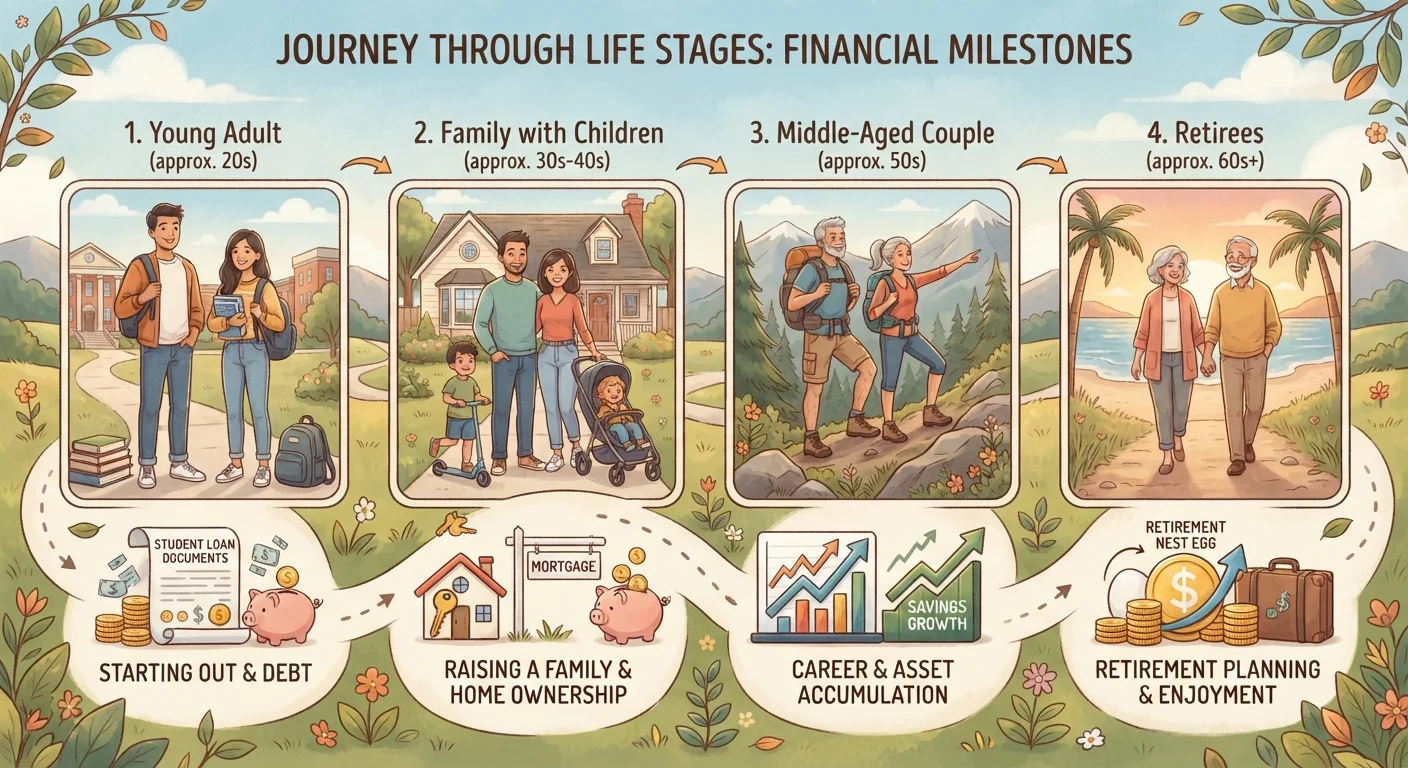
Debt is rarely static. The kind of debt a household carries, how much of it feels manageable, and which repayment strategies make sense all shift considerably as income, responsibilities, and time horizons change. A 24-year-old with student loans faces a fundamentally different financial picture than a 54-year-old with a mortgage, college tuition costs for children, and retirement on the horizon.
Understanding how debt evolves across life stages helps families avoid applying the wrong framework at the wrong time. Before diving into stage-by-stage guidance, it helps to have a firm grasp of core concepts - terms like APR, secured vs. unsecured debt, and minimum payments carry weight at every stage. Our plain-language debt glossary is a useful starting point.
$59,580
Median household debt among under-35 families
According to the Federal Reserve's Survey of Consumer Finances, younger households carry substantial debt loads relative to their assets.
~$200,000
Median outstanding mortgage balance for homeowners aged 45-54
Federal Reserve data consistently shows the 45-54 age group carries the highest median mortgage balances of any age cohort.
43%
Americans aged 60-69 still carrying mortgage debt
Federal Reserve Survey of Consumer Finances data shows a rising share of near-retirees entering retirement with housing debt still outstanding.
Early Adulthood: Student Loans and First Credit
For many Americans, debt begins before their first paycheck arrives. Student loan balances represent the most common form of debt in early adulthood, and they can shape financial decisions for a decade or more. Federal student loans typically carry fixed interest rates and income-driven repayment options; private loans often do not.
Beyond education debt, young adults encounter credit cards, car loans, and potentially personal loans - often with limited credit history, which can mean higher interest rates. Building a positive payment record during this stage matters both for debt costs now and for borrowing terms later.
Start With Your Highest-Rate Debt First
In early adulthood, it can be tempting to pay off smaller balances first for a sense of progress. However, mathematically, targeting the debt with the highest interest rate first - sometimes called the avalanche method - reduces the total interest paid over time. Whichever method you choose, consistency matters more than perfection.
The priority in early adulthood is generally twofold: avoid high-interest debt accumulation and establish consistent repayment habits. Aggressive extra payments on federal student loans can make sense if rates are high, but may be less urgent if rates are low and employer benefits like retirement matching are available - a trade-off explored in our guide on paying off debt while saving simultaneously.
Growing Families: Mortgages, Cars, and Competing Priorities
The family-formation years - roughly the late 20s through early 40s for many households - often bring the largest debt obligations of a lifetime. A mortgage is typically the biggest: a long-term, secured loan tied to a physical asset. Understanding the full arc of that commitment is worthwhile; our overview of the mortgage lifecycle explains each stage from application through final payment.
Simultaneously, families in this stage frequently carry auto loans, may still be repaying student debt, and face rising household expenses - childcare, insurance, healthcare. The risk here is debt sprawl: accumulating multiple obligations without a clear hierarchy. The distinction between secured and unsecured debt becomes practically important, since the consequences of falling behind differ sharply.
Debt Sprawl Can Quietly Derail Family Finances
When multiple debt obligations accumulate simultaneously, it becomes easy to lose sight of total interest costs and repayment timelines. Families in the household-formation stage should periodically list every debt obligation - balance, interest rate, and minimum payment - to maintain a complete picture. Without this visibility, low-priority debt can linger and compound for years.
Households juggling several financial products simultaneously benefit from an organized tracking approach. Our resource on managing multiple financial products offers practical organizational methods.
Middle Age: Peak Earning, Peak Complexity
Many households reach peak earning potential in their 40s and 50s - but peak earning often coincides with peak financial complexity. College tuition for children, aging parent support, growing retirement contributions, and remaining mortgage balances can all compete for the same dollars.
This is frequently the stage where households benefit most from deliberate debt prioritization. High-interest unsecured debt - particularly credit card balances - should generally be addressed before lower-rate obligations, since carrying high-rate debt while simultaneously investing can represent a net financial loss. Some families in this stage consider debt consolidation or structured repayment plans; a comparison of debt consolidation versus debt management plans can clarify which approach suits different situations.
In midlife, run the numbers before making extra mortgage payments. If your mortgage rate is lower than your expected long-term investment return, redirecting extra cash to retirement accounts may be more advantageous - though this trade-off depends on individual tax situations and risk tolerance.
The interaction between debt interest rates and investment returns is central to optimal allocation decisions, yet it is often overlooked in favor of the psychological appeal of paying down a mortgage early.
In your final working decade, audit every debt account for rate and term. Refinancing or consolidating high-rate balances while you still have employment income can be significantly easier than doing so after income drops in retirement.
Lenders assess creditworthiness partly on income; securing favorable terms before retirement income begins typically offers more options and better rates.
Broader budgeting discipline also becomes critical during these years. A comprehensive look at household budget strategy can help families align spending with longer-term goals.
Approaching and Living in Retirement
Entering retirement with significant debt - particularly variable-rate or high-interest debt - can create meaningful pressure on a fixed or semi-fixed income. While some debt in retirement is not inherently problematic (a low-rate mortgage with ample assets to service it, for example), carrying credit card balances or unresolved personal loans into this stage can limit financial flexibility considerably.
Retirees and near-retirees may have fewer straightforward options for increasing income, making proactive debt reduction in the final working years especially valuable. At the same time, it is worth noting that complete debt elimination is not the universal goal it is sometimes portrayed as - a nuanced look at debt-free living myths and realities provides useful perspective.
Retirement Debt Is Highly Individual
Whether carrying debt into retirement is manageable depends on asset levels, income sources, debt type, and interest rates - factors that vary enormously between households. General guidance can outline considerations, but the right course of action for a specific situation should involve a licensed financial adviser who can assess the full picture.
For households in this stage, consulting a licensed financial adviser is particularly advisable - the interaction between debt repayment, Social Security timing, and retirement account withdrawals involves considerations that are highly individual.
Principles That Apply at Every Stage
Despite the differences across life stages, several evidence-informed principles hold broadly. Prioritizing high-interest debt reduces total interest paid over time. Maintaining an emergency fund - even a modest one - reduces the likelihood that an unexpected expense becomes new high-cost debt. Communicating openly within a household about debt reduces the risk of misaligned decisions. And regularly reviewing the full picture of what is owed, at what rates, and with what terms prevents debt from growing unnoticed.
Our article on household debt repayment principles explores these ideas in greater depth. For foundational budgeting support at any stage, the Budgeting Basics hub offers accessible frameworks for families managing everyday finances.
This article is for general informational and educational purposes only and does not constitute personalized financial, legal, tax, or investment advice. Individual circumstances vary significantly; readers should consult a qualified, licensed financial professional before making decisions about their own debt or financial situation.