

Key Takeaways
- Both methods require paying minimums on all debts while focusing extra funds on one account at a time.
- The debt snowball targets the smallest balance first, offering quick early wins.
- The debt avalanche targets the highest-interest debt first, reducing total interest paid.
- Research suggests behavioral motivation matters as much as mathematical efficiency for many people.
- Neither method is universally superior - the best choice fits your psychological style and financial situation.
- Consulting a licensed financial adviser can help you choose and customize a repayment strategy.
Debt Snowball & Debt Avalanche
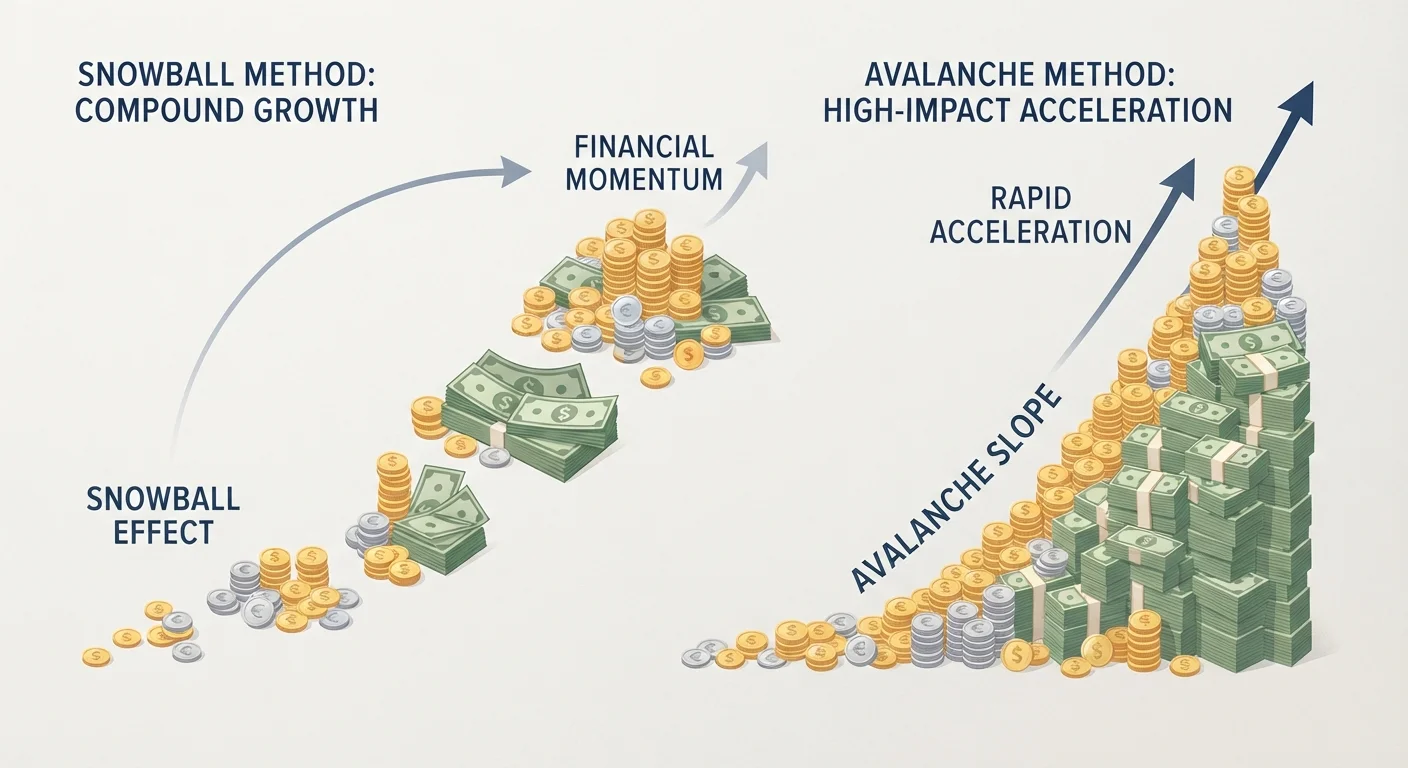
The debt snowball and debt avalanche are two structured methods for paying off multiple debts. Both require you to make minimum payments on all debts while directing any extra money toward one debt at a time. They differ only in which debt you target first: the smallest balance (snowball) or the highest interest rate (avalanche).
The avalanche method minimizes total interest paid over time, while the snowball method prioritizes behavioral momentum by eliminating individual accounts faster.
How Both Methods Work
Regardless of which method you choose, the mechanical foundation is the same. Each month, you pay the minimum required amount on every debt you carry. Any money left over in your budget - sometimes called the "debt payment surplus" - is applied entirely to one target debt. Once that debt is fully paid, you roll its former minimum payment into the surplus, increasing the amount hitting your next target. This compounding of freed-up payments is where both strategies draw their power.
Before starting either approach, it helps to have a complete picture of what you owe. Our debt vocabulary reference explains concepts like APR, minimum payments, and secured versus unsecured debt - foundational knowledge for mapping your debt landscape accurately.
List Every Debt Before You Start
Write down every balance, minimum payment, and interest rate before committing to either method. A clear inventory prevents surprises and makes it easier to track progress month by month. Even a simple spreadsheet can serve this purpose effectively.
The Debt Snowball Method
With the snowball method, you list your debts from smallest balance to largest and direct all extra payments toward the smallest one first, regardless of its interest rate. When that balance reaches zero, you redirect everything to the next-smallest debt.
The logic here is psychological rather than mathematical. Eliminating an entire account - even a small one - delivers a tangible sense of accomplishment. Research in behavioral economics suggests that these early victories can sustain motivation over a long repayment journey, reducing the likelihood of abandoning the plan altogether.
77%
Americans carrying some form of debt
According to Pew Research Center survey data, a large majority of U.S. adults carry at least one form of debt, making structured repayment strategies broadly relevant.
$6,000+
Average U.S. credit card balance per cardholder
Federal Reserve data indicates average revolving credit card balances in the thousands, underscoring the importance of targeting high-interest balances strategically.
2-3 years
Typical structured repayment timeline
Financial planning practitioners generally cite two to three years as a realistic timeline for households applying a consistent snowball or avalanche strategy to moderate consumer debt loads.
The trade-off is cost: if your smallest debt also carries a low interest rate while a larger balance accrues interest at a much higher rate, you may pay more in total interest over time than you would with the avalanche approach.
The Debt Avalanche Method
The avalanche method reorders your debt list by interest rate - highest to lowest - and targets the most expensive debt first. Mathematically, this is the more efficient route: every dollar of extra payment is reducing the balance that costs you the most to carry.
For households with high-interest revolving balances, such as credit cards, the savings can be meaningful over a multi-year repayment timeline. However, if your highest-interest debt also has a large balance, it may take many months before you see an account drop to zero. That delay can make the method feel slow, and some people lose momentum before they see their first win.
“The best debt repayment method is the one you'll actually stick with. Mathematical optimality means little if the plan is abandoned three months in.”
— Consumer Financial Protection Bureau, U.S. federal agency providing consumer financial education and guidance
Families navigating debt at different income levels or life stages may find one method more practical than the other. Our guide on managing debt across life stages explores how priorities can shift over time.
Choosing the Right Method for Your Household
The decision comes down to two factors: your financial profile and your behavioral style. If your debts are clustered at similar interest rates, the mathematical difference between methods is small - motivation becomes the deciding factor. If rates vary widely, the avalanche offers a clearer financial advantage worth weighing.
Consider how you've handled long-term goals before. Do you need visible progress to stay engaged, or are you comfortable tracking slow, steady gains against a specific number? There is no universally correct answer. Both approaches beat making only minimum payments.
It's also worth noting that these methods are not your only options. Debt consolidation and debt management plans are alternative structures that some households use, each with different implications for interest, credit, and financial flexibility.
For broader principles on managing debt as a household unit - including how to align on priorities with a partner - see our piece on household debt repayment principles.
This article is for general informational purposes only and does not constitute personalized financial, legal, or tax advice. Individual financial situations vary. Please consult a qualified, licensed financial adviser before making decisions about your debt repayment strategy.