

Key Takeaways
- Clicker training delivers a precise, consistent marker that helps pets isolate the exact rewarded behavior.
- Verbal cues require no equipment and can be used in any situation without preparation.
- A clicker's sound never varies, whereas tone of voice can shift with emotion, potentially confusing pets.
- Hearing-impaired pets or noise-sensitive animals may do better with one method over the other.
- Both approaches rely on positive reinforcement and can be used together or switched over time.
- Consistency and timing matter more than the specific signal you choose.
Option A
Clicker Training
The precise, consistent marker method.
Best for: Pets and owners who benefit from a clear, split-second signal that is completely separate from everyday household noise.
Option B
Verbal Cues
The hands-free, always-available approach.
Best for: Owners who want a training method that requires zero equipment and integrates naturally into daily routines.
If your pet is easily distracted and needs pinpoint feedback
Clicker Training
The click's distinct, neutral sound cuts through background noise and marks the precise moment of correct behavior, helping pets learn faster in busy households.
If you want a low-cost, always-ready training tool
Verbal Cues
Your voice is always with you, requiring no device to carry or remember - ideal for spontaneous training moments throughout the day.
If your pet has hearing difficulties
Clicker Training
A vibrating or tactile clicker variant can replace sound-based signals for hearing-impaired pets, whereas voice-based cues become unreliable.
If you have young children helping with training
Verbal Cues
Children's voices are less consistent, but verbal cues still involve the whole family naturally without the risk of misusing a clicker device.
If you're training multiple pets with different skill levels
Clicker Training
A clicker's neutrality means it can address individual animals without emotional spillover, keeping sessions clear and separate.
How Each Signal Works
Both clicker training and verbal cues fall under the umbrella of positive reinforcement - rewarding desired behaviors to make them more likely to repeat. The difference lies in how the reward is marked. For a deeper look at why positive reinforcement outperforms punishment-based methods, see our guide to reward-based training at home.
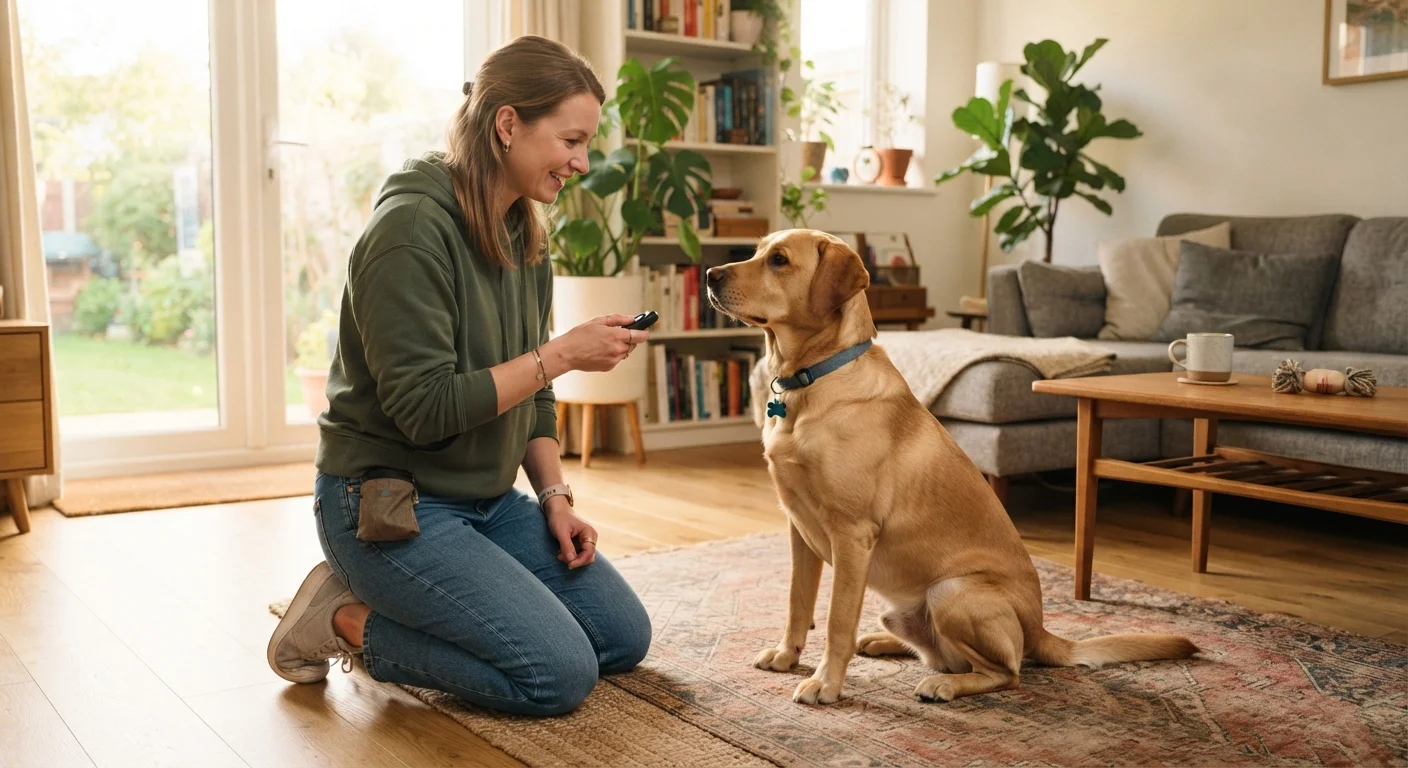
Clicker training uses a small handheld device that emits a consistent clicking sound. Through a process called classical conditioning, the pet learns that the click reliably predicts a reward. Because the click happens at the instant of correct behavior, it bridges the gap between the action and the treat with precision.
Verbal cues use spoken words - "sit," "stay," "good" - either as markers or as commands. Many owners use a single word like "yes" as a verbal marker, functioning similarly to a clicker. Commands layer on top, directing the animal toward specific behaviors before a reward follows.
| Criterion | Clicker Training | Verbal Cues |
|---|---|---|
| Equipment needed | Small handheld clicker device | None - voice only |
| Signal consistency | Identical every time | Varies with tone and mood |
| Timing precision | Very high - split-second marker | High, if practiced |
| Suitable for hearing-impaired pets | Yes, with tactile adapters | No |
| Ease of use for beginners | Moderate - requires coordination | High - intuitive for most owners |
| Hands-free use | No | Yes |
| Cost | Minimal one-time purchase | Free |
Consistency and Timing: Where the Methods Differ Most
The clicker's biggest advantage is mechanical consistency. Every click sounds identical, regardless of whether the trainer is tired, excited, or frustrated. Human voices, by contrast, naturally shift in pitch and pace with mood. For pets - particularly dogs and cats who are highly attuned to emotional cues - an enthusiastic "yes!" and a flat "yes" can signal two different things.
That said, timing is equally critical with both methods. A click or verbal marker that arrives even a second late can accidentally reinforce the wrong behavior. Trainers new to both approaches often benefit from practicing without their pet first to sharpen their reaction speed.
Animals that display stress or anxiety during training sessions may respond differently depending on which method is used. Our article on recognising stress signals in cats and dogs can help you read your pet's body language during sessions.
Can You Use Both Methods Together?
Many experienced trainers use a clicker to teach new behaviors, then phase in verbal cues once the animal has learned the action. This is sometimes called "transferring the behavior." The clicker marks the precise moment during initial learning; the verbal cue eventually takes over as the primary signal. Using both simultaneously from the start, however, can create confusion - introduce one clearly before layering in the other.
Matching the Method to Your Pet and Lifestyle
Several practical factors should guide your choice:
- Hearing status: Deaf or hearing-impaired pets cannot respond to verbal cues reliably. A vibrating collar paired with a tactile marker, or a visual signal, adapts the clicker concept effectively.
- Noise sensitivity: Some pets startle at sudden sounds. For these animals, introducing the clicker gradually - or switching to a softer-click device - is important. Others thrive with the clarity the sound provides.
- Your hands: If you frequently carry items during training - treats, a leash, a harness - juggling a clicker adds complexity. Verbal markers keep both hands free.
- Household dynamics: Multiple family members training the same pet? A verbal marker is more accessible to everyone. A clicker requires that each person using it understands its purpose and timing.
Whichever signal you choose, it fits into a broader approach to your pet's wellbeing. Training is just one piece of the picture - caring for your pet across every life stage covers how behavioral needs evolve over time.
~0.5 sec
Ideal marker-to-reward window
Animal behavior research suggests that markers landing within half a second of the desired behavior are most effective at strengthening the behavioral association.
3-5 min
Recommended session length for dogs
Veterinary behaviorists generally recommend keeping training sessions short - particularly for puppies and senior dogs - to maintain focus and avoid frustration.
This article is for general informational purposes only. For behavioral concerns or signs of distress in your pet, consult a qualified veterinarian or certified animal behaviorist.