

Key Takeaways
- A capsule-style approach reduces clutter and ensures every item earns its place in the closet.
- Children's sizing varies widely by brand - always measure before purchasing.
- Natural and blended fabrics each have distinct trade-offs for durability, comfort, and care.
- Rotating seasonal clothing prevents wear-out and makes dressing easier year-round.
- Proper care labels extend garment life significantly, saving families money over time.
- Tracking clothing spend as a household budget category reduces unplanned overspending.
Building a Family Wardrobe Philosophy
Managing clothing for a household of multiple ages and body types is less about accumulating more and more about choosing with intention. A clear wardrobe philosophy - a set of guiding principles - helps every family member dress appropriately for their daily life without constant shopping stress.
The most effective approach borrows from capsule wardrobe thinking: a defined number of versatile pieces that mix and match across occasions. For families, this means each member has a functional core of items suited to their lifestyle - school, work, sport, and social - plus a handful of occasion-specific pieces. The goal is not minimalism for its own sake, but usefulness.
Before buying anything, conduct a wardrobe audit. Pull every item out, assess what fits, what's worn, and what's simply taking up space. Donate or pass on items that no longer serve the household. This resets your baseline and makes gaps obvious. See our practical shopping guide for how to approach these decisions with a value-focused mindset.
Start with a Wardrobe Audit
Before any seasonal shopping, spend 30 minutes pulling everything out and sorting into 'keep,' 'donate,' and 'discard' piles. This resets your view of what you actually have and prevents duplicate purchases. Doing this with children present also teaches them practical decision-making around possessions.
Sizing and Fit Across Every Age Group
Fit is the single biggest factor in whether clothing looks and feels good - and it's also where families lose the most money when they get it wrong. Children's sizing is especially inconsistent across manufacturers. A child labeled size 5T in one brand may fit better in a 4T from another.
Always take body measurements - chest, waist, hips, and inseam - before purchasing, particularly for children who are growing. Many retailers provide size charts; use them. For toddlers and young children, sizing up slightly for longevity can be sensible, but avoid going too large as ill-fitting clothes affect comfort and safety (loose waistbands, tripping hazards).
For adults, fit varies by cut and intended silhouette. Understanding basic terms - relaxed, slim, regular, tailored - helps filter options efficiently, whether shopping online or in store. Our guide on online and in-store shopping for families covers how to evaluate fit when you can't try items on in person.
When buying children's school uniforms or everyday basics, purchase two identical items in the current size and one in the next size up. This reduces mid-year emergency shopping when growth spurts hit unexpectedly.
Children's growth is rarely linear; having the next size ready prevents gaps in functional wardrobe coverage without requiring immediate extra spend.
For adults, investing in well-constructed basics - a structured trouser, a neutral knit - in neutral colors yields more outfit combinations per item than trend-led pieces at any price point.
Versatility per item is the most reliable metric for clothing value, particularly for working parents with limited time to assemble outfits each morning.
Choosing Fabrics for Durability and Comfort
Fabric choice shapes how a garment wears, washes, and ages. For families with active children and busy adults, durability and ease of care typically outweigh novelty or luxury feel.
- Cotton: Breathable, washable, and widely available. Heavier weaves (such as canvas or twill) resist wear better than lightweight jersey for high-traffic kids' clothing.
- Polyester and nylon blends: Highly durable and quick-drying, making them practical for activewear, school uniforms, and outerwear linings.
- Wool: Excellent insulation and natural odor resistance, but requires careful washing. Merino wool blends offer easier care.
- Linen: Breathable for warm climates, but wrinkles easily and may not suit households that skip ironing.
- Bamboo and modal: Soft and often moisture-wicking; increasingly available in children's basics and loungewear.
Check care labels before purchasing, not after. A garment that requires dry-cleaning or hand-washing only adds ongoing cost and inconvenience for most families.
~66%
Clothing worn less than 7 times before disposal
Industry estimates suggest a significant majority of garments in many households are underused, underscoring the value of intentional purchasing.
2-3x
Lifespan extension from proper garment care
Textile care researchers and consumer organizations note that following care instructions and air-drying can meaningfully extend the usable life of everyday clothing.
Seasonal Wardrobe Planning and Rotation
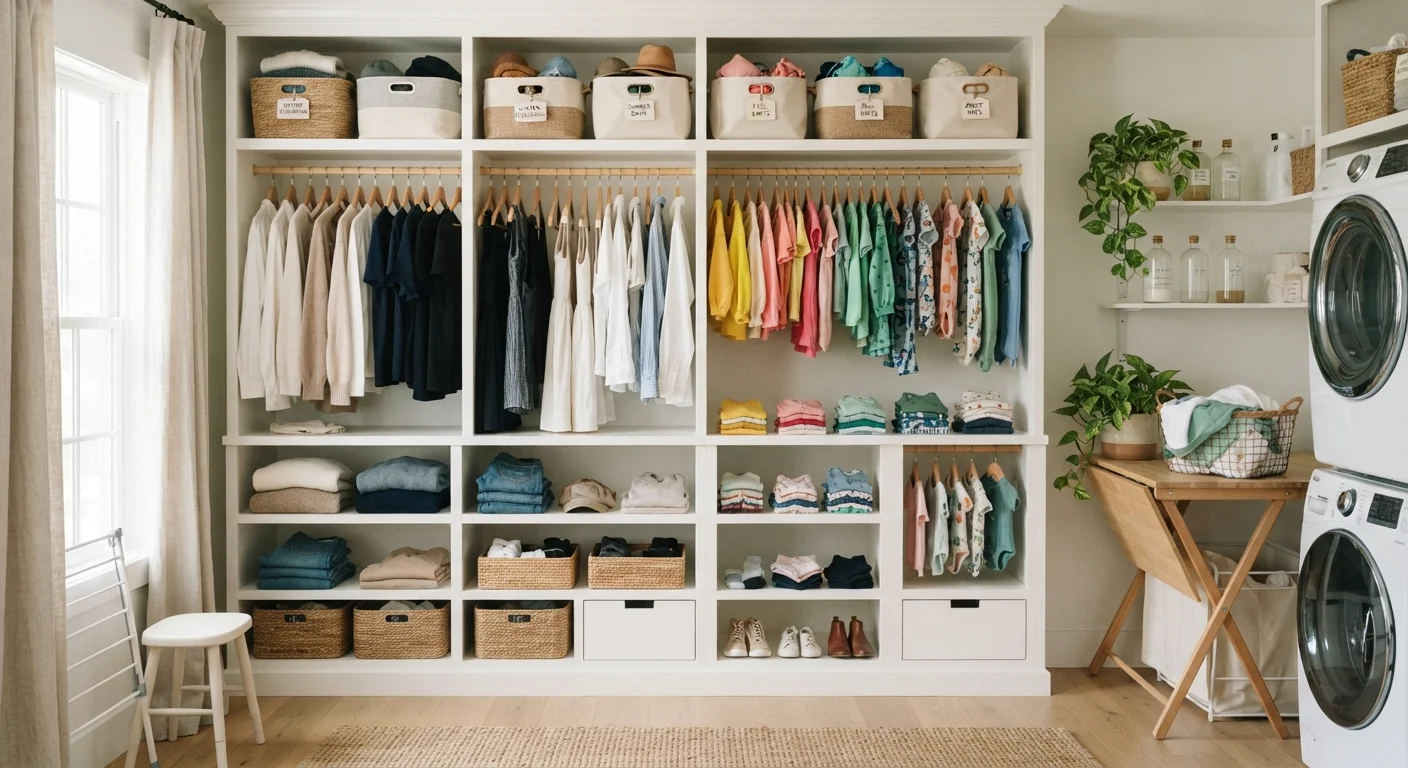
Rotating clothing seasonally keeps closets manageable and extends garment life. The practical approach: twice a year (typically spring and fall), assess what still fits, what's worn out, and what needs replacing for the coming season.
Store off-season items in labeled, breathable bins or vacuum storage bags to protect against dust and moisture. Avoid plastic bags for long-term storage, as they can trap humidity. Moths are a particular concern for wool - cedar blocks or sachets deter them without chemicals.
Use the seasonal transition as a natural checkpoint for children's wardrobes. Kids can grow a full size or more between seasons, so what fit in October may not work the following October. Build a simple checklist by category - bottoms, tops, outerwear, footwear, and occasion wear - and note gaps before the season begins rather than scrambling mid-winter.
Climate and Lifestyle Affect Seasonal Needs
Families in warmer climates may find a two-season rotation unnecessary, while those in regions with harsh winters need more robust outerwear investments. Adjust your rotation calendar to your actual local conditions rather than following a generic schedule. Lifestyle factors - remote schooling, frequent outdoor activities, formal work requirements - also shift what 'enough' looks like for each household.
Clothing Care and Longevity
How clothing is laundered and stored directly determines how long it lasts. Most garment damage - pilling, fading, shrinkage, fiber breakdown - is preventable with basic care habits.
Key practices that extend garment life include: washing on cold or gentle cycles where care labels allow, turning dark items inside out to reduce fading, air-drying rather than machine-drying where practical, and treating stains promptly rather than letting them set. Overwashing is itself a source of wear; items that aren't soiled don't need to be washed after every use.
Store knits folded rather than hung to prevent stretching. Use appropriate hangers - padded or wide-shoulder hangers for structured garments, slim hangers for everyday pieces. Avoid wire hangers for anything that retains its shape, as they can deform shoulders over time.
Don't Ignore Care Labels
Machine-washing a dry-clean-only garment or tumble-drying a fabric marked 'lay flat to dry' can permanently damage the item after a single wash. Always check care instructions before the first wash, not after the damage is done. For unfamiliar fabrics, when in doubt, use cold water and air-dry.
Managing Clothing Budgets for the Whole Family
Clothing is often one of the least-tracked household expenses, which is exactly why it tends to exceed what families intend to spend. Treating clothing as a distinct budget category - with sub-allocations by family member - creates accountability and prevents drift.
A useful framework: estimate annual clothing needs per person at the start of the year, factor in expected growth spurts for children, and distribute budget across the four seasons. Review actuals quarterly. For guidance on building household spending plans, the budgeting basics hub provides accessible frameworks for families at different income levels.
Hand-me-down systems within families or with trusted friends significantly reduce spend on children's clothing, particularly for fast-growing toddlers and primary-school-age children. Organizing these by size and season makes the system practical rather than chaotic. When gaps remain, prioritizing quality in high-wear items (school shoes, everyday trousers) and accepting lower price points for rapid-growth sizes is a sensible trade-off.
This article is for general informational and educational purposes only. It does not constitute financial, medical, or professional advice. Consult a qualified professional for decisions specific to your circumstances.