

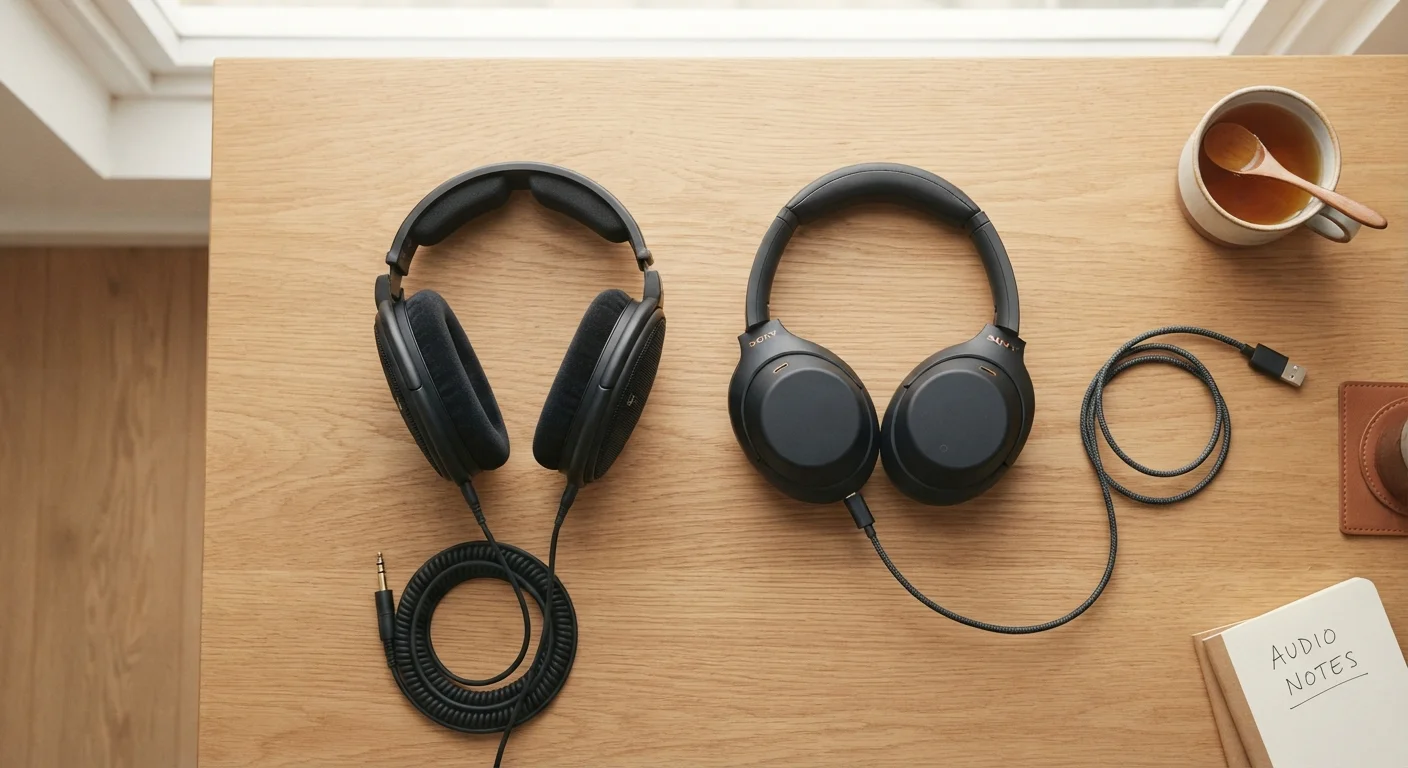
Key Takeaways
- Wired headphones deliver audio without latency or battery dependency, making them dependable for critical listening.
- Wireless headphones use Bluetooth, which introduces a small but measurable audio delay relevant in gaming and video editing.
- Battery life is the defining practical constraint of wireless headphones, typically ranging from 20 to 40 hours per charge.
- Wired headphones are generally more durable long-term because they have fewer electronic components that can fail.
- Wireless headphones have steadily improved in audio quality and now satisfy most everyday listening needs.
- Your primary use case - commuting, gaming, casual listening, or studio work - should drive the decision.
Option A
Wired Headphones
The reliable, no-compromise audio connection.
Best for: Users who prioritize consistent audio quality and never want to worry about battery life.
Option B
Wireless Headphones
The flexible, cable-free listening experience.
Best for: Active users and commuters who value freedom of movement and modern convenience features.
If you primarily watch videos, game, or edit audio
Wired Headphones
Zero latency means audio and video stay perfectly synchronized - a noticeable difference when even small delays disrupt the experience.
If you commute, exercise, or move around frequently
Wireless Headphones
Freedom from cables is a genuine daily convenience, and modern Bluetooth codecs deliver audio quality that suits most on-the-go listening.
If you want the lowest long-term cost and fewest failure points
Wired Headphones
No battery to degrade, no firmware to update, and fewer internal components means wired headphones typically last longer with basic care.
If you use a modern smartphone without a headphone jack
Wireless Headphones
Many current smartphones have removed the 3.5mm port, making Bluetooth headphones the more practical choice without requiring a dongle.
If audio fidelity is your top priority for home listening
Wired Headphones
Wired connections avoid Bluetooth compression, delivering an unaltered audio signal that audiophiles and serious music listeners notice in controlled settings.
The Core Difference: How Each Connection Works
Wired headphones transmit audio as an analog electrical signal through a physical cable - typically a 3.5mm or 6.35mm jack, or USB-C on newer devices. This is a direct, uninterrupted path from the source to your ears. Wireless headphones, by contrast, receive a digital Bluetooth signal broadcast from your device, which is then decoded and converted to sound by a chip inside the headphones themselves.
That internal processing is why wireless headphones require a battery and why they cost more at equivalent audio specifications. It also explains one of the most misunderstood specs in consumer headphones: latency, which is the delay between a sound occurring on your device and you hearing it.
| Criterion | Wired Headphones | Wireless Headphones |
|---|---|---|
| Audio latency | Effectively zero | 30-100ms (codec-dependent) |
| Battery required | No | Yes, 20-40 hrs typical |
| Audio compression | None | Codec-dependent |
| Cable management | Required | None |
| Device compatibility | Requires 3.5mm or USB-C port | Any Bluetooth-enabled device |
| Long-term durability | Fewer components to fail | Battery degrades over time |
| Typical price range | Lower at equivalent specs | Higher at equivalent specs |
For casual music streaming, latency is largely imperceptible. Where it matters is video playback, gaming, and any work where audio must sync with visual content. Wired connections are essentially instantaneous; standard Bluetooth introduces a delay typically between 30 and 100 milliseconds depending on the codec (audio compression format) used. More recent codecs such as aptX Low Latency or LC3 reduce this meaningfully, but wired remains the reference point for zero-delay audio.
Battery Life, Durability, and Daily Practicality
Battery dependency is the single most significant operational difference between the two types. Wireless headphones must be charged - most models offer 20 to 40 hours of playback per charge, with some models supporting fast charging that delivers several hours of use from a short charge. But when the battery dies mid-commute, you have no audio until you recharge. Wired headphones have no such constraint; plug them in and they work.
Replaceable Cables and Batteries
Some wired headphones feature detachable cables, making the most failure-prone component straightforward and inexpensive to replace. Similarly, a small number of wireless headphone models are designed with user-replaceable batteries - worth checking if longevity is a priority. This is not universal, however, and most wireless headphones require manufacturer service for battery replacement.
Durability patterns also differ in a practical way. Wired headphones have fewer electronic components: no battery cells, no Bluetooth chipset, no charging port. The most common failure point is the cable itself, which can be stressed at connection points over time - though many models feature replaceable cables. Wireless headphones carry all those additional components plus a battery that will degrade in capacity over hundreds of charge cycles, which is a normal characteristic of rechargeable batteries rather than a defect.
Families considering headphone longevity may find the research on electronics reliability and warranties useful when deciding how much protection makes sense for either type.
Audio Quality: What the Specs Actually Tell You
Wired headphones deliver audio without compression. The signal that leaves your device is the signal that reaches the driver in the headphone cup. Wireless headphones, however, must compress audio to transmit it via Bluetooth, then decompress it at the headphone end. The quality of this process depends heavily on the codec supported by both your device and the headphones.
30-100ms
Typical Bluetooth audio latency range
Standard Bluetooth SBC codec introduces this delay; newer codecs like aptX Low Latency aim for under 40ms.
20-40 hrs
Typical wireless headphone battery life
Battery capacity varies widely by model; active noise cancellation features reduce playback time measurably.
990kbps
Maximum bitrate of Sony LDAC codec
LDAC, developed by Sony, transmits up to three times more audio data than standard SBC at its highest setting.
Standard Bluetooth SBC is the universal fallback codec and audibly compresses audio. Higher-quality codecs - aptX, aptX HD, AAC, and LDAC - transmit significantly more audio data and narrow the gap considerably. For most family members listening to streaming music in everyday environments, the difference between a good wireless codec and wired audio is difficult to perceive. In quieter, controlled listening environments, or when using lossless audio files, the distinction becomes more apparent.
The decision also connects to how families think about connected technology in the home more broadly - a topic explored in our look at smart appliances and their genuine trade-offs. In both cases, the underlying question is the same: does the added technology deliver real value in your actual daily use, or does it introduce complexity without proportional benefit?
If you are evaluating headphones as a purchase - new or pre-owned - the trade-offs of buying second-hand versus new are particularly relevant for wireless models, where battery health is a hidden variable in used units.