

Key Takeaways
- Rated capacity in pounds or cubic feet tells you how much dry laundry fits per load, not the drum's water volume.
- Spin speed (RPM) affects how damp clothes are after the cycle - higher isn't always better for delicate fabrics.
- Energy and water consumption figures are measured under standard test conditions, so real-world use will vary.
- Programme count is less important than whether the specific cycles your household needs are actually included.
- Noise level in decibels (dB) matters most when the machine is on an open-plan floor or near living spaces.
What you will need
Why Spec Sheets Confuse Most Shoppers
A washing machine spec sheet is designed primarily for retailers and compliance databases - not for families standing in an appliance aisle trying to make a sensible decision. Numbers appear without context, abbreviations are assumed knowledge, and the figures that matter most are often buried beneath ones that matter least.
This walkthrough takes you through each major category in the order you'll typically encounter them, explains what the number actually measures, and tells you what it means for a real household. For a quick reference to terms used across all appliances, see our Family Household Appliance Glossary.
What you will need
Step-by-Step: Decoding Each Section of the Spec Sheet
Locate the Rated Capacity Figure
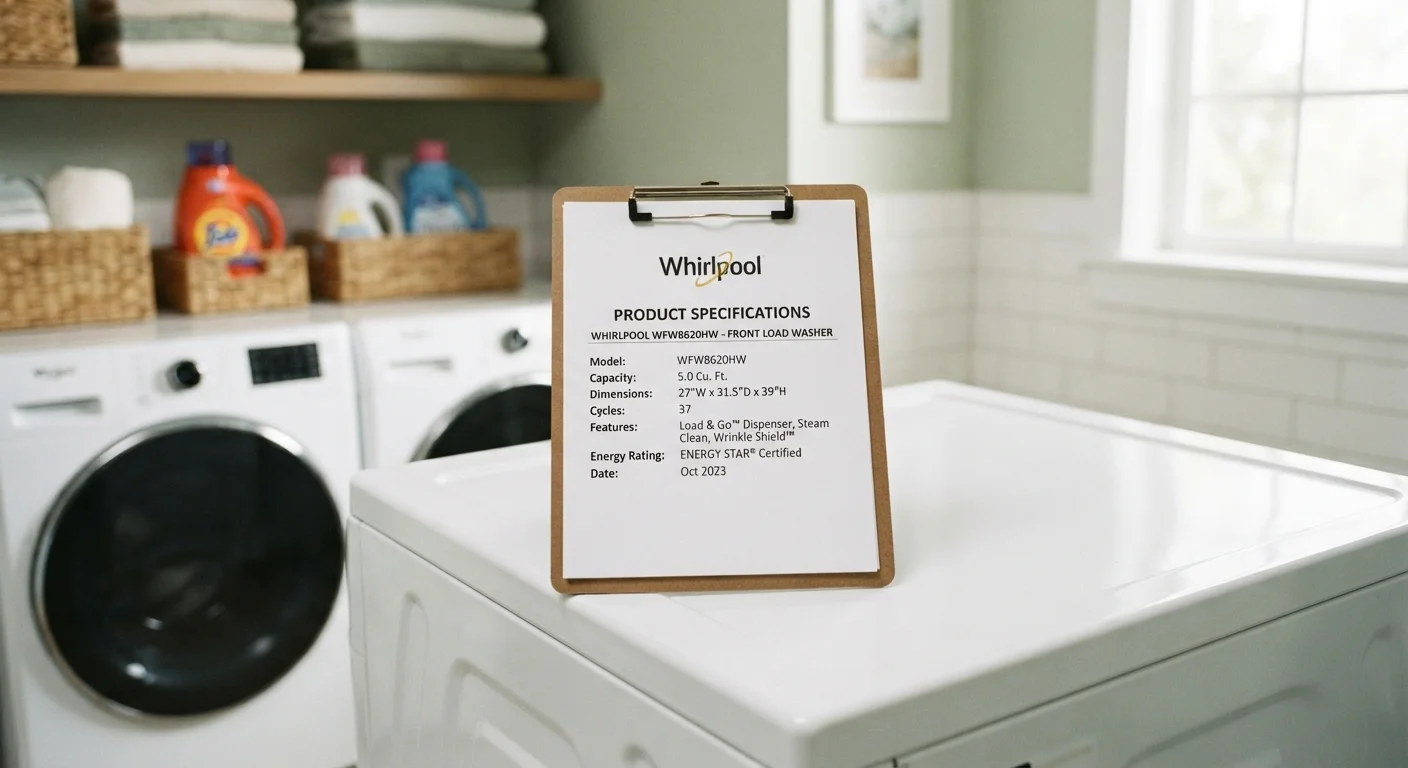
Rated capacity is stated in cubic feet in the US market. It refers to the usable drum volume and is measured under standardized test conditions using dry laundry. A larger drum means bigger loads per cycle, which can reduce the total number of washes per week.
As a rough guide, a 4.5 cu. ft. drum is generally sufficient for a household of four doing standard weekly laundry. If your household generates large loads regularly - sports kits, bedding, towels - a figure closer to 5 cu. ft. may reduce the number of separate loads you need to run.
Read the Spin Speed (RPM)
RPM - revolutions per minute - describes how fast the drum spins during the final extraction phase. A higher RPM removes more water from fabric, which shortens drying time. Common residential spin speeds range from around 800 RPM to 1,400 RPM.
Higher RPM is beneficial for everyday cotton loads but can stress delicate or synthetic fabrics over time. If your household washes a significant amount of delicates, verify that the machine allows you to select a lower spin speed rather than being locked into the maximum.
Understand the Energy and Water Consumption Figures
Spec sheets list annual energy consumption in kilowatt-hours (kWh) and water use in gallons per cycle or per year. These figures are calculated under standardized EU or US Department of Energy test protocols - typically using a cotton cycle at a defined temperature - so they represent a controlled baseline, not your actual usage.
Real-world consumption will differ based on how often you wash, which programmes you choose, and your local water temperature. Use the spec figure as a comparison tool between models, not as a precise utility cost forecast.
Check Noise Levels in Decibels
Most spec sheets list two noise figures: one for the wash cycle (typically 50-58 dB) and one for the spin cycle (typically 70-78 dB). The spin figure is the one that matters most perceptually - it's when the machine is loudest.
For context, 70 dB is roughly equivalent to a normal conversation or a running dishwasher at close range. If the machine will be installed on an upper floor, in an open-plan kitchen, or adjacent to a bedroom, prioritize models with a spin dB rating closer to 72 or below.
Review the Programme List Critically
The programme count tells you how many selectable wash cycles the machine offers. A higher number is not inherently better. Scan the list for the programmes your household will realistically use: a standard cotton cycle, a 15- or 30-minute quick wash, a delicate/hand-wash cycle, and a high-temperature sanitize option if you have young children or allergy concerns.
Specialty cycles - 'outdoor gear', 'baby care', 'duvet' - add to the count but have limited value unless they match your specific laundry habits. Focus on cycle quality (adjustable temperature, spin speed) over cycle quantity.
Note the Dimensions and Installation Requirements
Standard US washing machine dimensions are listed as height × width × depth in inches. Confirm these against your available installation space, including overhead clearance for top-loaders and door-swing clearance for front-loaders. Also check the door hinge direction - some front-loaders allow the door to be re-hung, others do not.
Weight (listed in pounds) is relevant if the machine needs to be carried up stairs or placed on a raised pedestal, which must be rated to handle the machine's operating weight under full drum load.
Common Pitfalls and What to Ignore
Spec sheets frequently include figures that look impressive but have little bearing on everyday use. Programme counts are a prime example: a machine advertised with 16 wash programmes may include options like 'outdoor wear' or 'sports intensive' that a typical family household will never select. What matters is whether the machine includes the cycles you will use - a reliable cotton cycle, a quick wash under 30 minutes, and a delicate or hand-wash setting.
Focus on Cycles You Will Actually Use
Before evaluating any spec sheet, write down the three or four wash programmes your household uses every week. Use that short list as your filter - a machine that performs those cycles well at a reasonable energy cost will serve your family better than one with an impressive programme count but compromises on the basics.
Similarly, maximum load capacity is tested at specific spin speeds with specific fabric types. If you routinely wash king-size duvets or heavy denim, check whether the manufacturer specifies a reduced capacity for bulky items - this figure is often listed in the user manual rather than the spec sheet itself.
For a broader look at how capacity figures are determined across appliance categories, our guide to appliance capacity puts washing machine drum sizes into useful household context. And if running costs are a priority, pairing this knowledge with our energy ratings explainer gives you the full picture before you decide.