

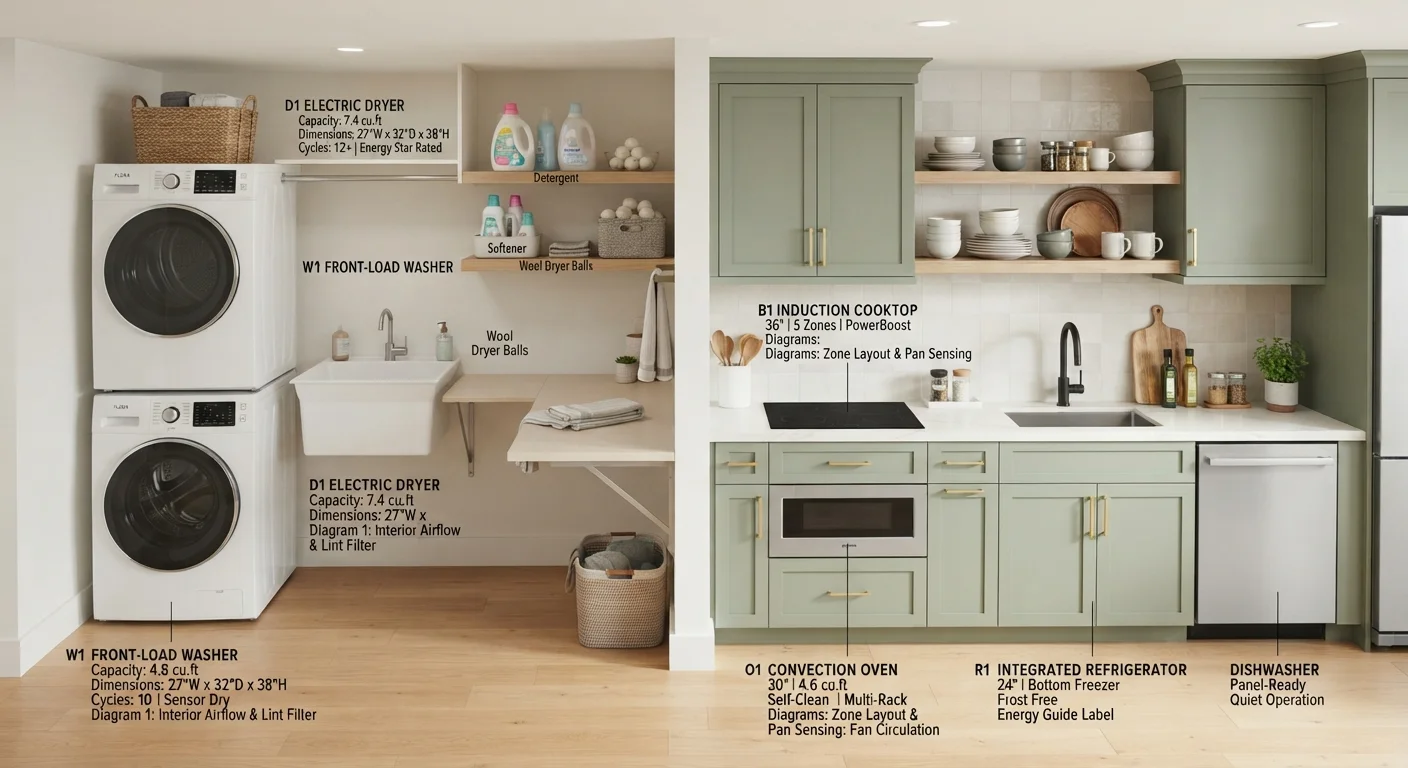
| Typical fridge capacity for a family of four | 18-22 cubic feet (General industry guidance; varies by household habits) |
| Common washing machine drum sizes | 4.0-5.0 cubic feet (standard US) (Manufacturer specifications across major appliance categories) |
| Spin speed range (washing machines) | 800-1,600 RPM (Typical range across residential washing machine models) |
| ENERGY STAR programme administered by | US EPA and Department of Energy (energystar.gov) |
| Quiet dishwasher threshold | Below 45 dB (Generally cited as suitable for open-plan living spaces) |
| Average US household appliance energy share | ~13% of total home energy use (US Energy Information Administration (EIA)) |
Why Appliance Jargon Matters for Family Buyers
Appliance spec sheets are written for salespeople, not families. Terms like inverter compressor, RPM, and cubic feet appear on every box, but manufacturers rarely explain what these figures mean in daily use. Misreading them - or ignoring them - can mean buying a washing machine that can't handle your household's laundry load, or a refrigerator that costs more to run than expected.
This glossary gives you plain-language definitions for the terms you're most likely to encounter when researching or purchasing household appliances. Use it alongside our complete home appliance guide to build a solid working knowledge before you commit to a purchase.
| Typical fridge capacity for a family of four | 18-22 cubic feet (General industry guidance; varies by household habits) |
| Common washing machine drum sizes | 4.0-5.0 cubic feet (standard US) (Manufacturer specifications across major appliance categories) |
| Spin speed range (washing machines) | 800-1,600 RPM (Typical range across residential washing machine models) |
| ENERGY STAR programme administered by | US EPA and Department of Energy (energystar.gov) |
| Quiet dishwasher threshold | Below 45 dB (Generally cited as suitable for open-plan living spaces) |
| Average US household appliance energy share | ~13% of total home energy use (US Energy Information Administration (EIA)) |
Core Terms: Capacity, Power, and Efficiency
These are the specs that most directly affect whether an appliance suits your household size and keeps running costs manageable.
Cubic Feet / Litres (Capacity)
A measurement of the usable interior space inside an appliance - most commonly fridges, freezers, and ovens. Larger numbers mean more storage or cooking room. Manufacturers measure total internal volume, which may not reflect how much you can practically fit inside.
RPM (Spin Speed)
Revolutions per minute - how fast a washing machine's drum spins during the final spin cycle. Higher RPM removes more water from laundry before drying, reducing drying time. However, higher spin speeds can cause more wear on delicate fabrics.
Inverter Motor / Compressor
A type of motor that adjusts its operating speed to match the current demand, rather than switching fully on or off. Inverter technology typically uses less electricity over time and runs more quietly than conventional motors.
Energy Rating
A standardised label that indicates how efficiently an appliance uses energy compared to others in its category. In the US, the ENERGY STAR label identifies appliances that meet federal energy-efficiency guidelines set by the EPA and DOE.
Wattage
A measure of how much electrical power an appliance consumes while running. Higher wattage generally means faster heating or more powerful operation, but also higher electricity use - which affects your utility bill.
Drum Capacity (Laundry)
The volume inside a washing machine or dryer drum, measured in cubic feet. A larger drum can handle bigger loads, which is relevant for households doing frequent or bulky washing such as bedding, towels, or sportswear.
Smart Connectivity / Wi-Fi Enabled
Appliances that can connect to your home's wireless network and be monitored or controlled via a smartphone app. Features vary widely - some offer remote start and diagnostics, others primarily send notifications.
Noise Level (dB)
Decibels (dB) measure how loud an appliance is during operation. For appliances used in or near living spaces - such as dishwashers, washing machines, or range hoods - a lower dB rating means less disruption during daily life.
Sensor Drying
A dryer feature that uses moisture sensors to detect when clothes are dry and automatically stops the cycle. This avoids over-drying, which can damage fabrics and waste electricity compared to running on a fixed timer.
Cycle Count / Programme Options
The number of pre-set wash, cook, or dry programmes built into an appliance. More cycles offer greater flexibility for different fabric types or food items, though most households regularly use only a handful of settings.
Self-Cleaning (Oven)
An oven function that uses very high heat (pyrolytic) or a steam process to loosen and burn off food residue. Pyrolytic cleaning is thorough but heats the kitchen significantly and uses a substantial amount of electricity.
Variable Temperature Zones (Fridge)
Sections within a refrigerator that can be set to different temperatures - for example, a dedicated meat drawer cooled slightly below the main compartment. This helps preserve different food types at their optimal storage temperature.
If you're unsure how to translate capacity figures into practical household terms, our capacity guide walks through drum sizes, fridge volumes, and oven measurements with real-world examples.
Technology and Connectivity Terms
Modern appliances increasingly include digital controls, sensors, and wireless connectivity. Knowing what these features actually do - versus what marketing language implies - helps you decide whether they're worth the added cost.
"Smart" Doesn't Always Mean Better
Wi-Fi connectivity and app control are marketed heavily but add complexity and potential points of failure. A connected appliance requires ongoing software support from the manufacturer - which may not be guaranteed for the full lifespan of the product. Weigh whether the convenience features genuinely fit your household's routines before treating smart connectivity as a must-have spec.
Wi-Fi connectivity, for instance, allows an appliance to receive software updates and send status alerts to your phone, but it doesn't automatically make the appliance smarter or more reliable. For an honest assessment of what connected appliances deliver in practice, see our guide to smart appliances in the family home.
Understanding these terms also connects to broader electronics knowledge. If you're navigating specs for phones or computers alongside appliances, our no-jargon guide to storage, RAM, and processing power covers the digital side in similar plain-language terms.
Using This Glossary as a Starting Point
Definitions are tools, not decisions. Once you're comfortable with the language, the next step is applying it to your specific household - factoring in family size, usage patterns, available space, and budget.
If you're equipping a home for the first time, our first-time buyer's guide covers which appliances to prioritise and what specs deserve the most attention at each stage. And if you want to challenge some common assumptions, appliance myths that keep costing families money is a useful reality check.
The goal is confident, informed decision-making - not perfect technical knowledge. You don't need to be an engineer to choose the right appliances for your home; you just need to understand what the numbers are actually measuring.