

Key Takeaways
- Local processing handles data on the device itself, so it works without an internet connection.
- Cloud processing sends data to remote servers, enabling more powerful features but requiring a stable internet connection.
- Local devices typically respond faster because there is no round-trip delay to an external server.
- Cloud-dependent devices may stop working if the manufacturer discontinues their server service.
- Privacy exposure differs significantly: local processing keeps data in your home, while cloud processing shares it with third parties.
- Many modern smart home devices use a hybrid approach, combining both local and cloud processing.
Option A
Local Processing
The self-contained, privacy-first approach.
Best for: Households that prioritize fast response times, offline reliability, and keeping personal data within the home.
Option B
Cloud Processing
The connected, feature-rich approach.
Best for: Families who want access to advanced AI features, remote access from anywhere, and easy software updates.
If your household experiences frequent internet outages
Local Processing
Locally processed devices continue functioning without an active internet connection, so your smart locks, lights, and sensors remain reliable even when your ISP has problems.
If privacy is a top priority for your family
Local Processing
Data that never leaves your home cannot be collected, shared, or compromised by a third-party server breach.
If you want advanced voice recognition or AI-powered automation
Cloud Processing
Complex machine-learning tasks demand computing power that most compact smart home devices cannot provide locally - cloud servers deliver the horsepower needed.
If you need to monitor or control your home remotely
Cloud Processing
Cloud-connected devices allow remote access from anywhere via a smartphone app, which requires server infrastructure to relay commands securely.
If you want long-term reliability and independence from manufacturer decisions
Local Processing
If a company shuts down its cloud service, locally processed devices remain operational, protecting your investment over time.
What Local and Cloud Processing Actually Mean
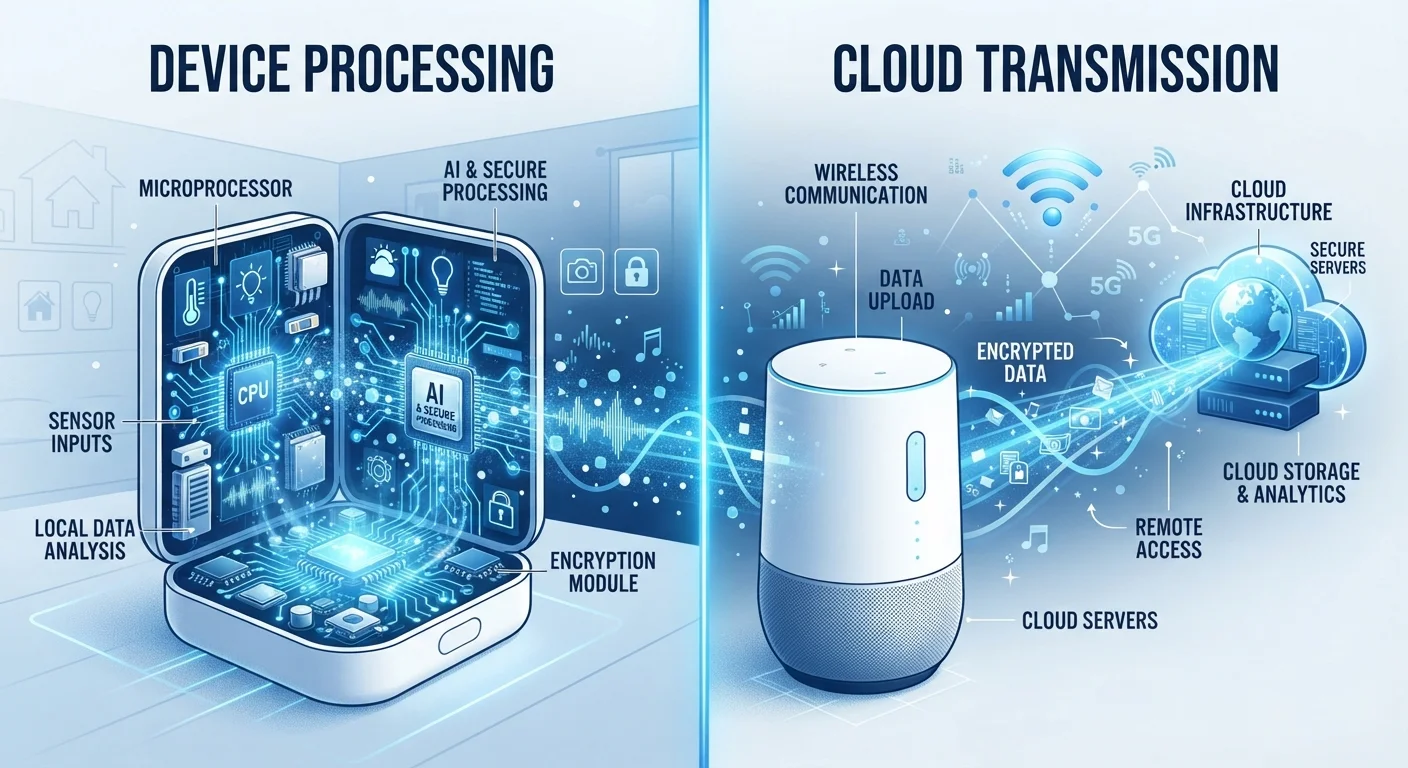
Every smart home device - whether a thermostat, doorbell camera, or motion sensor - has to process the data it collects before it can act on it or display results to you. The key question is: where does that processing happen?
With local processing, the computation occurs on a chip built into the device itself, or on a dedicated hub sitting inside your home. The data never needs to travel to an external server. With cloud processing, the raw data is sent over your home's internet connection to the manufacturer's remote servers, processed there, and a response is sent back.
To understand why this distinction matters for everyday families, it helps to think about what a smart home device actually does with information. A voice assistant, for example, needs to interpret spoken words - a computationally demanding task. A locally processed speaker might handle only basic commands on-device, while a cloud-connected one sends your audio to powerful servers capable of understanding complex or conversational requests. For a deeper look at the hardware concepts involved, see our plain-language guide to storage, RAM, and processing power.
| Criterion | Local Processing | Cloud Processing |
|---|---|---|
| Response speed | Very fast - no internet round-trip | Slower - depends on connection quality |
| Works without internet | Yes, fully or mostly | No, or severely limited |
| Privacy exposure | Low - data stays in the home | Higher - data sent to external servers |
| Feature sophistication | Limited by on-device hardware | High - leverages powerful server infrastructure |
| Long-term device viability | Strong - not reliant on manufacturer servers | At risk if service is discontinued |
| Remote access capability | Requires additional setup (e.g., VPN or hub) | Built-in via manufacturer's app |
| Software updates and new features | Limited to device hardware capabilities | Can improve over time via server-side updates |
Speed, Privacy, and Reliability: The Three Pillars That Separate Them
Speed: Local processing wins on response time. Because there is no round-trip to a distant server, commands execute in milliseconds. This is why a locally controlled smart light switch feels nearly instantaneous, while a cloud-reliant one may have a noticeable half-second or longer lag - a small but real difference when you are standing in a dark hallway.
Privacy: This is the dimension that concerns most families once they understand it. Locally processed devices keep all captured data - audio, video, motion patterns, household routines - inside your home network. Cloud-processed devices transmit that data externally, where it is subject to the manufacturer's privacy policies, data retention practices, and security infrastructure. A breach at the manufacturer's server could expose data from your home. For a broader look at how devices interact within ecosystems and what data flows between them, our article on smart home ecosystems covers compatibility and data considerations in detail.
Reliability: Local devices generally keep working during internet outages. Cloud-dependent devices may become partially or fully unresponsive when your connection drops - even to basic commands. This is a particularly important factor for security-related devices like smart locks or alarm sensors.
~500ms
Typical cloud command round-trip delay
Independent smart home latency tests have commonly measured cloud-processed command response times in the range of 300-700 milliseconds, compared to under 50ms for local processing.
~30%
Smart home devices using hybrid processing
Industry analysts estimate a growing share of mid-range and higher-end smart home products now integrate both on-device and cloud-based processing to balance speed with feature richness.
There is also a long-term reliability concern specific to cloud processing: if a manufacturer discontinues its server service, cloud-dependent devices can be permanently disabled - a scenario sometimes called being "bricked." Locally processed devices are far less vulnerable to this outcome. Our comparison of hub-based vs. hub-free smart homes explores how your broader setup choice affects this risk.
Hybrid Approaches and What to Look For When Choosing
Many devices sold today use a hybrid model - handling routine, time-sensitive tasks locally while offloading complex or remote-access functions to the cloud. A smart doorbell might detect motion locally (fast, private) but stream video to cloud storage and use cloud-based facial recognition (feature-rich, remote-accessible). Understanding which functions fall into which category helps families make informed trade-offs.
What 'Works Locally' May Actually Mean
Device marketing sometimes uses phrases like "local control" loosely. A device may process motion detection locally but still require cloud connectivity to trigger automations or send notifications. Before assuming a device is fully local, check whether core automations - not just basic detection - function without internet. User forums and independent technical reviewers are often the most reliable source for this level of detail.
When evaluating a smart home device, it is worth asking three practical questions: Does it retain basic function without internet? What data does it send to the manufacturer, and under what terms? What happens to the device if the company's service is discontinued? Answers to these questions - often found in product specifications, privacy policies, and independent technical reviews - reveal far more about long-term value than marketing language alone.
For families thinking about specific connected appliances, our article on smart appliances: genuine benefits and real limitations provides an honest look at where connected features add real value and where they introduce unnecessary complexity.