

Key Takeaways
- Comprehensive covers damage from events outside your control - weather, theft, animals, and falling objects.
- Collision covers damage from your vehicle hitting another car or a stationary object, regardless of fault.
- Both coverages are typically optional unless your lender or lessor requires them.
- Each coverage has its own deductible, which affects your premium and out-of-pocket costs at claim time.
- Neither comprehensive nor collision covers injuries to people - that falls under separate liability or medical coverages.
Option A
Comprehensive Coverage
Protection against what you can't control.
Best for: Drivers who want coverage for theft, weather events, falling objects, and other non-collision damage.
Option B
Collision Coverage
Protection when your vehicle makes contact.
Best for: Drivers who want repair or replacement coverage after an accident involving another vehicle or a fixed object.
If you're financing or leasing your vehicle
Both Comprehensive and Collision Coverage
Most lenders and leasing companies require both coverages to protect their financial interest in the vehicle.
If you live in an area prone to severe weather, hail, or flooding
Comprehensive Coverage
Comprehensive responds to weather-related damage and natural events that collision coverage does not address.
If you drive frequently in high-traffic conditions
Collision Coverage
More time on congested roads increases accident exposure, making collision protection especially relevant.
If your vehicle has a low market value
Review both carefully before adding either
When a vehicle's actual cash value is close to the deductible amount, the payout after a claim may not justify the added premium cost.
What Each Coverage Actually Does
Auto insurance policies bundle together several distinct coverages, and two that frequently cause confusion are comprehensive and collision. They sound interchangeable, but they respond to entirely different situations. Understanding the boundary between them helps you know what to expect when something goes wrong - and helps you make more informed decisions when selecting your policy. For a broader primer on auto policy components, see our guide to auto insurance coverage types.
Comprehensive Coverage
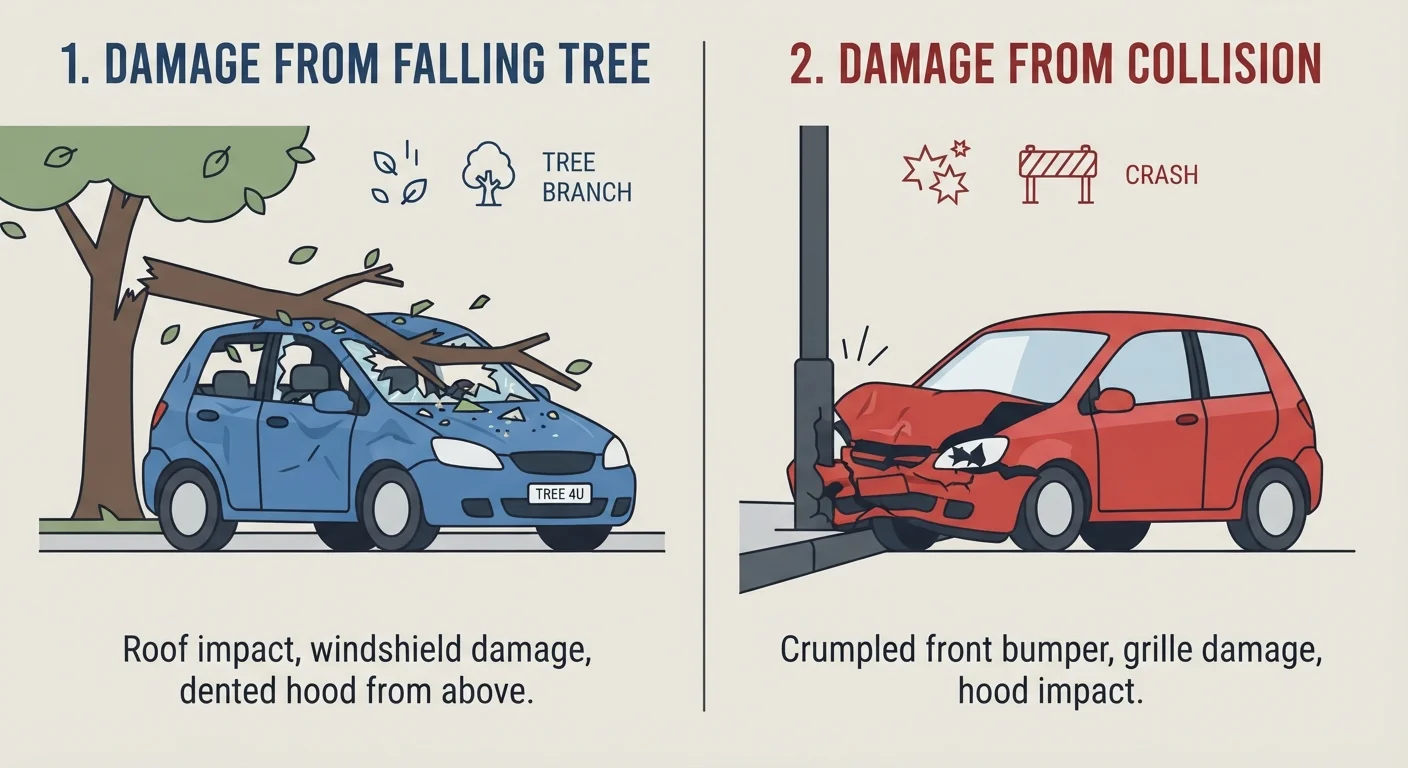
Comprehensive coverage pays for damage to your vehicle caused by events other than a collision with another vehicle or object. Common examples include:
- Theft or attempted theft
- Damage from hail, wind, flooding, or fire
- Falling objects such as tree branches
- Striking an animal (such as a deer)
- Vandalism
The defining characteristic is that the triggering event is largely outside the driver's control. Insurers sometimes describe this category informally as "other than collision" - a phrase that captures the scope accurately.
Collision Coverage
Collision coverage pays for damage to your vehicle when it makes physical contact with another vehicle or a fixed object - a guardrail, a telephone pole, or a parked car. Fault is generally not a determining factor for whether collision applies; what matters is that contact occurred. If you back into a concrete barrier in a parking lot, that is a collision claim, not a comprehensive one.
| Criterion | Comprehensive Coverage | Collision Coverage |
|---|---|---|
| Triggering event | Non-collision damage (theft, weather, animals, fire) | Contact with another vehicle or fixed object |
| Driver control | Typically outside driver's control | Often involves driver action |
| Fault relevance | Not applicable | Applies regardless of fault |
| Separate deductible | Yes | Yes |
| State-mandated | No | No |
| Lender/lessor required | Usually required | Usually required |
| Covers injuries | No | No |
How Deductibles Work for Each
Both comprehensive and collision coverage carry a deductible - the amount you pay out of pocket before your insurer covers the remainder of a covered loss. Importantly, they each have their own separate deductible, and you can often choose different amounts for each.
A higher deductible generally lowers your premium, while a lower deductible increases it. Families sometimes choose a lower deductible on collision (given higher claim frequency risk) and a higher deductible on comprehensive (given lower average claim frequency). However, the right balance depends on your financial situation and how much you can reasonably afford to pay after an unexpected loss.
Your Vehicle's Value Changes Over Time
Both comprehensive and collision typically pay based on your vehicle's actual cash value (ACV) at the time of loss - not what you originally paid. As a vehicle depreciates, the maximum payout shrinks accordingly. This is why revisiting your coverage elections annually makes practical sense, particularly for older vehicles.
When comparing how your insurer calculates a payout, it helps to understand how your vehicle's value is assessed. See actual cash value vs. replacement cost for an explanation of the two common methods.
When Each Coverage Applies: Real-World Scenarios
The fastest way to internalize the difference is through scenarios:
- A hailstorm dents your hood and cracks your windshield. → Comprehensive applies.
- You rear-end another driver at a stoplight. → Collision applies.
- Someone breaks into your car and steals your stereo. → Comprehensive applies to the vehicle damage (the stolen stereo itself may fall under a homeowners or renters policy).
- You swerve to avoid a deer but hit a fence. → Collision applies to the fence impact; had you hit the deer directly, comprehensive would apply.
- A tree falls on your parked car during a storm. → Comprehensive applies.
The swerve scenario is worth noting because it trips up many drivers. The key question is not why the contact happened but what made contact with your vehicle.
~6 in 10
U.S. drivers who carry comprehensive coverage
According to the Insurance Information Institute, most insured drivers with financed vehicles carry both comprehensive and collision coverage.
~$170
Average annual comprehensive premium
The Insurance Information Institute has reported average comprehensive premiums significantly below collision premiums, reflecting the difference in claim frequency and severity.
Are These Coverages Required?
Neither comprehensive nor collision is mandated by state law - state minimums typically require only liability coverage, which protects other parties when you are at fault in an accident. However, if you are financing or leasing a vehicle, your lender or lessor will almost certainly require both coverages to protect their financial interest in the asset until the loan or lease is paid off.
Once a vehicle is paid off, the decision to carry comprehensive or collision - or both - becomes a personal financial calculation. A general guideline used by many financial educators: if your annual combined premium for both coverages exceeds roughly 10% of the vehicle's current market value, it may be worth evaluating whether the coverage still makes economic sense. That said, this is a general framework, not financial advice, and your own risk tolerance and savings capacity matter significantly. Consulting a licensed insurance agent can help you weigh your specific situation.
For families trying to understand how their auto policy fits with their other coverage types, see how auto, health, home, and life insurance work together as a broader financial safety net. And if you want to understand what your policy may not cover, review common gaps between policy types that can leave families exposed.
This article is for general informational purposes only and does not constitute insurance, financial, or legal advice. Coverage terms, exclusions, and requirements vary by provider and state. Always review your actual policy documents and consult a licensed insurance professional for guidance specific to your situation.