

Key Takeaways
- Screen brightness and color accuracy vary significantly between models and are hard to judge from online specs alone.
- Speaker audio quality, keyboard feel, and build materials are best assessed through hands-on evaluation.
- In-store visits help families avoid returns caused by mismatched expectations on size, weight, or ergonomics.
- Salespeople can provide demos, but independent research beforehand leads to sharper in-store comparisons.
- Online research and in-store testing together generally produce better-informed purchase decisions than either alone.
Direct screen quality comparison is possible
Showrooms allow side-by-side panel comparisons that reveal contrast, color accuracy, and motion handling differences that spec numbers alone can't convey.
Audio evaluation is immediate and personal
Sound is subjective; brief listening demos let you assess whether a speaker or headphone suits your preferences before committing to a purchase.
Build quality and ergonomics become tangible
Hinge stiffness, keyboard feel, weight distribution, and grip size all affect daily usability and can only be fully evaluated by handling the product.
Reduces costly returns from size or fit mismatches
Seeing a TV's actual footprint in a space, or feeling a laptop's weight, helps families avoid surprises that trigger time-consuming returns.
Enables real-time comparison across models
Standing between two models often clarifies differences that hours of reading reviews may leave ambiguous.
Showroom conditions are not home conditions
Demo modes and optimized lighting inflate perceived quality. A TV that looks stunning under store lights may perform differently in your living room.
Prices may not match online availability
Physical retail pricing can differ from online channels, and some promotions are channel-specific. Independent price research is still necessary.
Salesperson influence can cloud judgment
Sales staff may steer recommendations toward higher-margin products. Entering with completed research is the most effective protection against this.
Store selection is often narrower than online
Physical stores carry a limited SKU range; niche or newer models may not be available for hands-on evaluation even if they're well-reviewed.
Geographic access is uneven
Families in smaller markets or rural areas may have few or no relevant electronics retailers within a practical distance.
Our Verdict
Shopping in person for electronics isn't about nostalgia - it's a practical strategy for product categories where sensory experience is part of what you're buying. For TVs, speakers, headphones, laptops, and cameras, a store visit adds genuine informational value that spec sheets can't replicate. That said, in-store visits work best when paired with solid online research, not as a substitute for it.
Families making mid-to-large electronics purchases where display quality, sound, or physical ergonomics are deciding factors.
Why Some Electronics Resist Pure Online Research
Buying a laptop or television based entirely on online specs is a bit like choosing a mattress from a description. The numbers tell part of the story, but they leave out the tactile, visual, and auditory details that matter most in daily use.
Spec sheets can tell you a panel's peak brightness in nits, but they can't tell you whether the screen looks washed out under your living room lighting. A product listing can list a speaker's frequency range, but can't convey whether the bass feels hollow or the highs are sharp. This gap between specifications and real-world experience is precisely where in-store evaluation earns its value.
For families making decisions across multiple devices - a TV for the den, a laptop for a teenager, headphones for a commuter - the sensory gap compounds. Each product category has its own hands-on variables. Understanding which categories reward an in-person visit helps you spend your time, and your money, more wisely. For a broader look at how the two channels compare, see how online and in-store shopping differ beyond convenience.
Product Categories Where In-Store Visits Pay Off
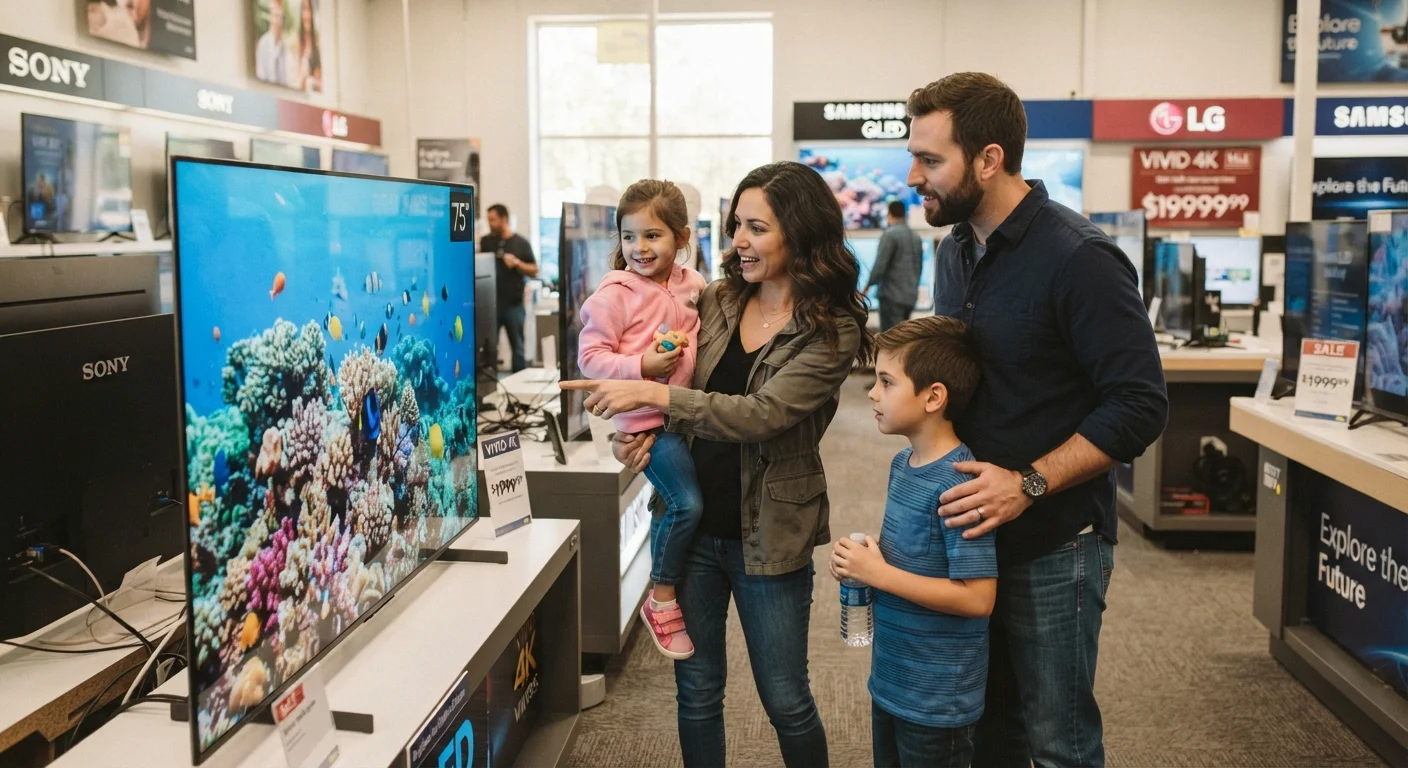
Televisions are arguably the strongest case for visiting a showroom floor. Manufacturers use panel technologies - OLED, QLED, LCD - that render contrast, motion handling, and color saturation very differently. Side-by-side comparisons on a showroom floor make these differences immediately apparent in ways that online photos and reviewer descriptions rarely capture with full accuracy. Viewing angle matters too: a panel that looks vivid head-on may wash out when viewed from a couch off to the side.
Laptops and tablets reward in-person testing for keyboard feedback, trackpad responsiveness, hinge stiffness, and weight distribution. A laptop listed at 3.5 lbs might feel manageable or surprisingly awkward depending on where that weight sits. Screen glare under bright lights is another factor that photos routinely obscure.
Headphones and portable speakers are obvious candidates. Audio is inherently subjective, and even technically accurate headphones can sound fatiguing to one person and pleasing to another. Many stores allow brief listening demos - use them. Our guide to wired vs wireless headphone trade-offs covers the spec differences, but a demo fills in what specs miss.
Cameras vary in grip size, menu layout, and button placement - factors that determine daily usability as much as sensor quality does.
Direct screen quality comparison is possible
Showrooms allow side-by-side panel comparisons that reveal contrast, color accuracy, and motion handling differences that spec numbers alone can't convey.
Audio evaluation is immediate and personal
Sound is subjective; brief listening demos let you assess whether a speaker or headphone suits your preferences before committing to a purchase.
Build quality and ergonomics become tangible
Hinge stiffness, keyboard feel, weight distribution, and grip size all affect daily usability and can only be fully evaluated by handling the product.
Reduces costly returns from size or fit mismatches
Seeing a TV's actual footprint in a space, or feeling a laptop's weight, helps families avoid surprises that trigger time-consuming returns.
Enables real-time comparison across models
Standing between two models often clarifies differences that hours of reading reviews may leave ambiguous.
Limitations to Keep in Mind
In-store evaluation has real drawbacks that deserve honest acknowledgment.
Showroom conditions are staged. TVs are often set to a vivid or demo mode that boosts brightness and saturation beyond what makes sense for home use. You're testing under store lighting, not your own. Speakers may be positioned favorably. Treat demos as comparative data, not absolute verdicts.
Price is a separate variable. In-store prices and online prices for the same model can differ, and return policies vary between retailers. Do your price research independently before visiting. The savvy deal-finding resources on this site can help you benchmark what a fair price looks like before you walk in.
Salesperson guidance, while sometimes genuinely helpful, carries inherent bias toward products with higher margins or promotional incentives. Arrive with your own research completed. Knowing which processor generation matters for your use case, for instance, prevents being upsold on features you won't use - our processor generations explainer is a useful primer.
Finally, not every market has robust retail options. Rural and suburban families may have limited store access, making the online-only path a practical necessity rather than a preference.
Showroom conditions are not home conditions
Demo modes and optimized lighting inflate perceived quality. A TV that looks stunning under store lights may perform differently in your living room.
Prices may not match online availability
Physical retail pricing can differ from online channels, and some promotions are channel-specific. Independent price research is still necessary.
Salesperson influence can cloud judgment
Sales staff may steer recommendations toward higher-margin products. Entering with completed research is the most effective protection against this.
Store selection is often narrower than online
Physical stores carry a limited SKU range; niche or newer models may not be available for hands-on evaluation even if they're well-reviewed.
Geographic access is uneven
Families in smaller markets or rural areas may have few or no relevant electronics retailers within a practical distance.
How to Make an In-Store Visit Actually Useful
An unstructured store visit often ends in decision fatigue or salesperson influence. A structured one gives you a clear advantage.
- Research before you go. Know which models fall within your budget and why they're candidates. Read independent reviews from consumer testing organizations, not just retailer summaries.
- Bring a list of specific tests. For a TV: check a sports clip for motion blur, find a dark scene to assess black levels, and step to the side to test viewing angles. For a laptop: type a paragraph, open several browser tabs, lift it one-handed.
- Ignore display mode settings. Ask store staff whether demo modes are active, or look for a picture settings menu. Calibrated or cinema modes are closer to real-world performance.
- Note your physical response. Does the keyboard feel right after 60 seconds of typing? Does the headphone fit feel comfortable, or does the clamping pressure bother you? These reactions predict long-term satisfaction better than specs do.
Avoid being swayed by myths around specs - more megapixels or a higher model number don't automatically mean better performance. The common electronics myths that lead families to overspend covers the most persistent of these in detail.
A Note on Demo Mode and Display Settings
Most TVs on retail floors are set to a 'vivid' or 'dynamic' picture mode designed to stand out under bright fluorescent lighting. These settings typically boost brightness and color saturation well beyond what's appropriate for typical home viewing. When possible, ask staff to switch the display to a calibrated or 'cinema' mode before forming your assessment. This gives you a more realistic preview of what the picture will look like in actual use.
Used alongside solid online research, an in-store visit is a tool for confirmation and sensory testing - not a replacement for homework. Families who combine both approaches generally walk away with fewer surprises and fewer returns.