

Key Takeaways
- Online prices aren't automatically lower - fees, shipping, and dynamic pricing affect the real cost.
- In-store shopping lets you assess quality firsthand, which matters more for some categories than others.
- Return policies often differ significantly between online and in-store purchases from the same retailer.
- Splitting purchases across channels by category can improve both value and satisfaction.
- Impulse buying and upsell pressure exist in both channels, just in different forms.
Online vs. In-Store Shopping
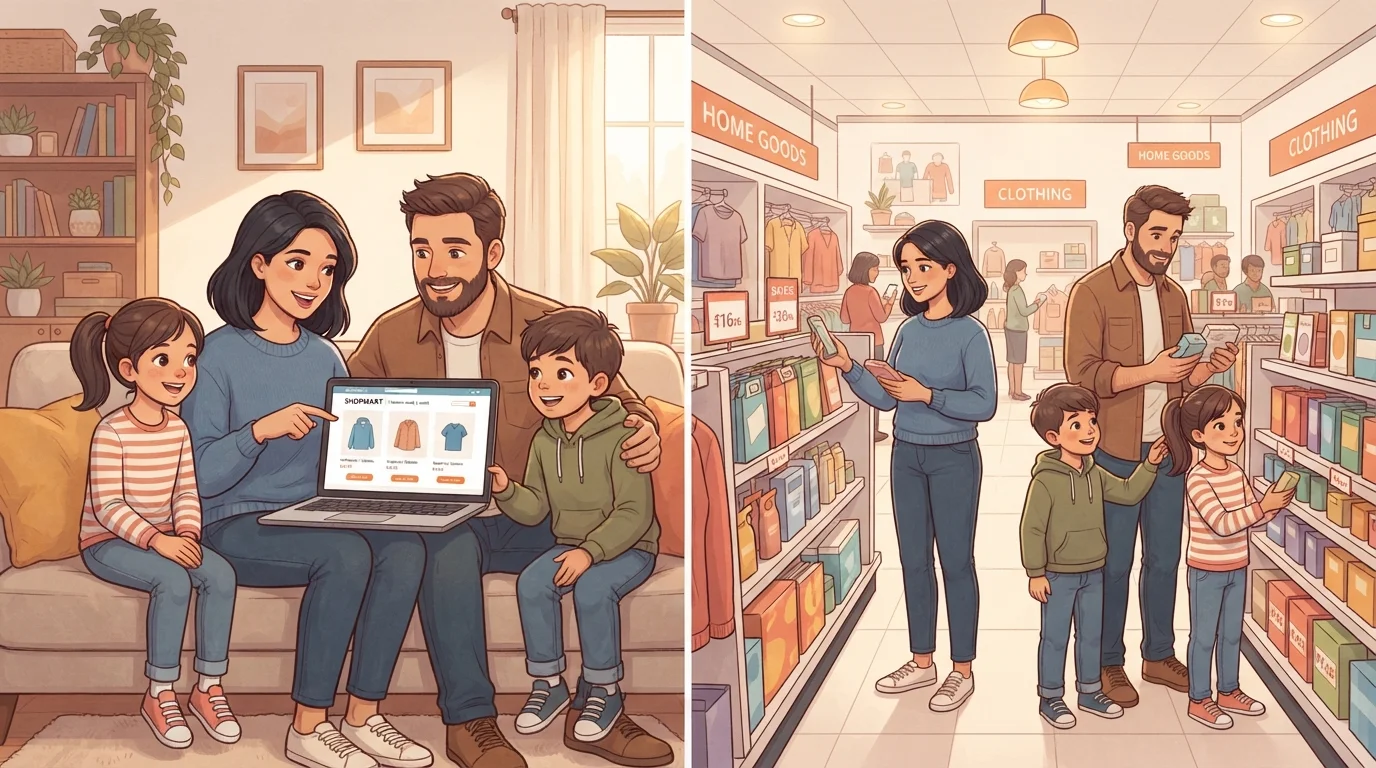
Online shopping means browsing and purchasing products through websites or apps, with items shipped to you or available for pickup. In-store shopping means physically visiting a retail location to select and buy products on the spot. The two channels differ not just in convenience but in pricing structures, product availability, return logistics, and the ability to evaluate an item before buying.
Retailers sometimes use dynamic pricing algorithms online, meaning the same product's price can shift based on demand, browsing history, or geographic location - something that generally doesn't apply in physical stores.
What Actually Separates the Two Channels
The instinct to frame online versus in-store as a simple convenience trade-off misses most of what actually matters. The channels differ across at least five practical dimensions: pricing transparency, product evaluation, return logistics, impulse-buying dynamics, and total transaction cost.
Neither channel is universally superior. The right choice depends on what you're buying, how much risk you're comfortable absorbing, and what your household actually needs from the shopping experience. See the full picture on online and in-store shopping for families for a more comprehensive breakdown.
~20%
Average online return rate for apparel
Industry estimates from the National Retail Federation suggest apparel sees some of the highest return rates in e-commerce, often driven by fit and color discrepancies.
65%
U.S. shoppers who check prices online before buying in-store
According to Forrester Research data cited in retail industry reports, the majority of in-store shoppers conduct prior online price research, reflecting how the channels have become interdependent.
3-5x
Higher return rate online vs. in-store across categories
Multiple retail industry analyses have found that online purchases are returned at a significantly higher rate than in-store purchases, largely due to the inability to evaluate products before buying.
Pricing: More Complicated Than It Looks
Online pricing is not static. Algorithms adjust prices based on demand, time of day, browsing history, and even your location. A product priced at one amount in the morning may cost more by afternoon. In-store shelf prices, by contrast, are generally consistent across a shopping day, though promotional tags can still be misleading if the reference price was inflated.
Shipping costs are the other hidden variable. Free shipping thresholds can push families to overspend to qualify, while expedited options can add meaningfully to an item's real cost. For a sharper look at how pricing varies across channels, including app-exclusive deals, see how multichannel pricing works.
Calculate total cost, not just sticker price
Before assuming an online price is lower, add shipping, any potential return shipping, and account for delivery timing. For in-store, factor in travel costs if the store isn't local. The real cost comparison is often closer than the headline price suggests.
Quality Assessment and the Evaluation Gap
One of the most underappreciated advantages of in-store shopping is the ability to evaluate a product before committing. Fabric weight, shoe fit, furniture scale, color accuracy on a paint sample - these are assessments that photos, even high-quality ones, cannot reliably replicate.
Product reviews partially fill this gap online, but review quality varies widely, and some are not independently verified. For categories where physical characteristics drive satisfaction - apparel, footwear, home furnishings, produce - in-store evaluation reduces the likelihood of costly returns.
Returns: Where the Channel Difference Bites Hardest
Return policies are frequently where families discover the real cost of their channel choice. Online purchases may require original packaging, specific carrier drop-offs, restocking fees, or self-funded return shipping. In-store returns tend to be more immediate and less logistically demanding.
Importantly, the same retailer can apply different return rules depending on whether the purchase was made online or in-store. Before buying anything likely to need a return - seasonal items, gifts, sizing-uncertain clothing - read the channel-specific policy. The full breakdown of return policies across channels covers what to check before you buy.
Impulse Buying Looks Different in Each Channel
Both channels are engineered to encourage unplanned purchases, but the mechanisms differ. In-store, it's aisle placement, end caps, and checkout-lane products. Online, it's algorithmic recommendations, countdown timers, "frequently bought together" prompts, and one-click purchasing that removes friction.
Families who budget carefully should recognize that neither environment is neutral. Building a list before shopping - in any channel - and sticking to it is one of the most reliable tactics for avoiding unplanned spend. Understanding the difference between price and value can help reinforce that discipline.
Channel loyalty programs add another layer
Many retailers offer different promotions depending on whether you shop via their app, website, or physical store. App-exclusive pricing and in-store-only coupons mean the effective price for the same item can differ by channel even at the same retailer. Checking all available channels before purchasing at a familiar retailer is worth the extra minute.
Matching the Channel to the Category
Experienced shoppers tend to develop category-level habits rather than loyalty to a single channel. Standardized products with fixed specifications - a specific electronics model, a known brand of household staple, a textbook with an ISBN - translate well to online purchasing because the product is identical regardless of where it's sold. Categories requiring physical assessment, or where sizing and condition matter significantly, are often better served in-store.
A practical framework for splitting your shopping between channels can help families stop guessing and build deliberate habits. For grocery-specific decisions, the trade-offs between digital carts and supermarket aisles are worth examining separately, since fresh food adds its own layer of complexity.
“Consumers increasingly move fluidly between channels - researching online, touching a product in-store, and completing the transaction wherever the terms work best for them. Retailers that don't account for this behavior leave money on the table and frustrate shoppers.”
— National Retail Federation, U.S. retail industry trade association, consumer research publications