

Key Takeaways
- SPF measures UVB protection only - look for 'broad spectrum' on the label for UVA coverage too.
- SPF 30 blocks about 97% of UVB rays; SPF 50 blocks roughly 98% - the difference is modest.
- Most people apply far less sunscreen than lab-tested amounts, reducing actual protection significantly.
- Reapplication every two hours matters more than choosing a very high SPF number.
- Skin type and sun exposure duration should guide your SPF choice, not marketing claims.
- No sunscreen provides 100% UV protection regardless of its SPF number.
Sun Protection Factor (SPF)
SPF is a measure of how well a sunscreen filters out UVB rays - the type of ultraviolet radiation primarily responsible for sunburn and a key contributor to skin cancer risk. The number indicates how much longer protected skin can be exposed to UVB before burning, compared to unprotected skin. It does not measure protection against UVA rays, which penetrate more deeply and contribute to premature aging.
SPF ratings are determined under lab conditions using 2 mg/cm² of product - roughly twice the amount most people apply in practice, which means real-world protection is typically lower than the label number suggests.
The Math Behind the Number
SPF is not a measure of strength in the way that, say, a pain reliever dosage is. It is a ratio. If unprotected skin begins to show sunburn after 10 minutes of UV exposure, an SPF 30 sunscreen theoretically extends that threshold to 300 minutes - 30 times longer. In practice, this calculation depends heavily on the amount of product applied, how evenly it is spread, and environmental conditions like sweating or swimming.
The protection percentages are where the numbers become most meaningful. SPF 15 filters approximately 93% of UVB rays. SPF 30 moves that to about 97%. SPF 50 reaches roughly 98%. At very high SPF values - 75, 100 - the additional UVB blocked is minimal, often less than a single percentage point above SPF 50. This is why the U.S. Food and Drug Administration (FDA) has historically proposed capping SPF labels at 50+ to prevent misleading consumers into thinking higher numbers offer dramatically greater protection.
93%
UVB rays blocked by SPF 15
According to FDA testing methodology, SPF 15 filters approximately 93% of UVB radiation under standardized lab conditions.
97%
UVB rays blocked by SPF 30
SPF 30 offers a modest but meaningful improvement over SPF 15, blocking roughly 97% of UVB rays in controlled testing.
~1%
Additional UVB blocked above SPF 50
Moving from SPF 50 to SPF 100 adds only about 1 percentage point of UVB filtration, illustrating the law of diminishing returns at high SPF values.
UVB vs. UVA: What SPF Doesn't Tell You
A critical piece of context: SPF only measures protection against UVB rays. UVB rays are the primary cause of sunburn and play a significant role in skin cancer development. But UVA rays - which penetrate more deeply into the skin - are associated with photoaging, collagen breakdown, and also contribute to cancer risk. They pass through clouds and glass, making year-round and indoor-adjacent exposure a real consideration.
The label term to look for is broad spectrum. Under FDA regulations, a sunscreen may only display this claim if it passes a specific UVA protection test. A high SPF number without broad-spectrum coverage leaves a meaningful gap in your protection profile. For a deeper look at how UV filters work chemically and physically, see our guide to physical vs. chemical sunscreens.
SPF Does Not Cover UVA Rays Alone
Because SPF is strictly a UVB measure, a product with a very high SPF but no broad-spectrum claim could leave you significantly exposed to UVA radiation. Always check for both the SPF number and the 'broad spectrum' designation on the label. In the US, the FDA regulates this terminology specifically to prevent misleading claims.
Choosing the Right SPF for Your Situation
The right SPF level depends on your skin, your environment, and how long you'll be outside - not on marketing language. A few practical frameworks:
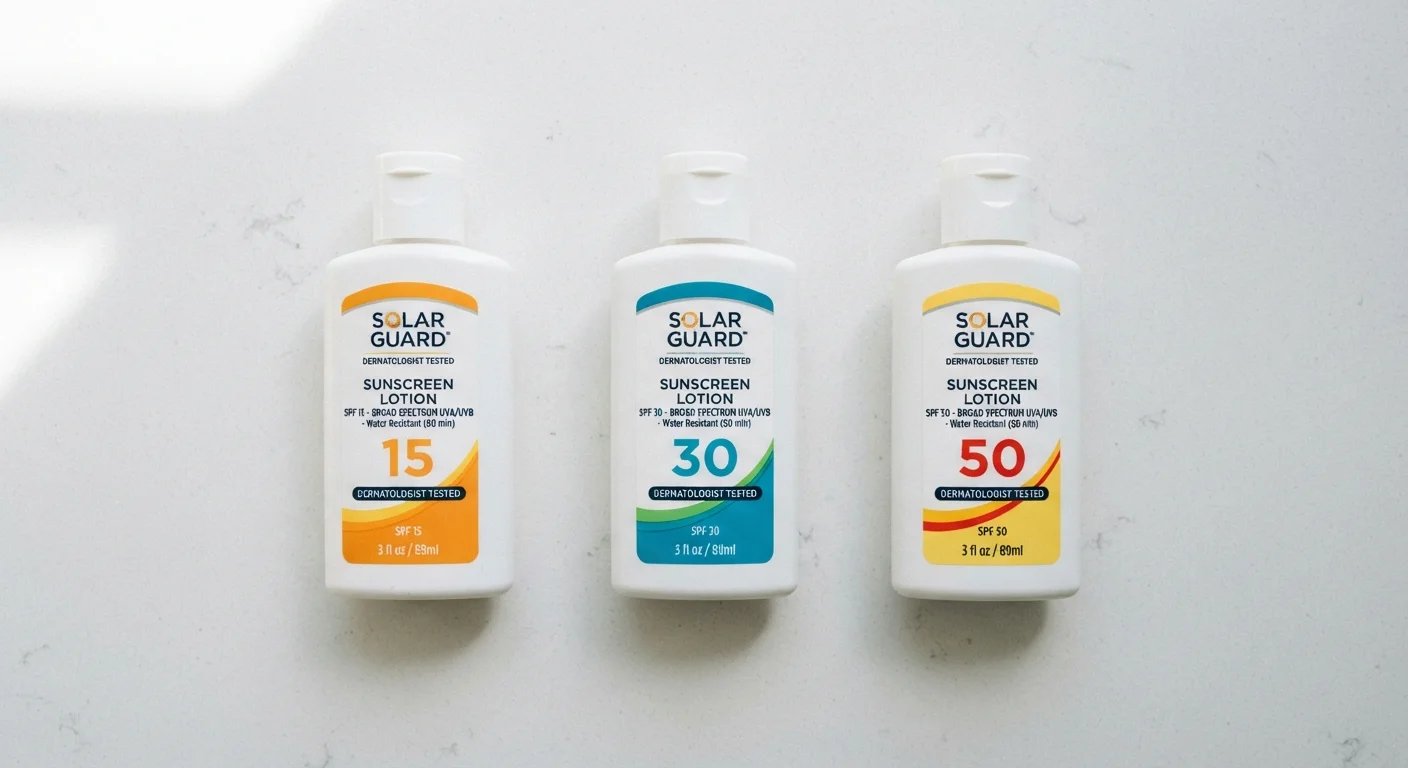
- SPF 15 is generally considered adequate for brief, incidental sun exposure on people with naturally deeper skin tones who are not spending significant time outdoors. Most dermatology guidance, however, now recommends at least SPF 30 as a daily baseline for the broadest range of skin types.
- SPF 30 is the most widely recommended level for everyday use - commuting, school runs, and errands. It filters about 97% of UVB rays and offers meaningful protection for most fair to medium skin tones with typical daily exposure.
- SPF 50 is the practical ceiling for most people, recommended for extended outdoor activities, beach or pool days, high-altitude settings, or those with heightened sensitivity. Beyond SPF 50, the real-world difference in protection is negligible.
Your skin type plays a role in this decision too. Understanding your skin type can help you identify whether formulation factors - such as how a sunscreen interacts with oily or sensitive skin - matter as much as the SPF number itself.
Match SPF to Your Activity, Not Just Your Skin
Even if your skin tans easily and rarely burns, UV exposure accumulates over time and contributes to long-term skin changes regardless of visible burning. Dermatology organizations generally recommend SPF 30 as a minimum for all skin types during regular daily exposure. For outdoor sports or beach days lasting several hours, SPF 50 with regular reapplication is a more appropriate baseline.
Application: Where Most Protection Is Lost
Lab SPF testing uses 2 milligrams of product per square centimeter of skin - a generous, precisely measured amount. Research suggests most people apply somewhere between 25% and 50% of that quantity in everyday use. The practical consequence: a sunscreen labeled SPF 50 may function closer to SPF 10-15 when under-applied.
Practical habits that close this gap include applying sunscreen as the final skincare step before going outside, giving it a few minutes to absorb, and not skimping on coverage areas like the ears, back of the neck, and tops of the feet. Reapplying every two hours - and after water exposure or heavy sweating - is consistently cited by dermatology organizations as more impactful than choosing a very high SPF number in the first place.
Reading ingredient labels closely can also help you understand what you're actually applying. Our guide to cosmetic ingredient labels breaks down how to interpret INCI names and active ingredient listings on sunscreen and other skincare products.
This article is for general informational and educational purposes only and does not constitute medical or dermatological advice. Consult a qualified healthcare professional for guidance specific to your skin health needs.