

Key Takeaways
- Not all appliances are equal priorities - focus on food storage, cooking, and laundry first.
- Capacity and energy efficiency ratings have a direct, measurable impact on daily running costs.
- Many desirable features are worth delaying until your budget and habits are clearer.
- Measuring your space before you buy prevents costly delivery and fit problems.
- Smart appliance features add convenience but should not be a primary buying factor for first-timers.
Start here
Why Appliance Choices Feel Overwhelming (and How to Simplify Them)
Next
Tier 1: Appliances You Need from Day One
Then
Specs That Actually Matter vs. Specs You Can Ignore
When you're ready
What Can Wait (and Why That's OK)
Why Appliance Choices Feel Overwhelming (and How to Simplify Them)
Walking into a home improvement store - or opening a retailer's website - for the first time as a homeowner can stop you in your tracks. Hundreds of models, dozens of specs, and an alphabet soup of ratings all compete for your attention at once. The antidote is a simple framework: not every appliance has the same priority, and not every spec matters equally to your household.
Think of appliances in tiers. The first tier covers what you genuinely cannot function without from the moment you move in. The second tier consists of appliances that improve daily life meaningfully but can be acquired over the first year as your budget allows. Everything else - the conveniences and extras - can wait until you understand your actual usage patterns.
Before you buy anything, measure your spaces carefully. Delivery surprises are among the most common (and avoidable) frustrations for first-time buyers. Our pre-delivery preparation guide covers every clearance and connection check you should make before a purchase is confirmed.
Energy efficiency rating
A standardized label (often a letter grade or star system) that tells you how much energy an appliance uses relative to others of the same type. A higher rating means lower running costs over time.
Capacity
The usable interior volume of an appliance - measured in cubic feet for refrigerators, kilograms for washers, or place settings for dishwashers. It tells you how much the appliance can handle in a single use.
Freestanding appliance
An appliance that stands on its own and is not built into cabinetry. It can be repositioned and is generally easier to replace without kitchen modifications.
Integrated appliance
An appliance designed to sit behind a cabinet door so it blends into your kitchen cabinetry. It looks seamless but typically costs more and is harder to swap out.
Front-load washer
A washing machine where the door is on the front and the drum spins horizontally. These models generally use less water per cycle and can be stacked with a dryer to save floor space.
dB (decibel) rating
A measurement of how loud an appliance is during operation. Lower dB numbers mean quieter operation - an important consideration for dishwashers or washers in open-plan homes.
Tier 1: Appliances You Need from Day One
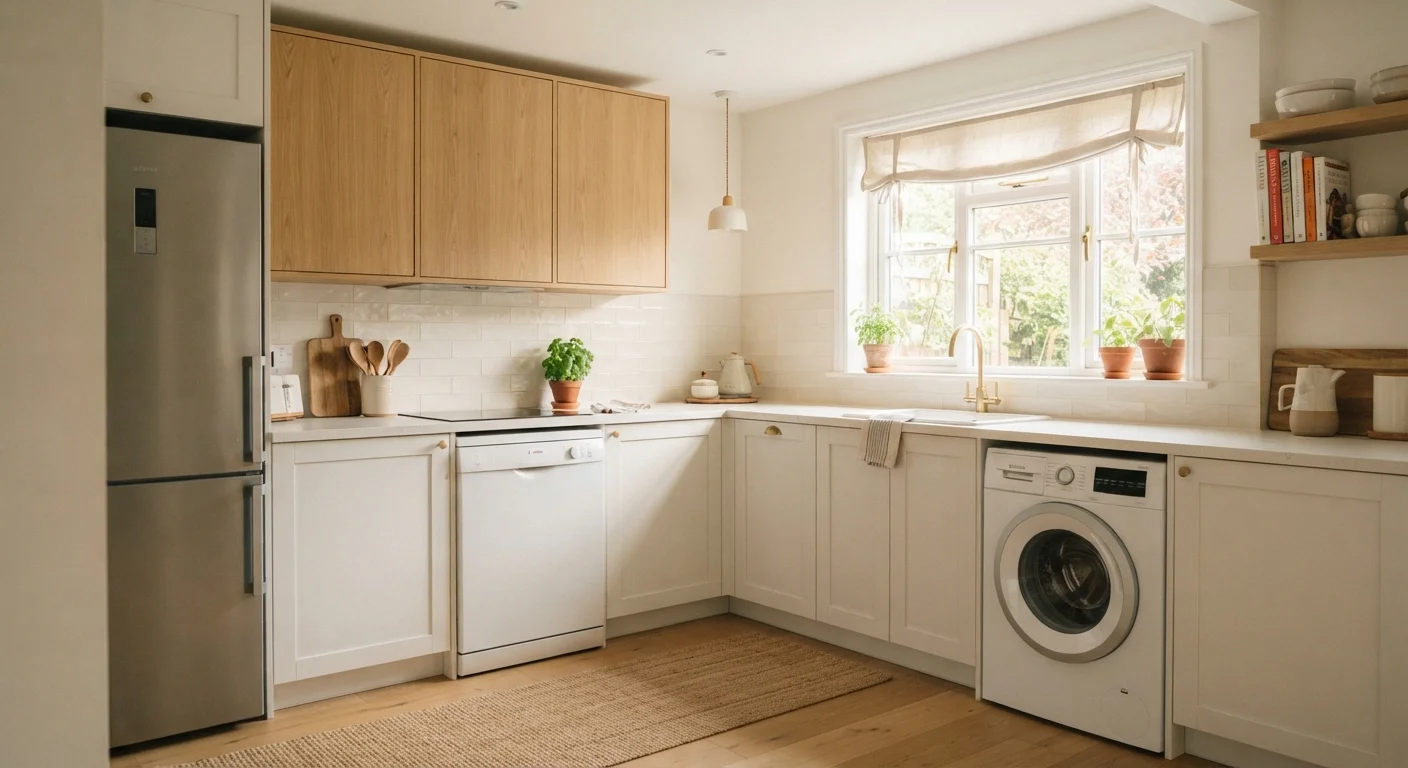
Three appliance categories genuinely belong in Tier 1 for most households:
- Refrigerator / freezer: Food safety depends on it. Capacity matters more than features here - a general guideline is roughly 4-6 cubic feet of refrigerator space per adult in the household, though your actual food shopping habits will quickly clarify what you need. If you're unsure which format suits your kitchen layout, our fridge-freezer format explainer breaks down freestanding, integrated, and larger side-by-side options.
- Cooking appliance: Whether that's a freestanding range, a separate cooktop with a wall oven, or a countertop solution depends heavily on your kitchen layout and lease or ownership terms. Focus on whether the appliance runs on gas or electric before anything else, since that's determined by what connections your home actually has.
- Washer (and ideally dryer): Laundry is a weekly necessity. A washer without a dryer is workable if you have outdoor drying space or a communal dryer, but a combined solution removes a significant friction point. Front-load models generally use less water per cycle than top-load models, though they vary in drum capacity and cycle times.
Check Connections Before You Commit
Before finalizing any Tier 1 appliance purchase, confirm what utility connections are already in place - gas line vs. electric outlet for cooking, hot and cold water inlets for a washer, and dedicated circuit capacity for large appliances. Retrofitting a connection after purchase can add significant cost and delay.
Tier 2: Appliances Worth Adding Within the First Year
Once your essentials are covered, these appliances offer meaningful improvements to daily life without being emergencies:
- Dishwasher: If a dishwasher connection exists in your kitchen, filling it sooner rather than later tends to save both time and water compared with hand-washing equivalent volumes.
- Microwave: Often underrated as a proper cooking tool, a countertop or over-range microwave handles reheating, defrosting, and certain cooking tasks that would otherwise require more energy-intensive appliances.
- Vacuum cleaner: Technically not a major appliance, but households consistently underestimate how much they need a reliable one from day one - particularly if pets are part of the picture. If you're also welcoming a pet into a new home for the first time, our guide for families bringing home a new pet covers what to expect in the first weeks.
Specs That Actually Matter vs. Specs You Can Ignore
Appliance listings are full of numbers - many of which have limited relevance to everyday family use. Here's a practical filter:
| Spec | Why it matters |
|---|---|
| Energy efficiency rating | Directly affects monthly utility bills for appliances used daily or continuously |
| Capacity (cubic feet / kg / place settings) | Determines whether the appliance actually fits your household's volume of use |
| Noise level (dB rating) | Relevant for dishwashers and washing machines in open-plan living spaces |
| Cycle options / programmes | Useful variety is 4-6 genuine options; anything beyond that is rarely used |
| Wi-Fi / app connectivity | Convenient in specific scenarios; rarely a deciding factor for first-time buyers |
For families considering connected appliances, our article on smart appliances: genuine benefits and real limitations offers an honest breakdown of what these features deliver in practice.
Smart Features: A Second-Purchase Consideration
Wi-Fi connectivity and app controls can add genuine convenience - remote start, cycle notifications, diagnostic alerts - but they also require a stable home network and occasional software updates. For most first-time buyers, these features are worth considering on a second appliance purchase once your household routines are established, not on the initial buy when reliability and capacity should take priority.
What Can Wait (and Why That's OK)
First-time buyers often feel pressure to have a fully equipped home immediately. Resist it. Appliances like stand-alone chest freezers, range hoods with premium extraction, wine coolers, and countertop specialty appliances (air fryers, espresso machines, bread makers) all serve real purposes - but their value depends entirely on your established habits, not your aspirations on moving day.
Buying these items after you've lived in the space for a few months means you'll make far better decisions about capacity, placement, and whether you actually need them. Your household budget strategy benefits from this discipline too - money not spent on appliances you don't yet need is money available for the things you discover you do need.
If you're eventually planning to build out a more connected home, starting with a clear plan is smarter than adding smart features reactively. Our guide to building your first smart home explains how to lay the groundwork without painting yourself into a corner.
For broader household purchasing habits and how to read value across product categories, the guidance in smart shopping for families is a practical companion to the decisions covered here.