
Fridge Freezer Formats: Understanding the Difference Between Freestanding, Integrated, and American-Style

Key Takeaways
- Freestanding units are the most flexible and easiest to replace, making them practical for renters and first-time buyers.
- Integrated fridges sit behind cabinet doors for a seamless look but cost more and are harder to swap out.
- American-style units offer the largest total capacity and are suited to larger kitchens and families with high storage needs.
- Format choice affects installation complexity, cabinet requirements, and ongoing energy use.
- Checking energy ratings before purchasing any format can significantly influence long-term household running costs.
Fridge-Freezer Format
A fridge-freezer format describes the physical design and installation style of a combined refrigerator and freezer unit. The three main formats - freestanding, integrated, and American-style - differ in how they fit into a kitchen, how much storage they offer, and what kind of installation they require. Choosing the right format affects your kitchen layout, daily convenience, and long-term running costs.
Capacity is measured in liters for fridge and freezer compartments separately; total usable volume varies significantly across formats and should be cross-referenced with your household size.
Freestanding Units: The Practical Default
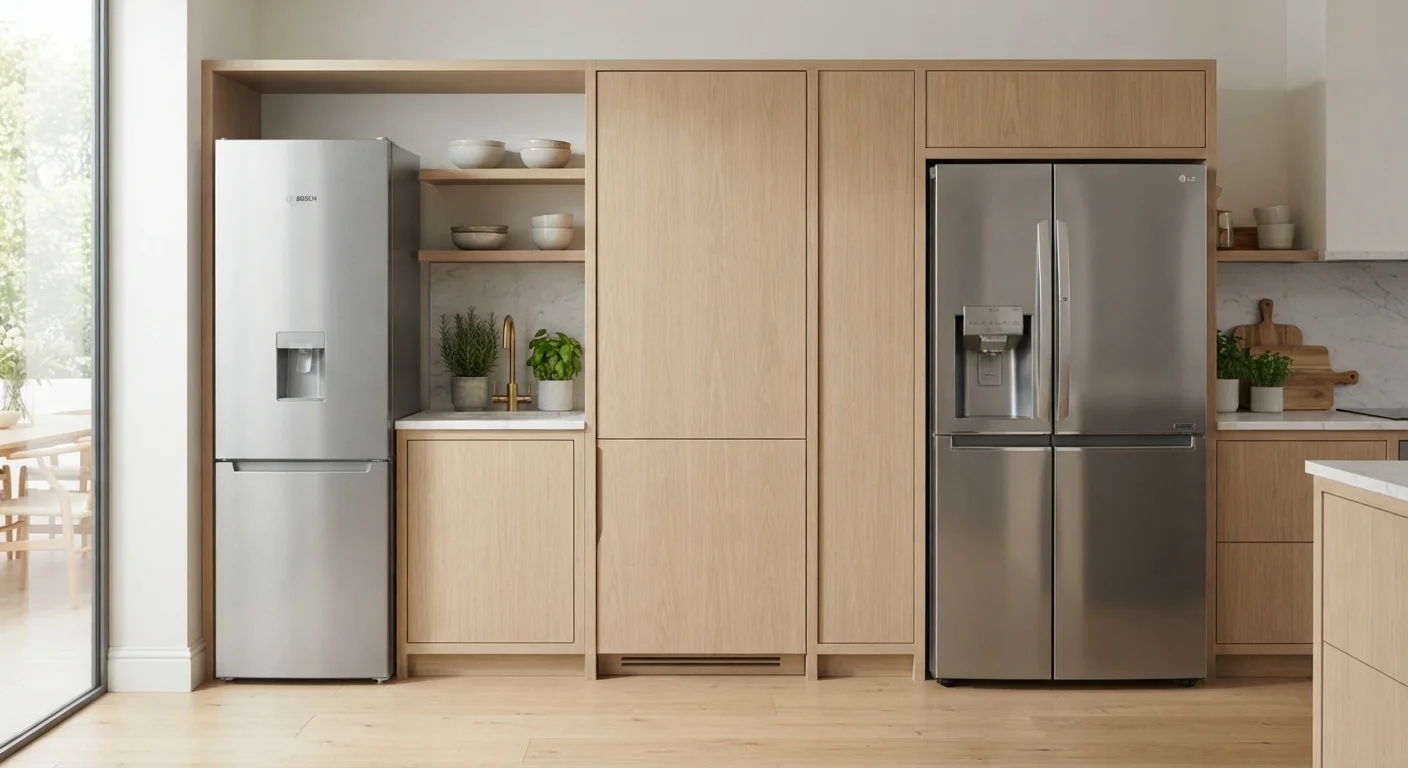
A freestanding fridge-freezer is a self-contained appliance finished on all sides. It plugs into a standard outlet, requires no custom cabinetry, and can be positioned almost anywhere with adequate ventilation clearance. This makes it the most common choice for renters, first-time buyers, and households that prioritise flexibility.
These units come in a wide range of sizes - from compact single-door models to tall 70/30 or 60/40 split configurations, where the ratio describes how the total height is divided between fridge and freezer. A 70/30 split gives more fridge space, which suits families who shop fresh produce frequently. See how to match appliance capacity to your household size before settling on a configuration.
The main trade-off is aesthetics: freestanding units have visible sides and typically sit slightly in front of adjacent cabinets, which can break the visual flow of a fitted kitchen. For households where practicality outweighs design uniformity, this is rarely a concern.
Measure Before You Commit
Before choosing any format, measure the available space in your kitchen including height, width, and depth - and don't forget to account for door swing clearance. Also check the ventilation gap requirements in the appliance's manual; restricting airflow reduces efficiency and can shorten the unit's lifespan.
Integrated Units: Built for Kitchen Continuity
An integrated fridge-freezer is designed to sit entirely within a kitchen cabinet unit, concealed behind a door that matches the rest of your cabinetry. From a design perspective, this creates a seamless, uninterrupted kitchen aesthetic - no exposed appliance panels visible.
Integrated units are almost always installed during a kitchen fit-out or renovation because the surrounding cabinetry must be built or adapted to specific dimensions. Replacing an integrated unit later is more involved: the new appliance must match the housing dimensions precisely, and the cabinet door mechanism must be compatible.
Total capacity on integrated models is typically lower than freestanding equivalents of the same height, because the cabinet housing adds depth around the unit. Households with high weekly grocery volumes should check the litre figures carefully rather than assuming the external footprint reflects usable interior space. If you're setting up a kitchen from scratch, this first-time buyer appliance guide explains how to plan around major appliance decisions.
Cabinet Compatibility Matters
Integrated appliances are not universally interchangeable. Door-hinge systems, fixing mechanisms, and dimensional tolerances vary between manufacturers. If you're replacing an existing integrated unit, confirm that the new appliance is compatible with your existing cabinet housing before purchasing.
American-Style Units: High Capacity, Larger Footprint
An American-style fridge-freezer - sometimes called a side-by-side - places the fridge and freezer in two full-height columns next to each other. The result is a wide, large-capacity unit that typically offers 500 liters or more of total storage across both compartments.
These units are well suited to households that buy groceries in bulk, store significant quantities of frozen food, or simply want easy access to both sections at eye level without bending. Because both compartments run the full height of the unit, there's no top-heavy or bottom-heavy layout to navigate.
500 L+
Typical total capacity of American-style units
Most American-style fridge-freezers offer 500 liters or more combined, compared to 250-350 liters for standard freestanding models.
90 cm+
Typical width of American-style models
Standard freestanding fridge-freezers are usually 55-70 cm wide; American-style units typically start at 90 cm, requiring significantly more kitchen floor space.
70/30
Common freestanding split favoring fridge space
The 70/30 configuration allocates roughly 70% of the unit's height to the fridge compartment, a popular choice for families who prioritise fresh food storage.
The footprint is the key consideration. Most American-style units are substantially wider than standard freestanding models, so kitchen layout and doorway clearance both matter. Running costs also tend to be higher in absolute terms - not necessarily because they are less efficient per liter, but because there is simply more volume to keep cold. Checking the energy label on any shortlisted model is always worthwhile; see what energy labels actually tell you for a plain-language explanation of those figures.
Some American-style models include plumbed-in ice makers and water dispensers. These features add convenience but require a water supply connection during installation and introduce additional components that may need maintenance over time.
Choosing the Right Format for Your Household
The right format comes down to three practical questions: how your kitchen is laid out, how much storage your household realistically needs, and how long you expect to stay in the property.
Renters and households in transition are generally better served by freestanding units - easy to move, easy to replace, and available across the widest price range. Homeowners undertaking a full kitchen renovation have more reason to consider integrated units for aesthetic cohesion. Larger families or households that rely heavily on frozen foods - worth considering alongside what families should know about frozen vs. fresh produce - may find the generous freezer space in an American-style unit genuinely useful day to day.
For unfamiliar appliance terminology that comes up during your research, the household appliance glossary covers common specs and jargon in plain terms. And if budget is a primary concern across all your appliance decisions, the budget-smart buying hub offers broader strategies for stretching household spending without sacrificing quality.