

Key Takeaways
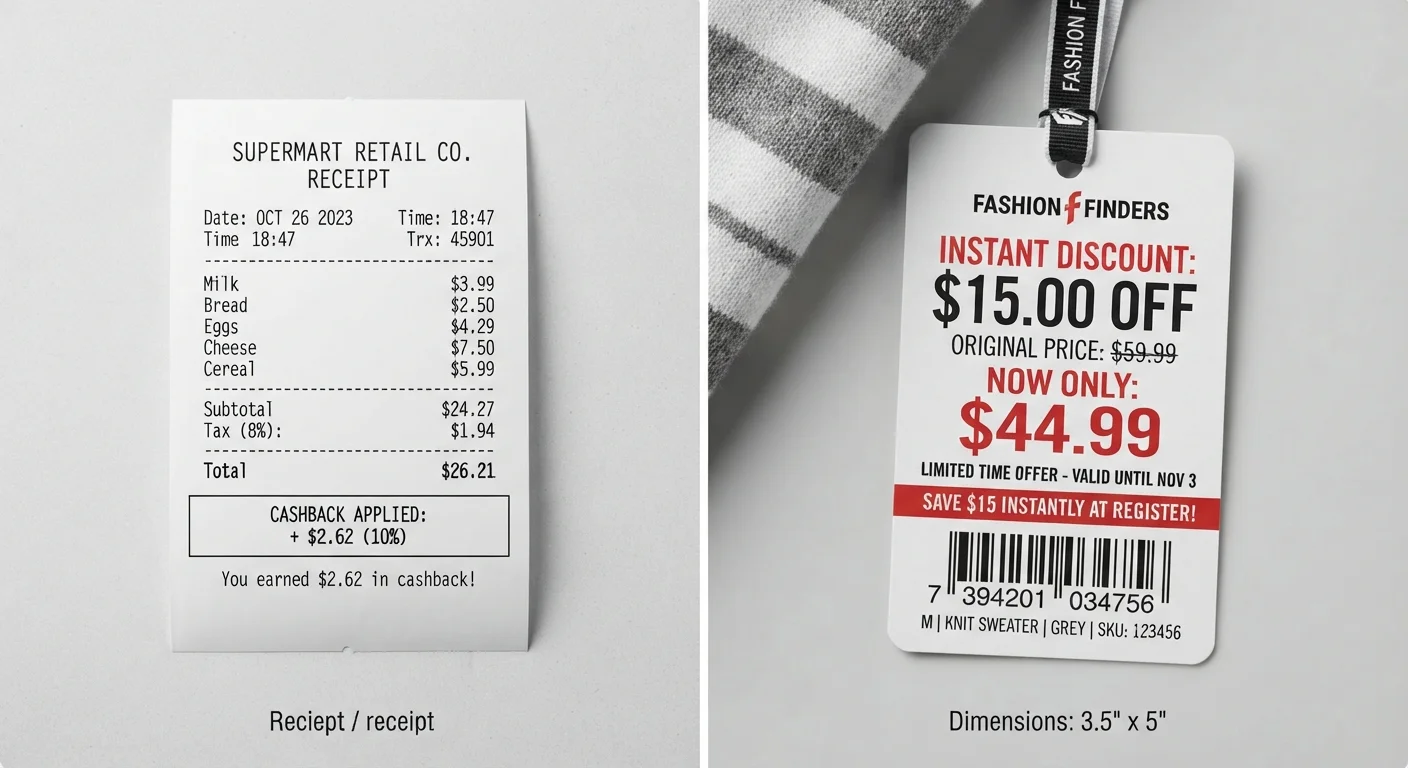
- Upfront discounts reduce what you pay immediately; cashback returns money only after a qualifying process.
- Cashback often comes with conditions - minimum spend thresholds, expiry dates, or portal requirements - that can erode the stated value.
- Unclaimed cashback is a common source of quiet profit for retailers and programme operators.
- An upfront discount is guaranteed savings; cashback is a conditional promise.
- Comparing offers requires calculating net cost, not just the headline figure on either scheme.
Option A
Cashback Schemes
The delayed-return model that pays you back after purchase.
Best for: Shoppers who can absorb the full upfront cost and remember to claim their reward consistently.
Option B
Upfront Discounts
The immediate price cut applied at the point of sale.
Best for: Budget-conscious families who need the lower price reflected in what they actually hand over at checkout.
If your household budget is tight and you need certainty at checkout
Upfront Discounts
The saving is immediate and unconditional - no claiming process, no risk of the reward expiring before you redeem it.
If you're a disciplined shopper who tracks claims and reads the fine print
Cashback Schemes
For organised households, cashback can stack meaningfully over time - provided every condition is met and claims are submitted promptly.
If you're evaluating a large one-off purchase like an appliance
Upfront Discounts
On high-value single purchases, an instant price reduction is simpler to verify and less exposed to programme changes or company policy shifts.
If you shop regularly through a specific retailer or platform
Cashback Schemes
Frequent, habitual purchases through a consistent channel let cashback accumulate without extra effort, making the delayed-return model more practical.
How Each Model Actually Works
An upfront discount reduces the listed price before or at the point of sale. You see a lower figure on the shelf, at checkout, or in your cart - and that's the number charged to your card. No further action required.
A cashback scheme works differently. You pay the full price (or a promoted price) at purchase, then receive a portion of that amount returned to you later - via a cheque, bank transfer, statement credit, or reward wallet. That return is almost always conditional. Common conditions include registering a claim within a set window, purchasing through a specific portal or app, meeting a minimum spend, and accepting that the reward may arrive weeks or months later.
Understanding this structural difference matters because the headline figures can look equivalent. A $20 cashback on a $200 product and a $20 upfront discount both appear to leave you $180 poorer - but only the latter guarantees it. What makes a discount genuine depends on whether the saving is real, unconditional, and actually received.
| Criterion | Cashback Schemes | Upfront Discounts |
|---|---|---|
| When savings are received | After purchase, often weeks later | Immediately at point of sale |
| Certainty of saving | Conditional on claim eligibility | Guaranteed at checkout |
| Action required | Registration, claim submission | None beyond the purchase |
| Risk of non-receipt | Present (expiry, programme closure) | None |
| Data sharing typically required | Yes, usually | Rarely |
| Impact on upfront budget | Full price paid initially | Reduced price paid initially |
| Potential to encourage overspending | Higher (minimum spend thresholds) | Lower |
The Hidden Costs of Cashback
Cashback programmes are structured around the reality that a meaningful share of offered rewards go unclaimed. Consumers forget to submit claims, miss deadlines, or don't meet eligibility requirements. This unclaimed value is sometimes called breakage in industry terminology, and it benefits the programme operator, not the shopper.
Beyond breakage, cashback schemes can involve data collection as part of their value exchange. Registering for a programme typically means providing personal and purchase information. For a fuller look at how these schemes are structured around your behaviour, see how loyalty programmes handle your data.
There are also timing risks. If a retailer closes or a programme is discontinued between your purchase and your scheduled payout, your pending cashback may be lost. Upfront discounts carry no such counterparty risk - the transaction is complete at checkout.
~40%
Estimated cashback breakage rate in some programmes
Industry analyses have suggested that a substantial share of cashback rewards go unclaimed, though rates vary widely by programme structure and consumer awareness.
6-12 weeks
Typical cashback processing window
Many retail cashback programmes disclose processing times of six to twelve weeks in their terms, meaning the saving is delayed well past the purchase date.
Comparing Offers Side by Side
When you encounter both types of offer simultaneously - a cashback deal and an upfront promotion on competing products - calculate the net cost under realistic conditions, not ideal ones. Ask:
- Will you actually complete the cashback claim process?
- Does the cashback require spending through a specific channel that changes your behaviour?
- What is the time value of your money sitting with the retailer or programme operator before the return arrives?
- Are there minimum spend requirements that would push you to buy more than planned?
This last point connects to a broader pattern worth examining. Bulk purchase incentives follow a similar logic - the per-unit saving is real only if you needed that quantity in the first place. Cashback that requires a larger basket to unlock functions the same way: net savings can vanish once you account for the extra spend it induced.
For context on how retailers structure both types of offer to appear more attractive than they are, common pricing tactics are worth reviewing before making any major purchase decision.
This Article Is General Information Only
The comparisons here are educational and do not constitute financial or purchasing advice tailored to your situation. Terms, conditions, and programme structures vary significantly between retailers and providers. Always read the specific terms of any cashback offer or discount promotion before making a purchasing decision. If you are evaluating significant financial commitments, consider speaking with a qualified financial adviser.