

Key Takeaways
- Elaborate grooming routines often cost significantly more without delivering proportional results.
- Layering too many active ingredients can irritate skin rather than improve it.
- Complex routines are harder to maintain consistently, which undermines their effectiveness.
- A streamlined routine with a few well-chosen steps frequently outperforms a lengthy one.
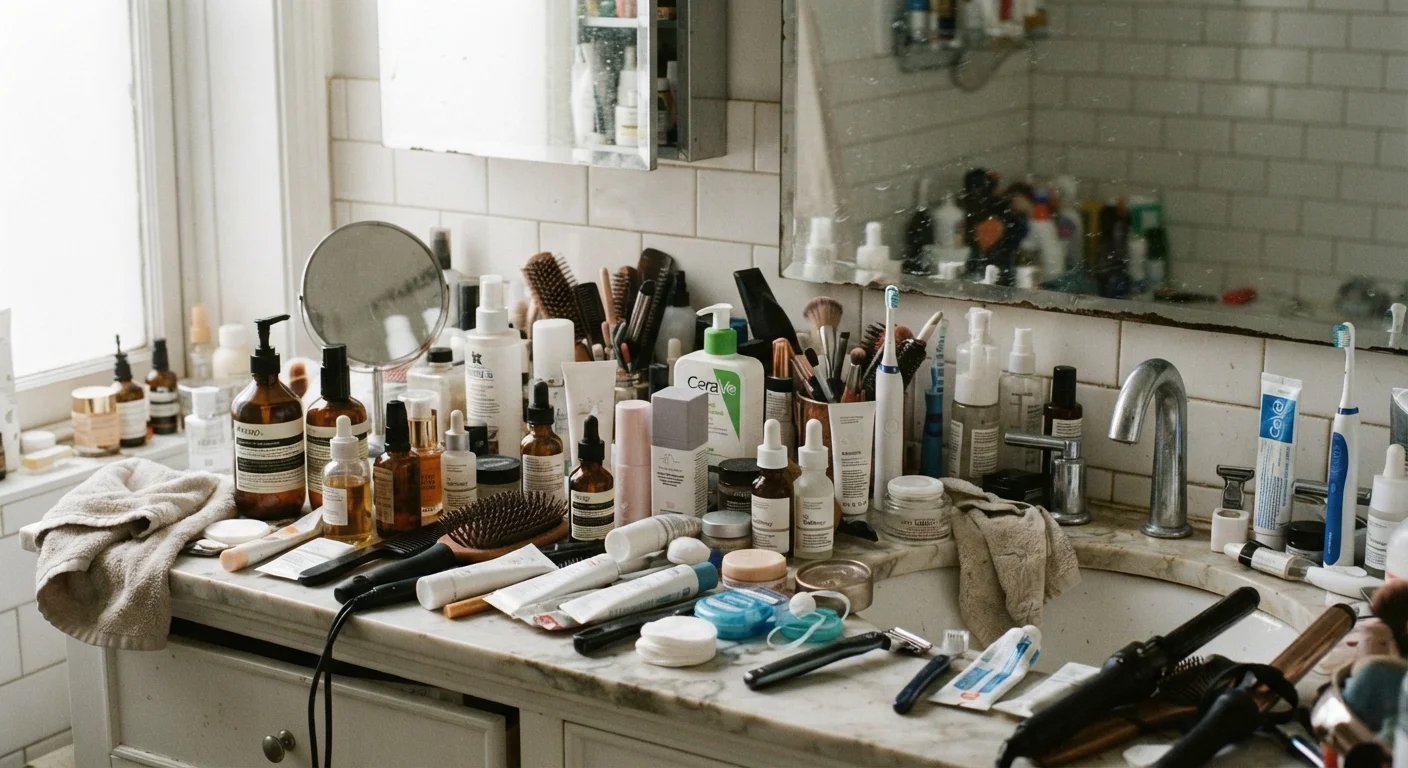
- Product accumulation is a predictable psychological pattern, not a sign of commitment.
Allows targeted treatment of multiple specific concerns
A longer routine can address distinct issues - uneven tone, dryness, and texture - simultaneously, provided each product is genuinely suited to the concern it targets.
Creates a consistent daily ritual with psychological benefits
For some people, a structured grooming routine provides a meaningful pause in a demanding day, with reported benefits for stress management and self-perception.
Enables gradual skin adaptation to active ingredients
Introducing products in a deliberate sequence can help skin adjust to potent actives over time, potentially reducing the risk of initial sensitivity.
Supports comprehensive hair and skin maintenance
Multi-step hair care routines - including targeted scalp treatments - can address underlying conditions that a single product cannot adequately manage.
Cumulative product cost adds up quickly
Eight products at modest price points can easily exceed $100 to $200 per person annually, a figure that multiplies across a household with several members.
Time demands make consistency difficult to maintain
Routines requiring 20 or more minutes are frequently shortened or abandoned during busy periods, which means the promised benefits are rarely fully realized.
Layering actives can compromise skin barrier integrity
Combining multiple exfoliants, acids, or retinoids without dermatological guidance increases the risk of irritation, redness, and long-term barrier damage.
Harder to identify which product is causing a reaction
When a problem develops - breakouts, dryness, sensitivity - a lengthy routine makes it genuinely difficult to isolate the responsible ingredient or product.
Drives product waste through expiry and redundancy
Many active ingredients degrade after opening, and large inventories mean products are often discarded unused - a direct financial loss with no grooming benefit.
Our Verdict
A complicated grooming routine offers genuine appeal - thoroughness, ritual, and the sense of investing in yourself. But the hidden costs in money, time, and skin health are real and easy to underestimate. For most households, a leaner, deliberate approach produces results that are easier to sustain and simpler to budget for.
Anyone who suspects their bathroom shelf has grown beyond what they actually need - or whose routine has become a source of stress rather than a genuine benefit.
What We Mean by a 'Complicated' Routine
A complicated grooming routine typically involves five or more distinct steps, multiple products targeting the same concern, or a sequence demanding precise timing to be effective. Think double cleansing followed by a toner, two serums, an eye cream, a moisturizer, and an SPF - each morning, before the day has started. These routines exist across skincare, hair care, and shaving, and they're often assembled incrementally rather than designed intentionally.
Understanding what drives this accumulation is its own subject. If you've ever wondered why your household ends up with half-used bottles and duplicates, our piece on why households accumulate grooming products walks through the psychology in detail.
This article focuses on the practical trade-offs: what elaborate routines genuinely offer, and what they reliably cost.
The Real Advantages of a Multi-Step Approach
It would be misleading to dismiss complex routines outright. There are legitimate reasons a person might benefit from additional steps - and understanding them helps you decide which ones, if any, apply to your situation.
Allows targeted treatment of multiple specific concerns
A longer routine can address distinct issues - uneven tone, dryness, and texture - simultaneously, provided each product is genuinely suited to the concern it targets.
Creates a consistent daily ritual with psychological benefits
For some people, a structured grooming routine provides a meaningful pause in a demanding day, with reported benefits for stress management and self-perception.
Enables gradual skin adaptation to active ingredients
Introducing products in a deliberate sequence can help skin adjust to potent actives over time, potentially reducing the risk of initial sensitivity.
Supports comprehensive hair and skin maintenance
Multi-step hair care routines - including targeted scalp treatments - can address underlying conditions that a single product cannot adequately manage.
Notably, people with specific skin conditions - such as chronic dryness, hyperpigmentation, or acne - may genuinely require targeted products that a minimal routine cannot address. For those households, the question isn't whether to have multiple steps but which steps are earning their place. See our guide on simplifying routines for sensitive skin for a practical framework on this.
The Costs That Don't Show Up on the Receipt
The sticker price of individual products is only part of the financial picture. A routine with eight products purchased across the year carries cumulative spend that rarely gets tallied until a bathroom audit forces the reckoning.
7-12
Average products in a typical multi-step routine
Consumer surveys on grooming habits suggest the average person using a multi-step routine applies between seven and twelve products across morning and evening sessions.
~30%
Grooming products discarded before fully used
Industry research indicates a significant portion of purchased grooming products are never fully used, contributing to both financial waste and bathroom clutter.
Beyond money, time is a genuine cost. A routine that takes 25 minutes each morning is functionally unsustainable for most working parents. Research into habit formation consistently shows that routines requiring high effort are abandoned more readily - which means the investment yields nothing. Our article on what makes grooming habits sustainable explores the behavioural science behind this in more depth.
Cumulative product cost adds up quickly
Eight products at modest price points can easily exceed $100 to $200 per person annually, a figure that multiplies across a household with several members.
Time demands make consistency difficult to maintain
Routines requiring 20 or more minutes are frequently shortened or abandoned during busy periods, which means the promised benefits are rarely fully realized.
Layering actives can compromise skin barrier integrity
Combining multiple exfoliants, acids, or retinoids without dermatological guidance increases the risk of irritation, redness, and long-term barrier damage.
Harder to identify which product is causing a reaction
When a problem develops - breakouts, dryness, sensitivity - a lengthy routine makes it genuinely difficult to isolate the responsible ingredient or product.
Drives product waste through expiry and redundancy
Many active ingredients degrade after opening, and large inventories mean products are often discarded unused - a direct financial loss with no grooming benefit.
Skin tolerance is another underappreciated factor. Layering multiple active ingredients - acids, retinoids, vitamin C, niacinamide - without understanding their interactions can cause irritation, sensitivity, or barrier disruption. More steps introduce more variables, and more variables make it harder to identify what's helping and what isn't.
Simplifying Without Sacrificing Results
Paring back a routine doesn't mean neglecting yourself - it means being deliberate. A well-constructed three-step routine (cleanse, treat, protect) can address most general grooming needs effectively. The key is selecting steps that serve a clear purpose rather than adding products reactively to address problems that previous products may have caused.
Multi-use formulations - products designed to perform more than one function - are worth evaluating as part of this process. Our editorial on stretching your beauty budget smartly covers where multi-use products genuinely deliver and where they're a compromise not worth making.
For families trying to establish shared grooming habits, simplicity has an additional benefit: routines that are easy to explain and quick to complete are far more likely to be adopted by everyone in the household - including teenagers. Our guide to family grooming routines addresses this directly.
When to Reassess Your Routine
A useful signal that a routine has grown beyond what's working: you regularly skip steps, you can't remember what each product does, or you've noticed new irritation since adding something new. These are practical prompts to audit rather than add. Reducing to essentials and reintroducing products one at a time is a widely recommended approach for isolating what's genuinely helping.
If you're starting from scratch or looking to rebuild a leaner approach, building a bare-minimum skincare routine is a practical starting point - no ten-step regimen required.
This article is for general informational purposes only. It does not constitute medical or dermatological advice. Readers with skin conditions or concerns should consult a qualified healthcare professional.