

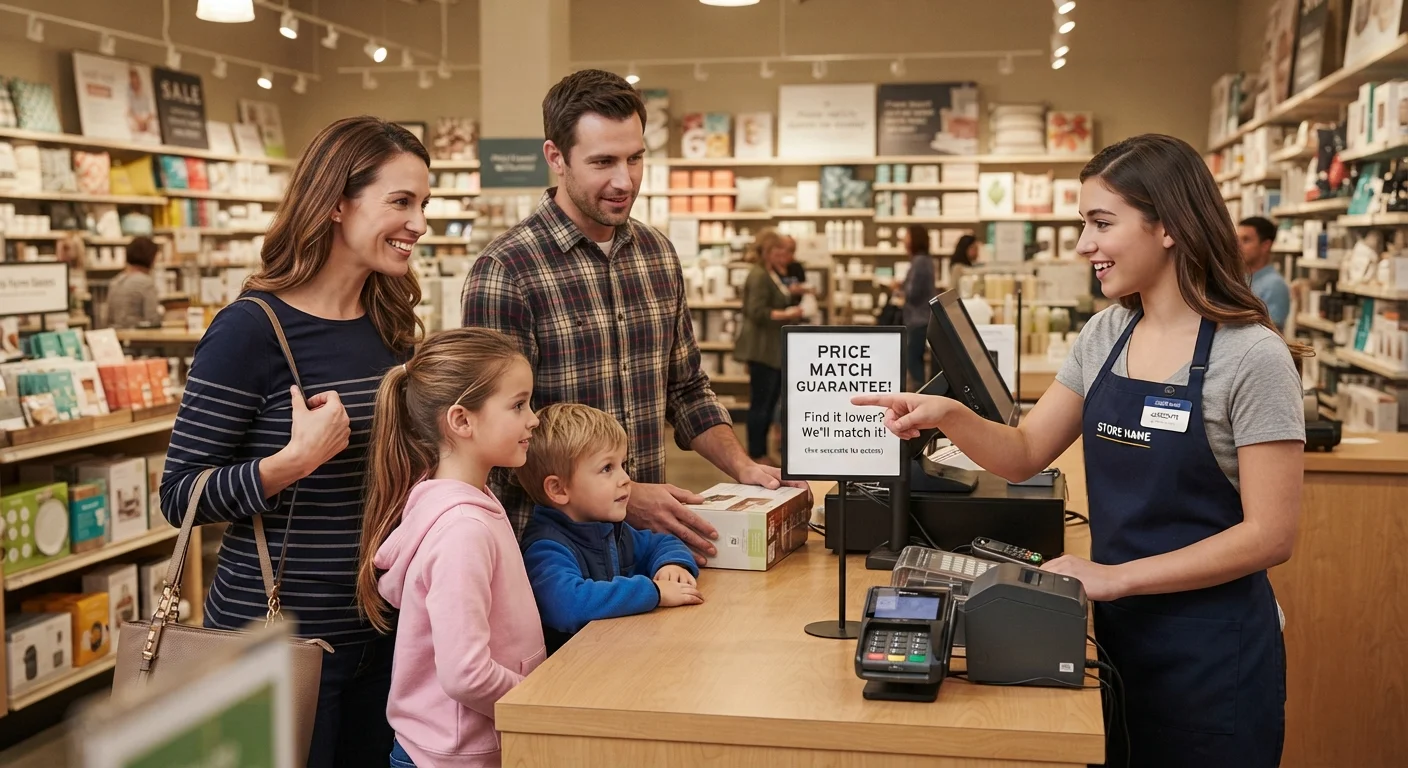
Key Takeaways
- Price-match policies cover far less than most shoppers assume - exclusions are extensive.
- Marketplace sellers, third-party listings, and flash sales are commonly excluded.
- The matched item must typically be identical in model, color, size, and condition.
- Timing matters: most policies require you to request a match before or at the point of purchase.
- Post-purchase price adjustments are a different policy and often have a shorter window.
- Reading the actual policy text - not just the headline promise - prevents surprises at the register.
Price-Matching Policy
A price-matching policy is a retailer's commitment to honor a lower price that a customer finds at a competing store or website for the same item. If you show proof of the lower price, the retailer adjusts what you pay to match it. These policies vary widely in what qualifies, which competitors count, and how the match must be requested.
Retailers distinguish between 'price matching' (matching a competitor's current price before purchase) and 'price adjustment' or 'price protection' (refunding the difference if the price drops after purchase). These are separate policies with different rules.
How Price-Matching Actually Works
At its core, a price-match guarantee asks you to do one thing: find documented proof that the identical item is currently available for less at a qualifying competitor. Present that proof, and the retailer closes the gap. Simple in concept - but the conditions surrounding that transaction are where most families run into friction.
Retailers design these policies to attract price-sensitive shoppers while controlling how often a match is actually paid out. That means the eligibility criteria tend to be narrow. The most common requirements include: the item must be in stock at the competing retailer right now; the product must be identical in brand, model number, color, and size; and the price must be offered by the retailer itself - not a third-party seller operating through that retailer's platform.
For savvy deal finders, understanding these mechanics upfront is the difference between a successful match and a frustrating rejection at the register.
Read the Policy Text, Not Just the Headline
Retailers often prominently advertise 'We'll match any price!' while burying a long exclusions list in fine print. Before making a trip to request a match, locate the actual policy page on the retailer's website and check both the qualifying competitors list and the exclusion categories. Two minutes of reading can prevent a wasted journey.
Common Exclusions You're Likely to Encounter
The exclusions embedded in most price-match policies are extensive. Knowing them before you shop saves time and prevents disappointment.
- Third-party and marketplace sellers: If the lower price comes from an independent seller listed on a major platform - even one with strong ratings - it almost certainly won't qualify. Retailers require the price to come from the platform's own inventory.
- Limited-time or flash sales: Prices described as 'doorbusters,' 'lightning deals,' 'one-day sales,' or 'limited quantities' are routinely excluded. The competitor's price must generally be a standard, currently available listing.
- Club or membership prices: Prices available only to loyalty members or warehouse club subscribers typically don't qualify unless your retailer explicitly states otherwise.
- Used, refurbished, or open-box items: The competing item must match in condition. A refurbished unit priced lower than a new one won't trigger a match on new inventory.
- Bundle deals and free-with-purchase offers: If the lower price is part of a package - say, a TV bundled with a streaming subscription - most retailers will not unbundle it for a match.
These exclusions reflect a consistent pattern across the retail industry. See our guide to retail pricing tactics to understand how promotional framing can make the ground rules even harder to parse.
~50%
Major US retailers offering some form of price match
Industry surveys of large-format US retailers suggest roughly half advertise a price-match or price-adjustment policy, though coverage terms vary significantly.
7-30 days
Typical post-purchase price-adjustment window
Most retailers that still offer price protection limit the window to between one and four weeks after the original purchase date.
3rd-party sellers
Most common single exclusion in price-match policies
Across reviewed retail policies, third-party marketplace seller pricing is the exclusion cited most consistently in the fine print.
Online vs. In-Store: Where the Rules Differ
Price-match policies don't always apply uniformly across a retailer's own channels. A price listed on a retailer's app may not automatically match what's in the store, and vice versa - especially for app-exclusive or online-only pricing tiers. Some retailers maintain deliberately separate pricing structures by channel.
When comparing prices across channels, it's also worth checking whether the retailer has a dedicated app price. Multichannel pricing has become a deliberate strategy for many large retailers, and the price-match policy may not bridge those gaps.
For returns, another layer of complexity emerges: if you price-matched in-store but the item was purchased online, return and adjustment rules can differ. Our breakdown of return policies by channel explains what to expect.
Price Matching and Price Adjustment Are Not the Same
Price matching applies before or at the point of purchase - you've found a lower price elsewhere and want the retailer to honor it now. Price adjustment (or price protection) applies after purchase if the price drops. These are separate policies with separate rules, and many retailers have reduced or eliminated post-purchase adjustment benefits in recent years. Don't assume one covers the other.
How to Make a Price-Match Request That Sticks
Preparation is the main factor in whether a price-match request succeeds. Here's what tends to work:
- Bring current proof. A live webpage shown on your phone, a printed ad that hasn't expired, or a screenshot timestamped from today. Prices that have since changed won't qualify.
- Confirm stock at the competitor. Some retailers require the item to be in stock - not just listed - at the competing location. Be ready to demonstrate availability.
- Ask before you buy. Price-matching is easier to apply at point of sale. Requesting it after purchase is a separate process (price adjustment) with its own rules and shorter windows.
- Know which competitors are on the approved list. Most retailers maintain a specific list of competitors whose prices they'll match. An unlisted retailer - however large - may not qualify.
Using price tracking tools in advance can help you document a genuine lower price and arrive at the store prepared, rather than scrambling to find proof at the register.