

Key Takeaways
- Retailers routinely price the same product differently across in-store, website, and app channels.
- App-exclusive pricing is a growing tactic used to build loyalty and collect behavioral data.
- Shipping costs, taxes, and return fees can erase apparent online savings - always calculate the true cost.
- Price-matching policies may not cover app-exclusive or limited-time channel prices.
- A channel-aware shopping habit can surface genuine savings without falling for artificial urgency.
Our Verdict
No single channel consistently delivers the lowest price on every product. The real advantage goes to shoppers who check all three before committing. App-exclusive pricing is increasingly where the deepest discounts live, but those savings only hold when total cost - including shipping, fees, and return logistics - is factored in.
| Best for | Recommended |
|---|---|
| Families managing tight budgets who want the lowest unit price | App channel (with total-cost check) |
| Shoppers who value hassle-free returns and immediate access | In-store |
| Research-first buyers comparing specs and reviews before purchasing | Online (retailer website) |
| Flexible shoppers willing to combine channels for maximum value | Multi-channel approach |
Why the Same Product Has Three Different Prices
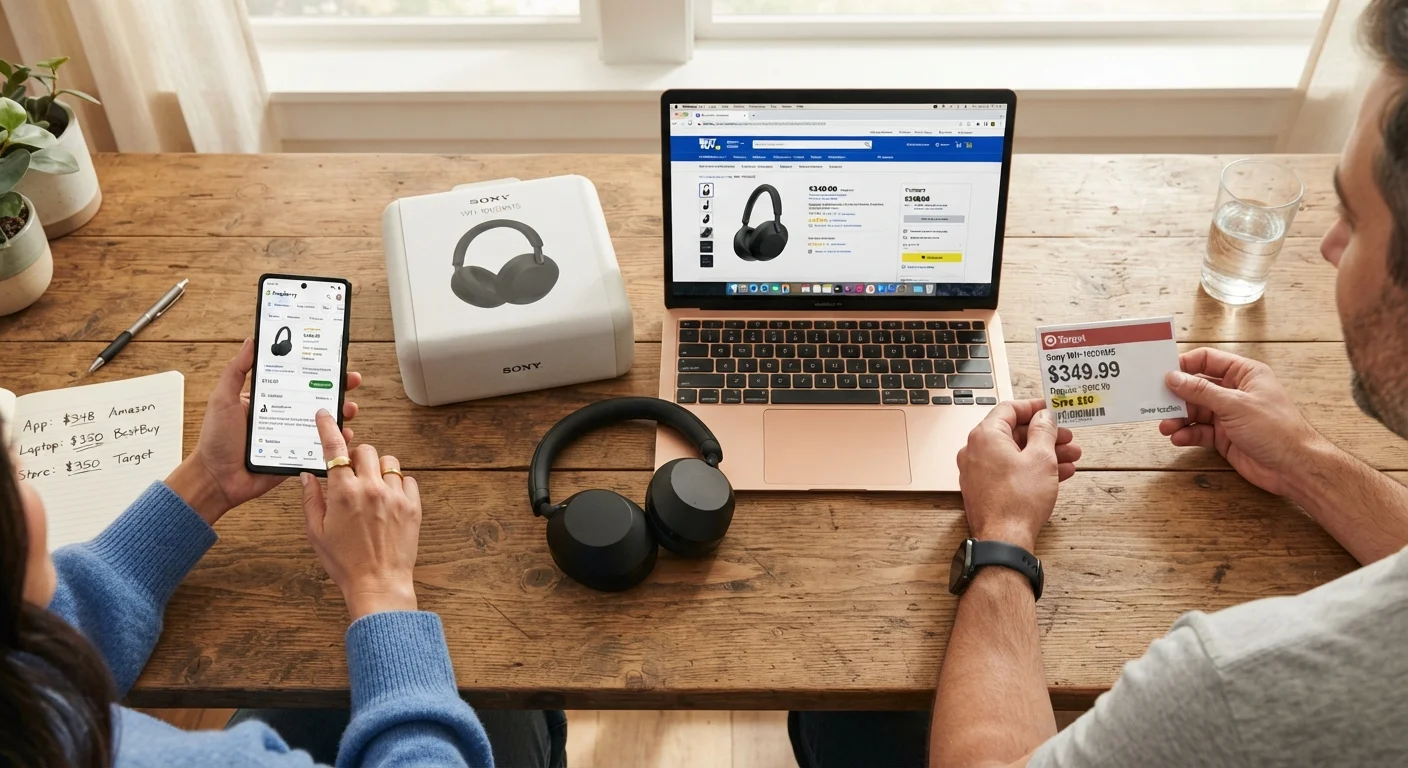
Walk into a store, pull up the retailer's website, and then open their app. For many product categories, you'll find three distinct prices for the same item. This isn't accidental - it reflects deliberate pricing strategy built around channel costs, customer data, and loyalty incentives.
In-store prices carry the overhead of physical retail: rent, staff, and shrinkage. Online prices compete with comparison tools and browser extensions that make cross-shopping frictionless. App prices are the newest layer - designed to lock users into a closed environment where outside comparisons are harder to make in the moment.
Understanding this structure is the foundation of channel-aware shopping. For a broader orientation, see our family starter guide to shopping channels before going deeper here.
| In-Store | Online (Website) | App-Exclusive | |
|---|---|---|---|
| Typical price level | Standard retail price | Often slightly lower | Frequently lowest listed price |
| Shipping cost | None | Varies; free above threshold | Varies; same as website |
| Return ease | Immediate, no cost | Requires shipping in many cases | Often mail-only return |
| Price-match eligibility | Usually yes | Usually yes | Often excluded |
| Comparison shopping ease | Moderate | High | Low (closed environment) |
| Impulse-buy pressure | Moderate | Moderate | High (push notifications, countdowns) |
The App-Exclusive Price: What's Really Going On
App-exclusive pricing has become one of the fastest-growing tactics in retail. Retailers offer lower prices inside their apps for a straightforward reason: app users generate richer behavioral data, are more likely to make impulse purchases, and are less likely to comparison-shop mid-session.
That's not inherently bad for consumers - genuine discounts do appear in apps. But the format is designed to reduce friction between browsing and buying, which can work against deliberate decision-making. Notifications about "today only" pricing are a common pressure tactic even when the same price has been available for weeks.
App Urgency Tactics Can Distort Your Judgment
Push notifications and countdown timers within retail apps frequently imply scarcity or time limits that don't reflect actual inventory or pricing reality. Before acting on an "ends tonight" alert, check whether the same price appears on the website or has been running for several days. Urgency framing is a documented tactic to accelerate purchases - slowing down and cross-checking takes under two minutes and often reveals the discount isn't as fleeting as advertised.
App pricing also tends to carry different terms. Return windows, price-match eligibility, and promotional stacking rules can differ from in-store or website purchases. Always check the fine print before assuming an app price is the clear winner. Our article on what price-matching policies actually cover covers these gaps in detail.
Calculating True Cost Across Channels
Headline price is only part of the equation. A product listed at $5 less online may cost more once shipping, handling, or a paid membership threshold is applied. In-store purchases avoid shipping but may involve sales tax in states where online orders do not (though this gap has narrowed significantly since states began requiring online retailers to collect tax).
~$10
Average online return shipping cost
Consumer research from the National Retail Federation indicates the average cost to return an online order through the mail runs roughly $10, eroding perceived savings.
~65%
Shoppers who check multiple channels before buying
Industry surveys consistently find the majority of US consumers consult more than one channel - online, app, or in-store - before making a purchase above $50.
Return costs are an underappreciated variable. In-store returns are typically immediate and free. Online returns may require printing a label, repacking the item, and waiting days for a refund - or paying a restocking fee. App-purchased items sometimes have to be returned via mail even if the retailer has physical locations.
The practical habit: before purchasing, add up the listed price, applicable taxes, any delivery or service fees, and the realistic cost of a return if the item doesn't work out. That total is the real price. For category-specific guidance on where channel choice affects these factors most, see nine categories where channel choice makes a measurable difference.
Building a Channel-Checking Habit That Actually Sticks
The goal isn't to spend 30 minutes researching every household purchase - it's to build a fast, repeatable check for items above a threshold you set yourself (many families use $25-$50 as a practical cutoff). For purchases above that threshold, the two-minute check below tends to pay off:
- Search the product on the retailer's website and note the price.
- Open the retailer's app (if installed) and compare - look for an app-only badge or different cart price.
- Check whether a competing retailer's in-store or online price differs meaningfully.
- Factor in shipping, taxes, and the return policy before deciding.
Artificially inflated "original" prices and phantom reference pricing are common tactics across all three channels. Our companion piece on retail pricing tricks that make deals look better than they are explains how to spot them quickly.
For families ready to formalize this into a broader strategy, splitting your shopping intentionally between channels offers a clear framework by product category.
Set a Personal Price-Check Threshold
Decide in advance which purchase size warrants a multi-channel check - many families find $25 to $50 a practical cutoff. Below that threshold, the time spent researching rarely produces savings worth the effort. Above it, even a two-minute comparison across website, app, and a competing retailer can surface a meaningful difference. Keep the retailer's app installed but notifications turned off to reduce impulse pressure while retaining access to app-only pricing.