

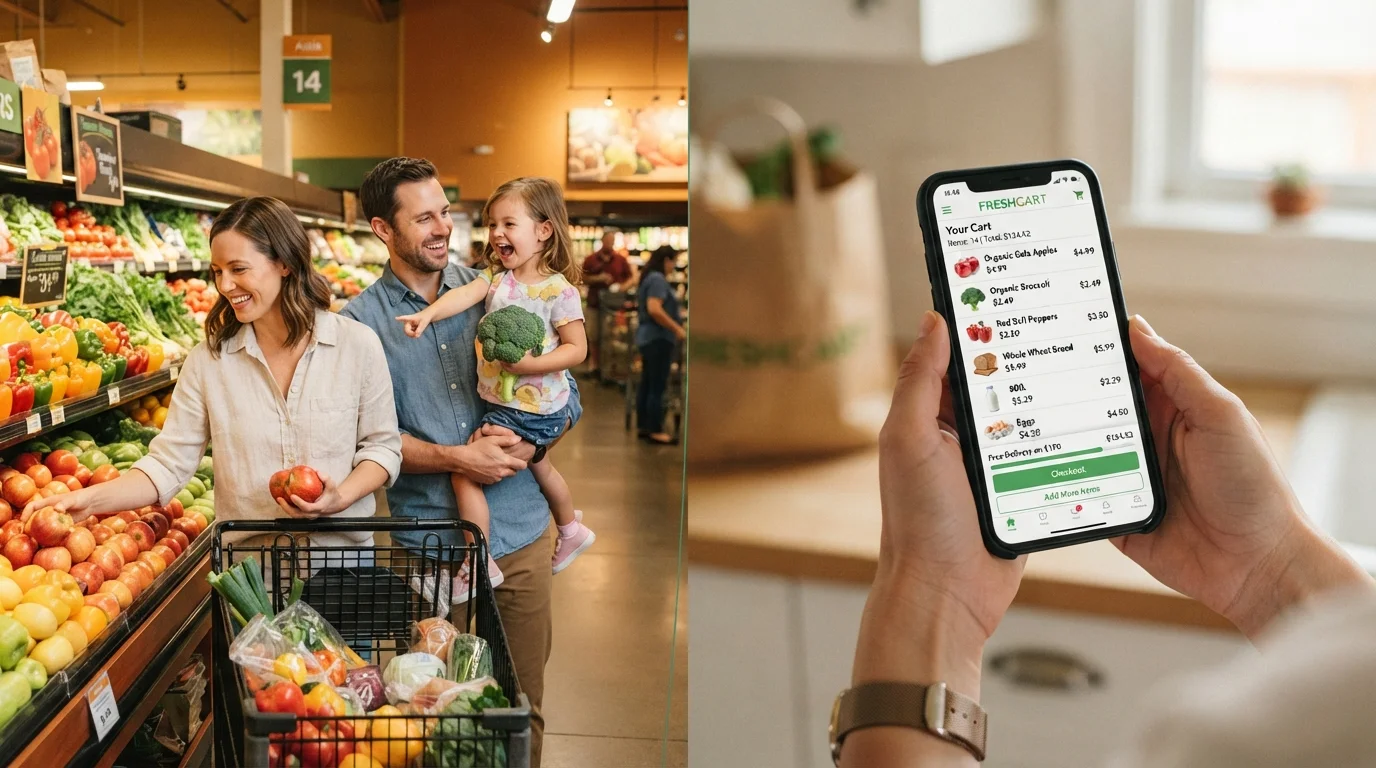
Key Takeaways
- Online grocery shopping reduces impulse purchases but adds delivery fees or subscription costs.
- In-store shopping lets you assess freshness and take advantage of unadvertised markdowns.
- Neither channel is universally cheaper - total cost depends on fees, habits, and cart contents.
- Splitting staples online and fresh items in-store often produces the best practical balance.
- Time value and household size are major factors that shift which channel genuinely saves more.
Option A
Online Grocery Delivery
The time-saving, plan-ahead approach.
Best for: Busy households that want to avoid impulse buys and eliminate weekly store trips.
Option B
In-Store Supermarket Shopping
The hands-on, flexible, discovery-friendly option.
Best for: Families who want to inspect produce freshness, catch markdowns, and adjust on the fly.
If your schedule leaves little time for weekly store runs
Online Grocery Delivery
Scheduled delivery removes the trip entirely, and a saved cart makes reordering staples fast and consistent.
If produce quality and freshness are non-negotiable for your family
In-Store Supermarket Shopping
You can select individual items, check ripeness by hand, and avoid the quality variability that can come with picked-for-you orders.
If your household budget is tight and markdowns matter
In-Store Supermarket Shopping
Manager's specials, clearance stickers, and unadvertised price cuts are only available in person and can add up meaningfully over a month.
If you want to limit impulse spending on packaged or processed foods
Online Grocery Delivery
A digital cart makes it easier to stick to a list without end-cap displays, samples, or in-store promotions pulling at your attention.
If you shop for a large household with predictable weekly staples
Online Grocery Delivery
Recurring orders for bulk staples can be streamlined digitally, especially when a subscription offsets per-order delivery fees.
What You're Actually Comparing
This isn't a question of which channel is objectively better - it's a question of which trade-offs your household can absorb. Online grocery delivery charges fees (per-delivery or subscription), substitutes unavailable items, and removes your ability to hand-pick produce. In-store shopping costs time, exposes you to marketing pressure, and requires transport. Both have real costs; they're just different in kind.
For a grounded look at how these channels differ across categories beyond groceries, see The Real Difference Between Shopping Online and In-Store. And if you're newer to comparing channels in general, Shopping Channels Decoded: A Family Starter Guide lays out how each works before you commit to either.
| Criterion | Online Grocery Delivery | In-Store Supermarket Shopping |
|---|---|---|
| Time cost | Low - no travel or checkout queues | Higher - travel, shopping, checkout |
| Delivery or transport fees | Per-order fees or subscription required | Fuel or transit cost |
| Impulse spending risk | Lower - list-based ordering | Higher - in-store displays and promotions |
| Produce quality control | Limited - picker chooses items | Full - you select every item |
| Access to markdowns | Partial - digital promotions only | Full - clearance and manager specials |
| Substitution risk | Present - stockouts trigger substitutions | None - you adapt in real time |
| Reorder convenience | High - saved carts, repeat orders | Low - manual each visit |
The Real Cost Breakdown
Delivery fees and service charges - commonly ranging from a few dollars per order to $10 or more, depending on the platform and cart size - can erase price parity quickly. Subscription models reduce per-order cost but only pay off if you order frequently enough to recover the annual fee. Many families underestimate this math.
In-store shopping has its own hidden costs: fuel or transit, time, and the well-documented tendency to overspend when browsing. Consumer research consistently finds that unplanned purchases represent a meaningful share of in-store grocery spending. Neither channel is inherently cheaper without accounting for these variables.
~$5-$15
Typical per-order delivery fee range
Fee structures vary widely by platform, cart size, and membership status; subscription plans can reduce or eliminate per-order charges for frequent shoppers.
~$50+
Estimated unplanned in-store spending per month
Industry research from the Food Marketing Institute and similar bodies consistently identifies unplanned purchases as a significant component of grocery spending for most households.
2-3×
Frequency needed to break even on grocery subscriptions
A subscription fee only pays for itself if delivery frequency is high enough; households ordering less than once a week often save more with per-order pricing or in-store shopping.
For tactics that apply across both channels, Finding Genuine Value Across Every Major Shopping Category offers a solid framework grounded in household budget realities.
Freshness and Product Quality
Produce is where in-store shopping holds its clearest advantage. Choosing your own tomatoes, checking the bottom of a berry container, or selecting a banana bunch at exactly your preferred ripeness stage isn't possible online. Pickers working against time pressure may substitute or select items that don't match your standards, and return processes for perishables are rarely straightforward.
Dry goods, pantry staples, and packaged items are a different story. Brand, size, and ingredient list are fixed - what you see online is what arrives. For these categories, quality risk is minimal, which is why many families default to ordering staples digitally and handling fresh items in person. If fresh versus frozen is already part of your household calculus, Frozen vs. Fresh Produce: What Families Should Really Know is worth reading alongside this comparison.
Which Approach Fits Different Households
Household size, schedule density, and how much variability you can tolerate in your weekly shop all shift the equation significantly. A two-adult household in a walkable neighborhood near a well-stocked store has different incentives than a family of five in a suburban area making one big weekly run.
A practical middle path - ordering predictable staples online and visiting the store for produce, meat, and anything on sale - reduces both the time burden and the freshness risk. This hybrid approach is explored in detail in A Practical Approach to Splitting Your Shopping Between Channels. The broader strategic picture, including how grocery fits into your full household budget, is covered in The Full Picture on Online and In-Store Shopping for Families.
Subscription Breakeven Is Worth Calculating
Before committing to a grocery delivery subscription, divide the annual fee by your expected order frequency to find the implied per-delivery value. If your actual usage drops during holidays, travel, or schedule changes, the math may not hold up. Revisit the calculation seasonally rather than treating it as a one-time decision.